
Jay-Ger considers mimetic desire and Sicily’s landscape in Mike White’s upside-down drama.
~
While Ethan angrily telling Cameron he has, ‘a bad case of something called mimetic desire’, is not the first time ‘French theory’ has been brought up in the show (books by Jacques Lacan and Judith Butler, among others, humorously feature in season one), it’s the most direct. Mike White hides his love for certain theorists like Reynolds Woodcock in the seams of his dresses, and to a partially literate and confused-taste viewer like myself Rene Girard appears to occupy the most intimate spot. Girardian themes are again revealed in season three, particularly with the much talked-about Sam Rockwell monologue, while one may also spot the way in which Sam Nivola’s character is torn between studying at two universities Girard taught at. In the theorist’s early works of literary interpretation, a sense of their respective times are observed in novels by Stendhal, Proust and Dostoevsky; while in Stendhal’s universe characters mimic mythical archetypes, in Proust’s such archetypes are excavated through remembering a better world, meanwhile for Dostoevsky the possibility of this seems blocked with few exceptions.
If Dostoevsky’s universe presents upside-down characters in an upside-down world, The White Lotus surely does the same. White’s acerbic characters seem filled with petty jealousies, giving the show its satirical edge. Largely portraying super-wealthy guests at the eponymous hotel chain, it seems the show has been widely interpreted as a critique of today’s bourgeoisie. While this is true, I think the mimetic drama on display is more spontaneous than this implies. To dig a little deeper, let’s start with the context of Ethan and Cameron’s conflict.

Harper, played by Aubrey Plaza, quickly intuits the rivalry between Ethan and Cameron, which she ultimately uses to her advantage while hardly escaping the mimetic dynamic. For Ethan (Will Sharpe), Cameron (Theo James) is a model for something like the Don Juan archetype; the related desire for sex with women is expressed through Ethan’s porn addiction, connecting to envy he projects onto Cameron in the guise of financial desire for his own lifestyle. The proximity forced by the show’s premise (spending a week together in an island retreat) encourages a confrontation with this form of mimesis, and with the symbolic lack of his model. Over the course of the season, Ethan is repeatedly asked by Harper to confront his desire, particularly when she finds evidence that someone else has been having sex in their room. Ethan, confident of the fact he did not cheat, is confused by Harper’s questioning, not fully realising that she wants him to communicate his desire for sex with women in general (not so much for a specific woman); something ultimately communicated in a sexual act between the couple. However, this is not until Ethan breaks Cameron’s symbolic status as a model by sleeping with his wife Daphne (Meghann Fahy). There is something of a tragic tone in the way Harper asks Ethan; ‘What’s going to happen to us?’, before they get it on – so she can sustain her desire which assumingly involves staying in a relationship with Ethan, she recognises that his addiction will have to be confronted.
It’s something of a shame that this mimetic dynamic plays into a trope which treats women as interchangable. In particular, Harper and especially Daphne’s desires are obscured, and both are implicitly asked to bear being viewed as women in general rather than unique individuals by their respective husbands. At the same time, White’s Girardian spirit favours the power of background desires, so the dynamic is complicated and unconscious. The interplay between background models and the show’s characters can be glimpsed in the plot involving the Di Grasso family, which will be talked about next.

The portrayal of Sicily’s landscape as playing an active role in the mimetic desires of the characters is perhaps what brings this season (and this show) to the next level. There is, however, also something to be said about Sicily’s form as an island. Something I am familiar with from studying archaeology is how islands tend to produce eccentric cultures, many of which have been subject to their own mimetic dynamics. For example, the roots of Western civilisation are arguably traceable to the Minoan culture of Crete, which still displays a unique sense of mythos and artistry in its archaeology. The geographic sense of Sicily being an island seems more important to the show than the cultural one. The forced proximity of island life seemingly plays an active role in the characters confronting their desires, as we have seen so far with Ethan in particular.
At the same time, Sicilian culture also comes off as active. The presence of the mafia especially is ultimately crucial to the death of Tanya (Jennifer Coolidge). While the use of such cultural distinctions risks playing into unhelpful stereotypes, I think the treatment of that regarding Sicily is fairly well-observed – although as someone with little connection to that background I am hardly in the best position to judge. Mimetically speaking, this theme plays an interesting role in the story of the Di Grassos, who have come from L.A. in search of their roots. Visiting the house prominently featured in The Godfather, their new friend Portia (Haley Lu Richardson) rightly calls out the hollowness of culture-based tourism, calling the experience ‘icky’. While the family agrees to an extent, their ability to separate today’s Sicilian culture from mafioso stereotypes is not applied to the stereotype or myth of harmonious extended family life. This results in hilarious consequences when they finally track down their ancestral house, only to be chased away by a grandmother swearing in Italian. Meanwhile, as it turns out the mafioso stereotypes have some basis in truth, as Portia in particular finds out to her shock and horror.
The three generations of Di Grasso men, each of which have modelled themselves to an extent on Sicilian-ness, are left questioning what this means – ultimately, they realise the larger extent to which they really modelled themselves on each other. While each of the Di Grassos successfully refine the understanding of their true models, they can hardly be described as freeing themselves from mimetic dramas either – as their interfamilial rivalry is bound to continue. This notion of freedom can perhaps be flipped when it comes to Tanya, who will be turned to next.

As the only character in the season to also feature heavily in the previous, and the most prominent to be killed, if any character carries the spirit of season two it’s Tanya. In contrast to most of the other characters, Tanya’s psychological drama arguably revolves around a lack of modelling. This may be understandable given her unique status as wealthy among the wealthy, the erratic behaviour of her mother revealed in season one, combined with the absence of her father, and her tendency to reject intimacy for fear of being taken advantage of financially. In psychotherapeutic language, she holds unstable object-relations. This is not saying she doesn’t try; in the first season we see a whirlwind attachment to Natasha Rothwell’s character, who is rapidly discarded when Tanya meets Greg, who in this season she has married. While this relationship seems promising given Greg’s stability, tragically the marriage is a scam to steal her money, which Greg has planned in cahoots with the mafia (or at least mafia-adjacent forces).
After a fight early in the season, Greg leaves the island and Tanya goes into psychological freefall. She tries to attach to the stars by getting a professional tarot reading, but this goes awry leaving her even more vulnerable. At this point, she makes friends with a group of European aristocrats, who as it turns out are also in on the conspiracy. Things are good for Tanya until she realises she has been betrayed, again. A particularly promising attachment is made with Quentin (Tom Hollander), who at one point invites her to see Madame Butterfly, with him later saying: ‘You’re like the heroine of your own Italian opera’. As Tanya dies, falling into the ocean, O Mio Babbino Caro plays. It’s a really emotional scene, and deeply tragic since it shows the unrealised potential for Tanya to attach to literary heroines themselves: a possibility which for her arrives too late. Going back to Girard, Tanya encounters the possibility of a Stendhalesque form of modelling after the fact and in a false pretence. In a Dostoevskyian universe, she falls (quite literally) as an upside-down hero who could in other circumstances have been rightside-up. Since, however, we are talking about a work of fiction ourselves, in her death Tanya becomes a relatively forgetten-about archetypal character.

What other buried archetypes does the season contain? This is where my interpretation becomes much more tentative (not that it wasn’t already), but where I would also like to put forth that landscape plays an active role in the mimetic dynamics of the characters, making for a nicely-observed depiction of what Jane Bennett calls vibrant matter.
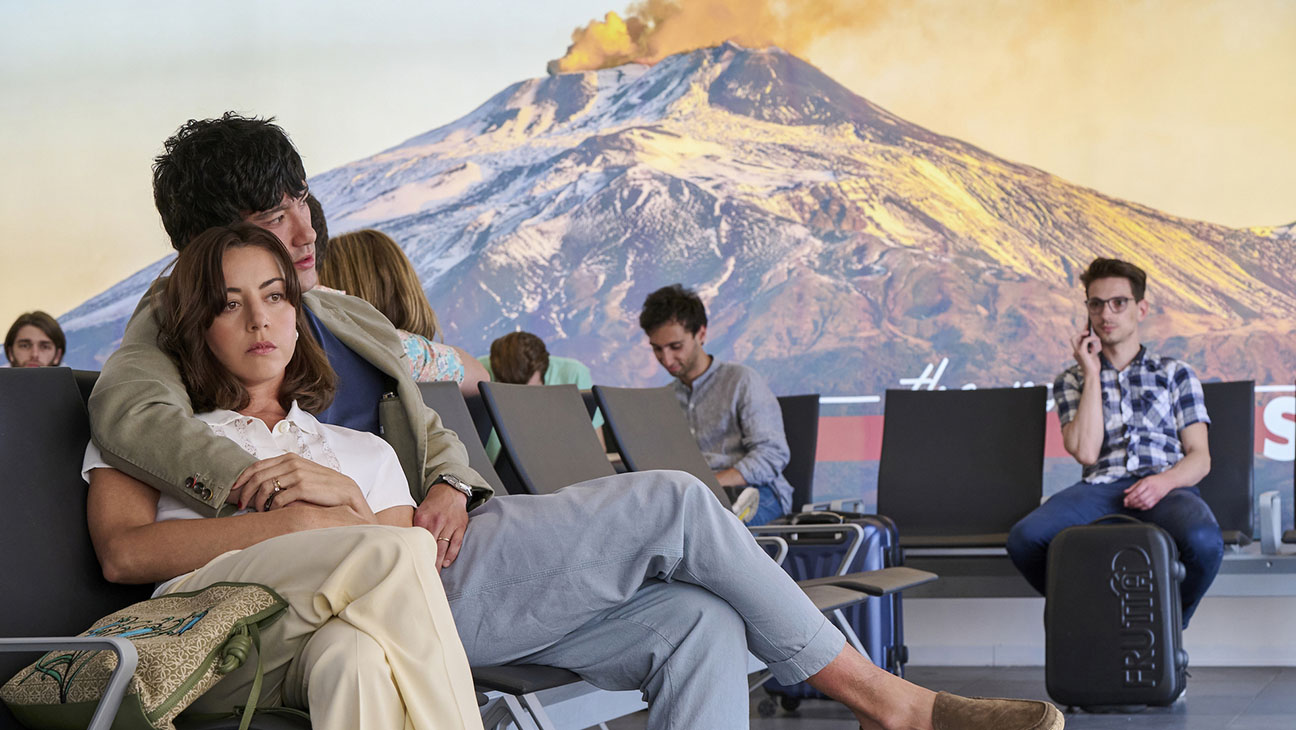
As previously mentioned, for me the most impressive aspect of the season is how the landscape seems to play an active role in the mimetic dynamics of the characters, and ultimately I think the truest drama takes place in the background. The season’s intro closes with a shot of a lone seagull freely soaring above the Aegean sea while that song again, O Mio Babbino Caro, plays – embodying Tanya’s literary spirit. While Ethan and Daphne are having sex, from a distance we see an islet just off the beach called Isolabella, which holds its own mythos and (through synecdoche) implies that the intimate events of the season are largely unknown to outsiders. The presence of Mount Etna in the background seems to suggest passivity, but ends up being anything else – erupting as the season enters its nexus.

In a similar way to the treatment of cultural differences, the way in which landscape features are shot could be described as touristic. This could quite easily play into the voyeuristic, but I think that rather than being shown as a kind-of romanticised object to be gazed at, Etna (for example), has a fire-breathing agency which is emphasised both in its eruption and its passive, everyday, desire not to erupt. I don’t think its a coincidence that the main events of the character’s dramas occur during its eruption – particularly Ethan and Harper’s pivotal sex scene, and Tanya’s death sequence. Both Ethan and Tanya’s eruptions of emotion can be speculated to be unconsciously modelled on Etna – with White perhaps suggesting that the mythical archetypes of Stendhal and the likes were themselves modelled on much more ancient things like the mountains, the seas, and the birds.
White again seems to explore such themes in the following season, with water being a pivotal model. In an upside-down world, that which has truly modelled the human story is unclear, and I think this show understands that: it’s searching for answers. As is communicated over the course of events, it is possible to escape negative mimesis, but doing so involves a large slice of luck, since the models most truly in control of reality are often opaque to us. Perhaps the overhanging message of the season is to start looking in a couple of directions to help model our desires more positively: literature and more broadly culture, and what we tend to call the natural world.


