
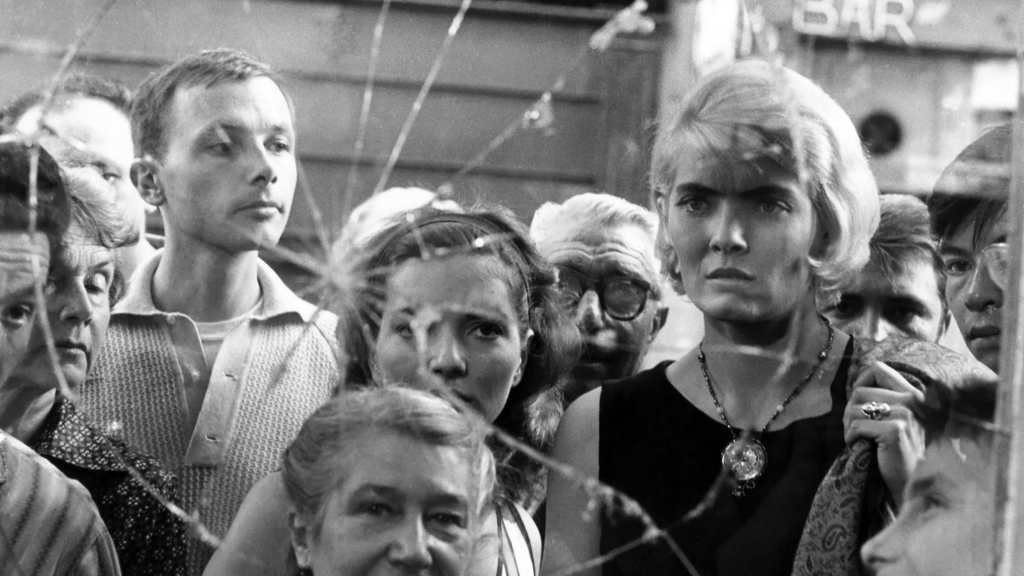
Jay-Ger thinks about walking in cities and encountering symbols with Agnes Varda’s existential slice-of-life.
I really enjoyed reading Al’s response to The Odyssey and would like to relate it back to some of the themes brought up in Tom’s review of Manhunter, if possible. In an elementally-lucid state of mind, Al asks: ‘If my Troy were to burn tomorrow, how much time would I have?’. It’s an interesting question, and reminds me of Tom writing about temporal suspension and the image of the sun. From my psychodynamic perspective, the things we love are experienced before we feel them in time (unless we happen to love time for its own sake, which leads to a bit of a different story). I think this means that there is an understanding of reality which is almost entirely spatial rather than temporal; in my own reflection on It’s Such a Beautiful Day, I danced around how that understanding might be contained in the objective beauty of everyday things. I’m sure Al, being a lover of architecture, is well-aware of the spatial experience of beautiful mundanities (which seems to me a fitting way to describe nice buildings). The thing is, when I walk around a city or a town, I feel like an alienated consumer of buildings rather than having anything to do with their creation; which may not be the case with Al.
What does this have to do with Cleo from 5 to 7? Well, it’s stunningly obvious but worth mentioning that Agnes Varda’s classic of the French New Wave takes place in a beautiful environment: the natty pavements, apartment buildings, and parks of ‘60s Paris. That being said, I like that Varda doesn’t seemingly attempt to have Paris resemble Paris. While a different film might have used established symbols of the city (like the Eiffel Tower), to comment on the city from with-out, Varda’s interest seemingly tends towards how it appears to the everyday person within. The person we as the audience are invited to see from the perspective of is Florence, a young singer known professionally as ‘Cleo’. The film’s premise is that, in a twist of fate, Cleo is given reason to doubt she will be alive much longer. This means that the professional ‘taskscape’ (a word Tim Ingold came up with, which I loved as an archaeology student), has subjectively collapsed into a kind of bare and existentially meaningless landscape.
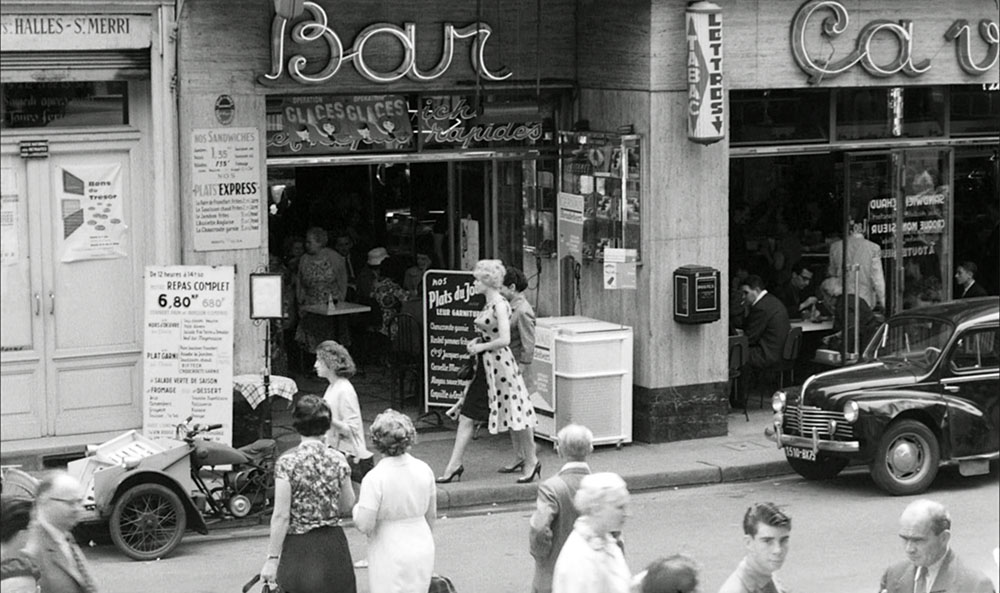
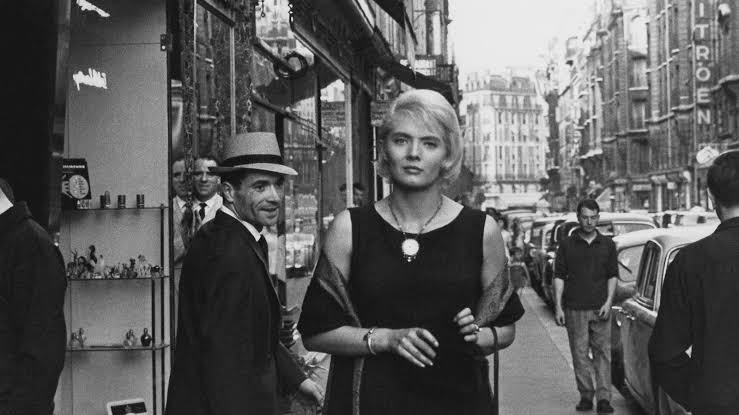
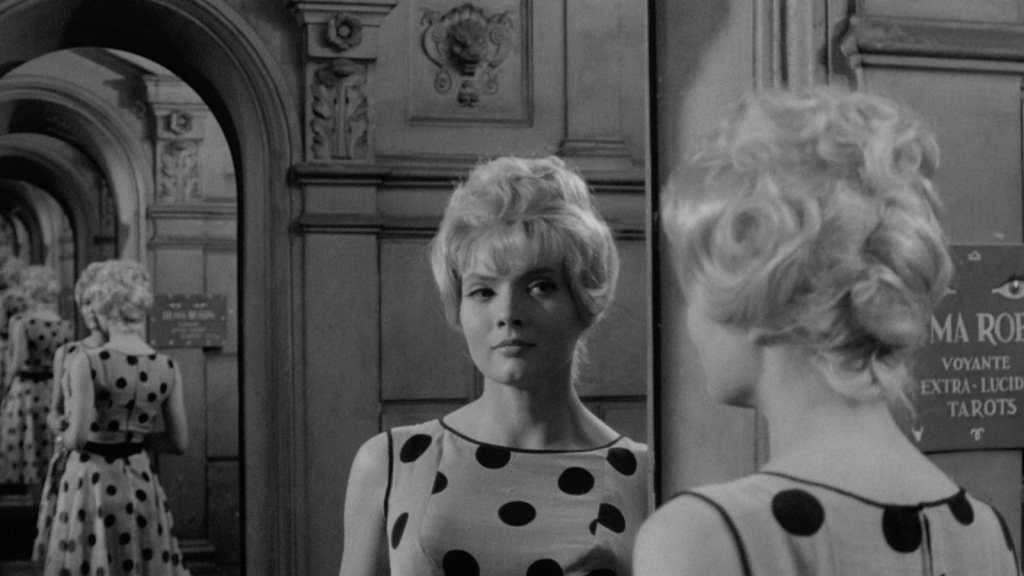
There is something to be said about being in public here; the fact that the protagonist has a famous professional persona means that simply walking down the street for her is a kind of work. At the same time, Varda cleverly makes the space for it to be shown between-the-lines that being a young woman and being a celebrity are sometimes not too different. As Cleo walks the pavements, the verite camera glimpses how people around her react; particularly men who may see her as a symbol of desire. Looking in the mirror, Cleo says; ‘Ugliness is a kind of death. As long as I’m beautiful, I’m even more alive than the others’, showing the dialectical way in which she is both reacting to her surroundings and creating a personal space within it. However, from the hours of (roughly) 5 to 7, Cleo is left purposeless; temporal suspension ensues. Without a task and an associated taskscape, there is a melancholic sense of having lost the need to work, to perform, both as a celebrity and as a woman. This is difficult, but ultimately shown to be quite freeing for Cleo. She is left ‘Florence’, having lost her sense of beauty and glow; but at the same time in the existentially-mature position of being able to envisage different ways of ‘becoming a woman’, rather than being the woman she was, until time left the room.
I think what’s so beautiful about Varda’s approach to this experience of subjective freedom is that she shows Cleo the possibility of growth in a more behind-the-scenes creative direction, but leaves the choice up to her, making for a strong sense of ambivalence when the movie ends. For me, there is a really sharp sense of mutual recognition and projective identification between the protagonist and their director. Varda and Cleo can be said to contain elements of each other; but my sense is it’s a case of ‘same but different’. In other words, Varda respects the choices Cleo has made in creating her persona, and also affirms her own sense of being otherwise; showing in the process different possible ways of becoming a woman. In my favourite Varda film (documentaries aside), One Sings, the Other Doesn’t, this dynamic of split feminine subjectivity and its reconciliation in universal responsibility is played out with less of the formal experimentation which characterised the nouvelle vague; but exploring that movie more is for another time.
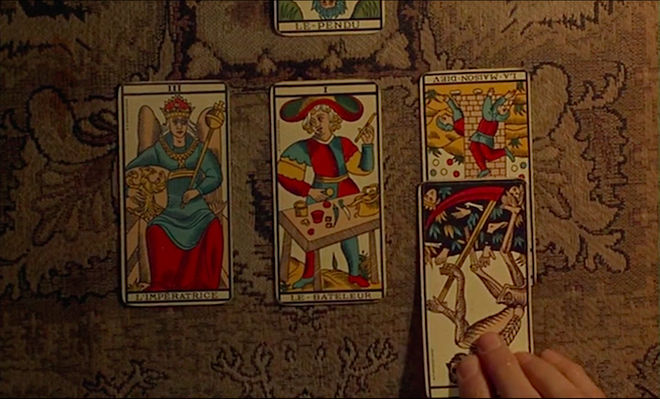
Let’s talk about archetypes. Cleo from 5 to 7 begins with a tarot reading, in which the protagonist interprets the cards as foretelling her death by cancer. The reader, in response to her anxiety, reassures considering the pivotal card; ‘This is not necessarily death; it means a complete transformation of your whole being’, a statement they both seem skeptical of. Nonetheless, Varda’s treatment of fate throughout the film is ambivalent; by the end the transformative interpretation seems more correct, but of course existentially-speaking the difference between transformation and death can be questioned. A theme of my first couple of essays was a consideration of the archetypal qualities in bizarre or everyday objects – from chocolate milk to Bill’s carpets. Part of what makes these things interesting to me is that they lack meaning in any established archetypal schema I’ve come across. Nonetheless, the fact that their meaning is open to interpretation can be universalised to established symbols. In the case of death, this adventurous approach allows for a questioning of whether death really means death, or something else; something Varda explores quite beautifully.
I wonder, Tom, if you would say something similar about the sunset. The sun (also a tarot card), I would say is an ‘established symbol’ of profound happiness; something Varda also explores in her film Le Bonheur (‘Happiness’ being the title in English). Sunset can be understood as an associated symbol of happiness in the process of being lost, yet established in its own right. My question is this: do you find it more interesting when a symbol has a fixed or established meaning, and if so to what extent do you see the symbol of the sunset (for example) as truly experienced universally? Of course, I am going back to a couple of posts ago with the question, so happy for you to address it many posts in the future too!
I think my personal feeling for the movie is primarily admiration for how wonderfully simple but effective it is. Sometimes I like to dress a little crazy, and in those moments I feel the streets are like catwalks more so than normal; it can be fun, and perhaps I do feel more alive. Like Cleo, I’m pretty comfortable with public attention, although as I’ve got older I find myself more interested in the background conditions of existence highlighted by Varda; in also illuminating, being-with, and understanding them. I also find walking, particularly in a city, to be remarkably consistent with mulling over these things. I think this is partly why I tend to blend my appearance in more than I used to; and also probably why I don’t dress as gender non-conforming as I feel – I value disappearing into a cityscape too much. I like the idea that there are some like me – and Cleo from 5 to 7, who are constantly thinking about death and meaning; anonymously roaming a landscape while others are floating on the thrill of the task – although I recognise, of course, that I am perceived as being involved in a taskscape too: I suppose time is never actually suspended.
That being said, sometimes I do like to dress with contrast. I have this yellow raincoat I quite like on a grey and dreich day; for someone who is generally quite sympathetic towards bleakness, I quite enjoy playing the sun. Putting jokes about Scottish weather aside, perhaps this is because when something novel emerges out of the everyday, I quite like to playfully embody its opposite; staging a contradiction for others to make what they will out of, I’m not sure. Maybe this gimmick only works, if it does, since yellowness and raininess are symbolically-coded in relative contradiction; although that would mean they are established enough to make some kind of common sense out of. Anyway, I’ll leave it there before I start bringing out my whole wardrobe. Cleo from 5 to 7 is a movie which looks for, and perhaps finds, magic in the everyday; despite the seriousness of its subject matter and realist elements of style, to me it feels profoundly warm and sincere. The mirror Varda holds to Cleo (and vice-versa) is something of the camera-obscura variety, and this makes for a sense of encountering the surprisingness of reality as it is; that is, with the mystique contained inside.
 What If Nobody's Home?