Category: Jay-Ger’s long journal

  • ‘Fargo (Season Five)’

    ‘Fargo (Season Five)’

    Jay-Ger reflects on the meaning of a biscuit in the popular TV show.

    The most recent season of Fargo, a show which may be the first contribution to a nascent Coen brothers shared universe, ends with a strange and symbolically dense scene in which the protagonist, Dorothy ‘Dot’ Lyon (Juno Temple), bakes a biscuit for Ole Munch (Sam Spruell). Munch is a nihilistic contract-killer who ritualistically slathers himself in mud, staging himself as a ‘sin-eater’; something mirrored in his profession, where he enacts murders on behalf of the rich and powerful. In response to Munch’s melancholic sense of cosmic debt, Dot says: ‘It feels like that, I know… What they do to us. Make us swallow. Like it’s our fault. But you wanna know the cure? You gotta eat something made with love and joy. And be forgiven’. Munch eats the biscuit and breaks into a mouth-full smile, and the season ends. The scene strikes me as very Coen brothers, containing absurdity and ideology in a world trying to come terms with the twists-and-turns into and of postmodernism. At the same time, it stays within the show’s tendency of advocating for a kind of ordinary nice-ness, of twee and small-town character, summed up in the cultural phrase ‘Minnesota nice’. Perhaps, the biscuit can be said to represent this concept.

    Niceness is often reified in capitalism. Something the show, especially this season, does well is making it rather obvious that this ethos can’t be taken for granted. Dot, a profoundly traumatised person with a horrifying past, would be (more than) forgiven for not being particularly nice; especially to Munch, who was originally contracted to kill her. In contrast to a work which treats Dot’s trauma as simply a plot device, I like that in this season her way of navigating complex trauma has an ideological valance; being nice isn’t simply an escape or defence, but is proposed to be an ideological option alongside Munch’s version of nihilism, and well as Roy Tillman’s (the primary antagonist of the season, contractor of Munch, and long-term abuser of Dot; played by Jon Hamm), version of patriachalism.

    At the same time, the demand to ‘be nice’ which we may feel (while watching or more generally), the idea that we ‘should’ be nice, is really what I would see as a reification. I think the season understands that niceness is not the natural order of things (because, perhaps, there is no natural order of things); meaning that being ‘Minnesota nice’ is an existential choice with no guarantee of reward. While the season ends comically, it could have ended tragically, and I don’t think this would have made Dot’s ethos any less inspiring. It’s worth also mentioning that ‘niceness’ isn’t totally treated in the somewhat one-dimensional, middle-class, way all this might suggest. Another character, Indira Olmstead (Richa Moorjani), is in many ways not stereotypically nice; being a kind of hard-nosed policewoman, who also happens to be grappling with around two-hundred grand of debt. At one point, her husband – a kind of man-child figure, says (in what apparently involves a direct adaption of Judy Brady’s 1971 essay): ‘I want a wife, someone to keep the house clean and cook… A wife who comes to the club for the socials… and trades recipes, with the other wives’. To continue my theme from the essay on Cleo from 5 to 7, I suppose there’s many ways to become a woman; and, well, also to become ‘Minnesota nice’.

    Sheriff Roy Tillman, ‘a hard man for hard times’, is far from nice. While I could go into a character analysis here, I’d rather use this opportunity to discuss whether the season provides a useful political ideology. My answer here is… maybe? Generally, I think the ideologies at play are used to resolve social contradictions amongst the season’s characters. While, in our relations with friends, family, and so on, we may be inspired to ‘be nice’; I don’t think this is enough to develop and enact a project capable of large-scale, political, change. A sense I have, related to the postmodern theories of Ernesto Laclau and Chantal Mouffe, is that much of politics has become something like an ecology of floating signifiers; ‘nice’ being one of them. While this isn’t at the sharp-end of what I think the show’s creator, Noah Hawley, wants to say; I think adopting the artifice of the Coen brother’s style has meant that highlighting such things are inevitable.

    In, for example, a scene towards the end, Tillman stands for re-election as sheriff. Usually unopposed, this time a scheme has been created to embarrass him; with three other candidates, each also named ‘Roy Tillman’ and adopting his (frankly spectacular, although nothing compared to Munch’s) adornment style, also on stage. As Roy responds using the usual ‘soundbites’ (in this case, ‘defense’, ‘security’), the other Tillman’s parrot him, leading to Roy losing his cool; storming off stage and punching the host. The postmodernist-ish point is, I suppose, that to speak of being ‘nice’ or ‘hard’ when it comes to mass culture (Fargo is arguably the first example of which I have written about for WINH); contains a substantial meaning with political potential, but it tends to be couched in so much irony that this meaning becomes opaque, in need of excavation.

    Well, I was supposed to talk about biscuits and I fear I’ve strayed too far. Fargo is an interesting show; although I’m not sure if it’s ‘good’, I’d recommend giving it a watch. The seasons I’ve seen (five, two and one) are pretty consistent in terms of quality, and each brings something a little different to this snowy, diner and mitts filled, area of the Coen’s universe. The show tends to support a non-progressive, twee, message; but, honestly, I think being twee or ‘nice’ is far from the worst thing a person can be. In the context of the season, the biscuit has a strongly representational quality. However, I tend to see objects of mass culture pointing not just to themselves, but also something bigger. In this sense, Dot’s biscuit is a little like the choccy milk I rambled about in my essay involving Show Me Love; representing a kind of potential (in this case for larger-scale change), but with no guarantee various political actors would, like Munch, love the biscuit; so to (ridiculously) speak.

    Anyway, I think the heart of the season remains with the smaller-scale; of discrete relationships, characters, places, twists-of-fate, psycho-dramas, and that sort of thing. I enjoyed getting to know Dot, Indira, and others – in a parasocial way of course; and look forward to what Hawley’s show brings next.

  • ‘Cleo from 5 to 7’

    ‘Cleo from 5 to 7’

    Jay-Ger thinks about walking in cities and encountering symbols with Agnes Varda’s existential slice-of-life.

    I really enjoyed reading Al’s response to The Odyssey and would like to relate it back to some of the themes brought up in Tom’s review of Manhunter, if possible. In an elementally-lucid state of mind, Al asks: ‘If my Troy were to burn tomorrow, how much time would I have?’. It’s an interesting question, and reminds me of Tom writing about temporal suspension and the image of the sun. From my psychodynamic perspective, the things we love are experienced before we feel them in time (unless we happen to love time for its own sake, which leads to a bit of a different story). I think this means that there is an understanding of reality which is almost entirely spatial rather than temporal; in my own reflection on It’s Such a Beautiful Day, I danced around how that understanding might be contained in the objective beauty of everyday things. I’m sure Al, being a lover of architecture, is well-aware of the spatial experience of beautiful mundanities (which seems to me a fitting way to describe nice buildings). The thing is, when I walk around a city or a town, I feel like an alienated consumer of buildings rather than having anything to do with their creation; which may not be the case with Al.

    What does this have to do with Cleo from 5 to 7? Well, it’s stunningly obvious but worth mentioning that Agnes Varda’s classic of the French New Wave takes place in a beautiful environment: the natty pavements, apartment buildings, and parks of ‘60s Paris. That being said, I like that Varda doesn’t seemingly attempt to have Paris resemble Paris. While a different film might have used established symbols of the city (like the Eiffel Tower), to comment on the city from with-out, Varda’s interest seemingly tends towards how it appears to the everyday person within. The person we as the audience are invited to see from the perspective of is Florence, a young singer known professionally as ‘Cleo’. The film’s premise is that, in a twist of fate, Cleo is given reason to doubt she will be alive much longer. This means that the professional ‘taskscape’ (a word Tim Ingold came up with, which I loved as an archaeology student), has subjectively collapsed into a kind of bare and existentially meaningless landscape.

    There is something to be said about being in public here; the fact that the protagonist has a famous professional persona means that simply walking down the street for her is a kind of work. At the same time, Varda cleverly makes the space for it to be shown between-the-lines that being a young woman and being a celebrity are sometimes not too different. As Cleo walks the pavements, the verite camera glimpses how people around her react; particularly men who may see her as a symbol of desire. Looking in the mirror, Cleo says; ‘Ugliness is a kind of death. As long as I’m beautiful, I’m even more alive than the others’, showing the dialectical way in which she is both reacting to her surroundings and creating a personal space within it. However, from the hours of (roughly) 5 to 7, Cleo is left purposeless; temporal suspension ensues. Without a task and an associated taskscape, there is a melancholic sense of having lost the need to work, to perform, both as a celebrity and as a woman. This is difficult, but ultimately shown to be quite freeing for Cleo. She is left ‘Florence’, having lost her sense of beauty and glow; but at the same time in the existentially-mature position of being able to envisage different ways of ‘becoming a woman’, rather than being the woman she was, until time left the room.

    I think what’s so beautiful about Varda’s approach to this experience of subjective freedom is that she shows Cleo the possibility of growth in a more behind-the-scenes creative direction, but leaves the choice up to her, making for a strong sense of ambivalence when the movie ends. For me, there is a really sharp sense of mutual recognition and projective identification between the protagonist and their director. Varda and Cleo can be said to contain elements of each other; but my sense is it’s a case of ‘same but different’. In other words, Varda respects the choices Cleo has made in creating her persona, and also affirms her own sense of being otherwise; showing in the process different possible ways of becoming a woman. In my favourite Varda film (documentaries aside), One Sings, the Other Doesn’t, this dynamic of split feminine subjectivity and its reconciliation in universal responsibility is played out with less of the formal experimentation which characterised the nouvelle vague; but exploring that movie more is for another time.

    Let’s talk about archetypes. Cleo from 5 to 7 begins with a tarot reading, in which the protagonist interprets the cards as foretelling her death by cancer. The reader, in response to her anxiety, reassures considering the pivotal card; ‘This is not necessarily death; it means a complete transformation of your whole being’, a statement they both seem skeptical of. Nonetheless, Varda’s treatment of fate throughout the film is ambivalent; by the end the transformative interpretation seems more correct, but of course existentially-speaking the difference between transformation and death can be questioned. A theme of my first couple of essays was a consideration of the archetypal qualities in bizarre or everyday objects – from chocolate milk to Bill’s carpets. Part of what makes these things interesting to me is that they lack meaning in any established archetypal schema I’ve come across. Nonetheless, the fact that their meaning is open to interpretation can be universalised to established symbols. In the case of death, this adventurous approach allows for a questioning of whether death really means death, or something else; something Varda explores quite beautifully.

    I wonder, Tom, if you would say something similar about the sunset. The sun (also a tarot card), I would say is an ‘established symbol’ of profound happiness; something Varda also explores in her film Le Bonheur (‘Happiness’ being the title in English). Sunset can be understood as an associated symbol of happiness in the process of being lost, yet established in its own right. My question is this: do you find it more interesting when a symbol has a fixed or established meaning, and if so to what extent do you see the symbol of the sunset (for example) as truly experienced universally? Of course, I am going back to a couple of posts ago with the question, so happy for you to address it many posts in the future too!

    I think my personal feeling for the movie is primarily admiration for how wonderfully simple but effective it is. Sometimes I like to dress a little crazy, and in those moments I feel the streets are like catwalks more so than normal; it can be fun, and perhaps I do feel more alive. Like Cleo, I’m pretty comfortable with public attention, although as I’ve got older I find myself more interested in the background conditions of existence highlighted by Varda; in also illuminating, being-with, and understanding them. I also find walking, particularly in a city, to be remarkably consistent with mulling over these things. I think this is partly why I tend to blend my appearance in more than I used to; and also probably why I don’t dress as gender non-conforming as I feel – I value disappearing into a cityscape too much. I like the idea that there are some like me – and Cleo from 5 to 7, who are constantly thinking about death and meaning; anonymously roaming a landscape while others are floating on the thrill of the task – although I recognise, of course, that I am perceived as being involved in a taskscape too: I suppose time is never actually suspended.

    That being said, sometimes I do like to dress with contrast. I have this yellow raincoat I quite like on a grey and dreich day; for someone who is generally quite sympathetic towards bleakness, I quite enjoy playing the sun. Putting jokes about Scottish weather aside, perhaps this is because when something novel emerges out of the everyday, I quite like to playfully embody its opposite; staging a contradiction for others to make what they will out of, I’m not sure. Maybe this gimmick only works, if it does, since yellowness and raininess are symbolically-coded in relative contradiction; although that would mean they are established enough to make some kind of common sense out of. Anyway, I’ll leave it there before I start bringing out my whole wardrobe. Cleo from 5 to 7 is a movie which looks for, and perhaps finds, magic in the everyday; despite the seriousness of its subject matter and realist elements of style, to me it feels profoundly warm and sincere. The mirror Varda holds to Cleo (and vice-versa) is something of the camera-obscura variety, and this makes for a sense of encountering the surprisingness of reality as it is; that is, with the mystique contained inside.

  • ‘Pariah’ and ‘Show Me Love’

    ‘Pariah’ and ‘Show Me Love’

    Jay-Ger considers a couple of takes on the bildungsroman, along with poetic and punk ways of being.

    Following my last essay, I thought I would indulge in memories of teenagehood in a slightly different way; a couple of versions of bildungsroman. ‘Pariah’, directed by Dee Rees, centres around seventeen year-old Alike, growing up in inner-city Brooklyn. It has a social realist tone with slight poetic flourishes, such as the soundtrack and Alike’s own spoken-word pieces; similar films might include ‘Moonlight’ and ‘Fish Tank’. In contrast, Lukas Moodysson’s ‘Show Me Love’ is somewhat more tonally punk, capturing the more ferocious energy and village angst of the slightly younger Elin and Agnes. While both contain coming-of-age and coming-out, in ‘Show Me Love’ the characters seem to break through a certain barrier; meanwhile for Alike the breaking is ontologically posited – the closing poem contains the repeated lines: “I am broken, I am open”, following, “See the love shine through my cracks? See the light shine out through me?”. Alike (and the film’s) sensitivity towards words is perhaps what makes it unique; the associated movie posters, for example, tend to display its title as broken too, into syllables. Meanwhile, Moodysson’s film is arguably more sensitive towards music; or at least the relatively fast-paced rhythms of yearned-for city life. I was initially thinking of just writing about ‘Pariah’, being one of the movies I associate most with purple, but after reading Tom’s writing about ‘Manhunter’ I thought including the Swedish film would make a nice comparison piece.

    ‘Show Me Love’ ends in quite a light way for a movie which grapples with some serious themes (somewhat like ‘Manhunter’), almost coming off as a rom-com by the end. After clumsily but quite beautifully coming out to their whole school, Elin and Agnes have a mundane kind of conversation about chocolate milk. I love this scene because while the film could have ended in a more “happily ever after” sort of way, the conversation glimpses a kind of everyday curiosity and being-with this likely entails; what you (Tom) said about ‘Manhunter’ reminded me of that, even if it wasn’t the intention. So… I’ll play with your question!

    The short and boring answer is obviously that I think the way in which a film’s soundtrack matters is context dependent. At least, soundtracks often allow a glimpse into subjective feeling. This seems quite clearly the case in ‘Show Me Love’, where the consistent punk represents a kind of existential angst and rebellion against the apparent constraints of peripheral village life (the Swedish title, “Fucking Amal” – Amal being the village, captures this better than the English one). The love shared by Elin and Agnes is very much intermixed with this feeling – assuming as I do that the film’s main “subject” is the couple and emotional bonds between them rather than either of the girls individually. On the other hand, I think the soundtrack in Rees’ film is less important, partly because the subjective feeling of the film is expressed more genuinely in Alike’s poetry. A lot of the music in ‘Pariah’ is non-digetic, capturing something about her environment, meanwhile the relative silence of the mise-en-scence in ‘Show Me Love’ tells its own story; the social realist tone of ‘Pariah’ reflects a sense of absence that Alike assumingly positions as the melancholic core from which she creates poetry: in this case a lack of music resonates with subjective feeling.

    Funnily enough, the major element I left out of my reflection on ‘It’s Such a Beautiful Day’ was indeed the soundtrack, which is quite powerful – mostly containing sweeping romantic-classical compositions from Bedrich Smetana to Georges Bizet, with the occasional Celtic folk piece. I think, in a strange way, these pieces may also be best understood as related to subjective feeling; although there is a sense of harmonice mundi in Hertzfeldt’s movie which is not quite so present in Rees’ or Moodysson’s. My sense is that I don’t need to enjoy a soundtrack to enjoy a movie; but that’s also entangled with the extent to which the film’s meaning is centred around music – or, perhaps even more radically, the film is musical in form.

    One of my favourite examples of this latter kind of movie are the early films of Gregg Araki, particularly the “Teenage Apocalypse” trilogy; which at one point I decided to think of as “ontological shoegaze”. In, for example, ‘Nowhere’, there is a kind of absurd or dream logic which does not suggest a human subject to me (as with ‘It’s Such a Beautiful Day’), but rather a kind of big, monstrous, surreal, queer, and indeed soft and pillowy being. I was not sure what to call this entity, but it gave me the same sense as shoegaze so I decided the subjective logic of the movie was connectable through this kind of feeling; called the resultant imagined object “ontological shoegaze” (ridiculously), and decided to move on. In this case, quite literally, I cannot understand the film without its associated music; and the more shoegaze is played throughout, the easier it becomes for me to make sense of and immediately enjoy. Here, it is even possible that subjective feeling isn’t even important: there is something which “goes beyond” that – with shoegaze pretty much being a hyperobject in Timothy Morton’s sense; at least in relation to the film.

    I’ll insert my own questions for you (Tom) at this point. Do you find the mirror more usually in a film’s music, or its characters? Also, do you think humanity is best expressed in music or people? In the meantime, let’s return to the themes of brokenness and openness. For Melanie Klein, maturity often involves acceptance of the self as it really is. People live in a state of attachment to loved ones, and how they act towards them changes what their loved ones mean to them; in this sense action creates cracks of meaning which it’s the self’s responsibility to resolve or repair. I like to think of the self, in this model, as analogous to a teacup in the Japanese art of kintsugi – perfectly-imperfect, composed of cracks yet being a complete object. From a subject-oriented perspective, the light of love shines out from within; through the cracks much like Alike describes. Openness to action and in this sense new bonds of love are preconditioned by brokenness; for Klein therefore, guilt toward one’s brokenness is among the fundamentals.

    At the same time, Alike’s sense of existential responsibility for her parent’s traumas and prejudice – motivating her to leave her “fish bowl” surroundings and take a new perspective on it, are psychodynamically very moving. Often, reparation in a Kleinian sense is not only a lifelong commitment but must be projected past one’s own being. For Alike, art and particularly poetry allow for this long-term projective identification. It’s moving to me because it glimpses what Klein calls the depressive position, which for her is a sign of maturity; immaturity involves “manic reparation”, where the subject attempts to resolve their relationships too quickly – Alike’s commitment to the art life seems congruent with what for her is an appropriate rhythm of the reparative process. It’s worth saying that, for Klein, people tend to fall out of the depressive position throughout life and thus are motivated to work back to it. Along these lines, I am slightly suspicious of coming-of-age as a genre: since it seems too often to focus on the transition from teenage to adult years. That being said, the psychodynamics involved in both ‘Pariah’ and ‘Show Me Love’ feel quite real to me.

    This is partly why I adore the ending of ‘Show Me Love’, as to me it implies the reconciliation of Elin and Agnes with Amal – their small-town environment. There is no punk apparent; in fact the following credits are paired with a much more “girly” pop track. In my reading, punk allows the girls to connect with a sense of being responsible in breaking or destruction. If both Elin and Agnes are like kintsugi teacups, their light shines through the cracks and attaches to punk as a loved object; this shared love is arguably fundamental to the girl’s relationship. Nonetheless, as a punk track plays over their coming-out scene, we transition into the aforementioned scene of everyday life. What is the meaning of choccy milk? Perhaps, here, it can be said that shared love of choccy milk has the potential to form a new basis of relationality between the girls. Punk, in this sense, is for them what Jacques Lacan calls the “passage to the act” – a medium for which the process of reparation can be completed and a new bond of love formed. The final scene is noteworthy for its sense of accomplishment but also ambivalence and ambiguity. There is no real guarantee that Elin and Agnes will find a new shared thing to love. Realistically, chocolate milk stands for the potential of anything in particular to provide this basis; meaning it is probably my favourite kind of object, that of a kind of unrecognised potential. For a moment, the girls see punk as it is (or was), to them. Because of its role as a passage to the act, I think ‘Show Me Love’ also becomes much less enjoyable without its propulsive soundtrack.

    I’ll wrap up with an unfortunately abridged version of personal reflections because, again, I’ve droned on too long. There are aspects of all three – Alike, Elin, and Agnes – which I see parts of myself in. When it comes to Elin and Agnes, I relate to the feeling of wanting to leave my small town environment and finding music as a kind of imaginative way to do that (temporarily). My memory of those years strikes me as slightly more along the lines of Alike’s though, and my instinct is that ‘Pariah’ is a marginally better film. It’s a sad film, because ultimately I think it’s largely grappling with multifaceted intergenerational trauma; but it does so in a way which feels honest, mature, and patient. These aspects of myself are somewhat buried in characters like Alike, Elin, and Agnes (overlapping with queer characters more generally); and, honestly, I’m kind of okay with that – the past is the past, even if it’s good to take out and look at every now and then.

    The signifier “teenage pariah” can do a lot of work to contain these; and I suppose writing this has helped me realise why I often describe myself that way. Both films are a little under the radar, but in my view are worth a watch. They handle bildungsroman well in their respective ways, showing the variation of rhythms and trajectories we are on in this life. Music (or lack of it), plays an important role in creating a synchronous emotional landscape; although I think both movies make sense without it. For Elin and Agnes, punk style, attitude, and more are accentuated by the soundtrack; but my sense is they would still go down the passage if it were slightly differently shaped. For Alike, there seems to be a need to focus on words; perhaps with the more obviously rhythmic aspects of existence becoming significant later in life. For me, music can often carry a film; however, in most instances its elements could also have been held otherwise.

  • ‘It’s Such a Beautiful Day’

    ‘It’s Such a Beautiful Day’

    Jay-Ger reflects on their favourite film, and beginning ‘What If Nobody’s Home?’.

    ‘It’s Such a Beautiful Day’ is my favourite film. At least, it’s the film I say when people ask me, “what’s your favourite film?”. To tell the truth, I haven’t seen it in years and I’m unsure if I’d even enjoy it if I watched it tomorrow; the movie has a lot of flaws. I first watched Don Hertzfeldt’s animated trilogy of shorts – compiled to create ‘It’s Such a Beautiful Day’, aged around sixteen and found it profoundly moving. Since then I’ve rewatched a handful of times and tried (unsuccessfully) to show it to a few friends in recent years. It’s a hard sell – an animated “surrealist” movie about a stick man with such a pretentious name as, ‘It’s Such a Beautiful Day’. Some folk of around my age may be familiar with Hertzfeldt’s work through the short called ‘Rejected’, which in my mind captures the mainstreaming of internet “brainrot” alongside the likes of asdfmovie (a.k.a. “I like trains”), ‘Charlie the Unicorn’, and ‘The Duck Song’, and if folk are nostalgic about this kind of thing then the sell is a bit easier. In my over-intellectualisation of the movie, it’s a nice representation of a dialectic of importance to me in recent years – that between subjects and objects; but we’ll get to that. For now, I’ll say it’s a pretty good film, which you might like if you don’t mind/enjoy eccentric personalities, and are into the more surreal, absurd, and existential aspects of life.

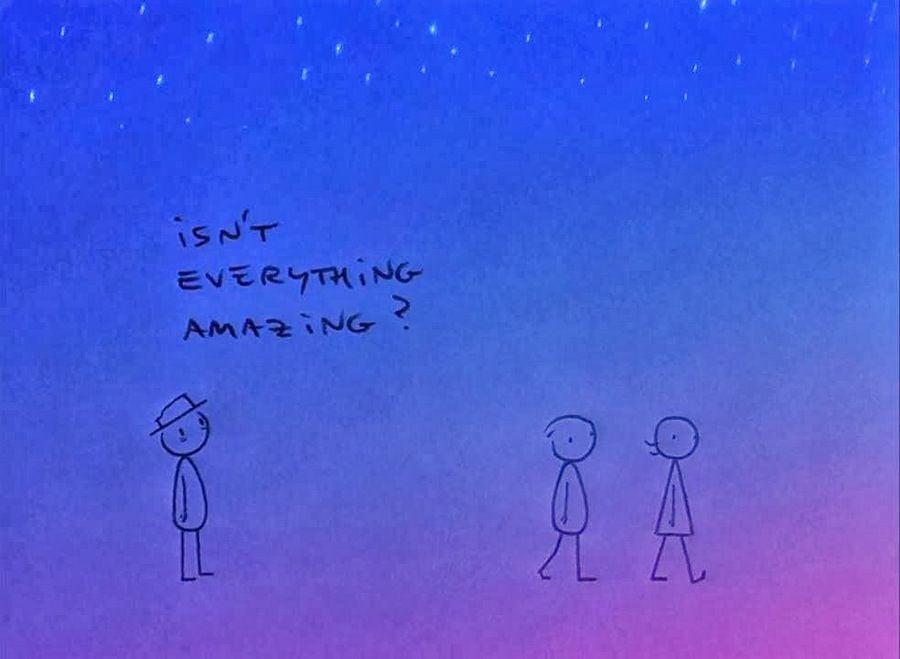
    Despite Hertzfeldt having quite a distinct personality, which some may understandably find grating, the main character of ‘It’s Such a Beautiful Day’ strikes me as a generic, average, everyday sort of person. Bill (his name), is literally a stick man with the only sign of quirkiness to his appearance being that he’s pretty much always wearing a top hat. He’s pretty much the visual embodiment of being “just a little guy”. There is something slightly imperfect (to me) about that, if Bill is supposed to be a kind of representation of the abstract human, then the fact that he’s a man plays into the history of philosophy depicting the average person – “the subject” – as masculine or implied to be a man, from Saint Paul to Karl Marx and beyond.

    At the same time, maybe Bill speaks to the “wee guy” in all of us; I don’t know. The more queer or gender neutral reading would be that Bill’s subjectivity is expressed entirely in his hat, in a similar way to Salvador Dali’s thin mustache or Marilyn Monroe’s blonde hair. I’ll leave that to readers to decide. The bigger point I wanted to make is that Bill is a little guy in a vast, vast universe. This is most obvious in the final third, where Bill seems to become some kind of universal (in the more literal, cosmic, sense) space traveller. He even travels to different planets and befriends a bunch of aliens at one point, who apparently worship him as a god. In this final part, time seems to disappear. Bill falls in and out of love again and again. There is a tragedy each time, since Bill’s atemporal being is destined to mourn the deaths of his lovers again and again too; and he will forget them all, eventually. Not only that, but he is destined to forget all the little, everyday, “things” he loves too; which are highlighted in a poetic way throughout.

    In Bill’s memento mori, so to speak, “His bathmats are gorgeous… The grain patterns in his cheap wood cabinets vibrate something deep within him… The air smells different, brighter somehow… The world is clumsy and beautiful and new”. It is narrated, “He’s never really appreciated these things. All these details he’s never noticed. Detail he’s never noticed. He’s alive…”. These everyday things are what I understand as “objects”. Unfortunately, from the perspective of atemporality, everything becomes an everyday thing. This is part of the tragedy experienced by Bill’s lovers, and even the species of aliens. I developed my understanding of this perspective while studying archaeology as an undergrad through the philosophical movement known as ‘Object Oriented Ontology’. This movement posits what it calls a “flat ontology”, meaning basically that things exist on an equal level of reality, in a kind of extreme anti-heirarchy or anarchism. This flattening of ontological importance between, say, bathmats and people may be deeply uncomfortable to some people, understandably so. For me, adopting this kind of perspective in relation to archaeology was a strategy to try and empathise with people in cultures probably very different to what I was/am familiar with – existing in an extremely different historical context (Ice Age people, for example). I wanted to get out of my modern presuppositions, to the best extent possible. I think it was useful in this sense, but of course I understand the reservations. Importantly, by the end of the film even space disappears. The final lines are: “He lives and he lives; until all of the lights go out”. And then they do… the screen goes black, like in pretty much all films. And then the lights come back on in real life, and we are surrounded by everyday objects… ‘It’s Such a Beautiful Day’ is phenomenological to the core.

    The middle section of Hertzfeldt’s film, originally titled ‘I’m So Proud of You’, is the most psychodynamic; delving into time and Bill’s personal (and intergenerational) history. He remembers moments from his childhood – for example a school trip to a beach where he met a seal, the immediacy of grass, and a note from his mum saying “I’m So Proud of You” but revealing her own anxiety about being a not good enough mother. The memories seem jumbled, as memories are; some also seem confused with what is happening in the “here and now”. Apparently, your life flashes before your eyes just before you die; and this section of the movie is kind of a representation of that idea. Again, the film takes a “poetic” stance; treating the memories as not begging to be untangled, but beautiful in-themselves.

    The first section of the film, originally titled ‘Everything Will Be Okay’, is precisely more about the “here and now”; and it’s the most narrativistic. As Bill does the “everyday” walks to the bus stop, corner shop, watches TV, and so on, he seems to experience something of a psychotic break. Bill is hospitalised with a mysterious illness and the narrative disintegrates into surrealism, hyperealism, absurdism – whatever you want to call it. Moments from the narrative section, while it lasts, are replayed throughout – again jumbling memory/experience from different “sources”; adopting a kind of dream logic.

    Deconstructing this everyday experience allows for what, for me, is a nice transition into the revelation of metaphysical concepts – which, again for me, always lie just “beyond” the everyday. The middle section strikes me as the most closely aligned with object-relations: which was my first love in the world of theory. Coming from a clinical psychotherapy perspective, object-relations needed to make a lot of space for the subject (i.e. the client or prospective client) in its schema. Objects are important or interesting because a person cares about them. In attachment theory, things (usually people – yes, the terminology is a bit problematic) which are important to the client may be related to in different ways – all of which we can glimpse in ‘It’s Such a Beautiful Day’.

    The movie frequently employs a first-person perspective to show Bill’s experience by using a variety of creative techniques to display its distortion, and then going back to showing Bill as a character (i.e. from the third-person perspective). As such, in my view the film is a really nice interplay between “object-oriented” and “subject-oriented” approaches; and the way it manages the repeated transitions between the two are often brilliant. Since I love both approaches, in different aspects of life, this interplay is pretty much perfect for me. I care about Bill, from a transferential (or countertransferential) perspective, and this is perhaps what motivated me to love the film in the first place. However, I think it also seems important to adopt a kind of melancholic position (in other words, secure attachment) towards the more poetic and experimental aspects of the film – which, to his great credit, Hertzfeldt gives the viewer many opportunities to. The movie, taken in its three parts, is a kind of descent into madness, poststructuralism, and the unknown; but a fairly gentle and kindhearted one, hopefully helping the viewer not be afraid of it.

    Let’s do the personal and present bit of this piece of writing, since I seem to be drifting in that direction. Indeed, going back-and-forth between subjective and objective perspectives is part of what I aim to do here on ‘What If Nobody’s Home?’. I want to communicate how I experienced the movie (or piece of art of another kind), or at least how I’m remembering it in a certain moment. I’ll tend not to rewatch a movie before writing about it, so it’s the case that I’m likely to misremember aspects; so I’ll be providing views that are highly subjective in many senses. The way in which I’m trying to be objective is in arranging certain elements or parts of the work which seem important for some reason – such as themes, characters, motifs, colours, even. Importantly, I’m not proposing that these things are only important to me, but suggesting that they are important/significant objectively. Of course, I’m secure in the faith that all elements are indeed ultimately important (from an ontological perspective), but – to not be too relativist, I’m also hoping that perhaps some of the things I write about may find importance in reader’s lives and sense of interiority too.

    At the same time, I’m about to start training as an existential psychodynamic therapist, so a few clarifications may be needed. Firstly, the image of myself which will inevitably emerge as this project progresses is not exactly real in terms of the psychotherapeutic relationship. As I write, I embody both the subjective and objective personalities, and how I transition between those is for me to manage; whereas in a therapeutic relationship the client aims to embody subjectivity and the therapist objectivity (although there may unfortunately and admittedly be countertransference, as it’s called). When Tom suggested starting this project, I was interested in having our entries be more of a dialogue (where we interplay subjective and objective positions with each other), but unfortunately we might not have the time and schedule compatibility for that, so the writing may be more “dialectical” or self-enclosed in this sense – although there may also be aspects which are more “letter like”.

    A few other things about me. I have a lot of ideas, and I’m pretty sure a lot of them are really dumb; so I might leave threads untied to be addressed in the future, and I reckon my interpretations are best understood as possibilities in an ocean of them. I love theory and “the life of the mind”, but I’m also a rather emotional and sentimental person so my interpretations are often changing based on mood. In this sense I am, admittedly, a rather bad theorist; although I work hard to keep my mood fairly consistent. I also tend to embody or emphasise different aspects of my personality to create a contrast between myself and the subject matter; since I find that difference opens up the possibility of creative reconciliation and learning as such. Sometimes (having experienced this in my personal life) I can do this too fast, meaning that the difference is treated as threatening rather than an opportunity to come up with something new; something, again, I am working on. This is another reason why it’s best not to treat the image which emerges of me through writing as real. If I was to meet you in real life, I would probably emphasise different aspects of myself. That being said, if a certain “part” of me speaks to you, that’s great.

    There’s a lot of things I didn’t get to mention here; for example I wanted to develop an understanding of “brainrot” (i.e. forgetting real things and being left with memetic objects) as contained both by the film and the movement Hertzfeldt is associated with in regards to the internet and “cyborg” humanism more generally; I wanted to talk about this film’s relationship to the colour purple; I wanted to talk more about the flaws, for example Hertzfeldt’s “imperfect” narration and the fact that many aspects of the movie already haven’t aged too well; I wanted to talk about some animation techniques; but Tom and I intended to keep things quite short so I’ll wrap up. I hope to have shared some resonant thoughts and sentiments with you today; that you found the writing interesting and continue to going forwards. ‘It’s Such a Beautiful Day’ is a curious and creative film, both simple and complex, about humanity’s place in the world and the world’s place in humanity. I’m not surprised it has become something of a twenty-first century classic and hope it is well-remembered; although I think, paradoxically, it wants itself to be forgotten.