
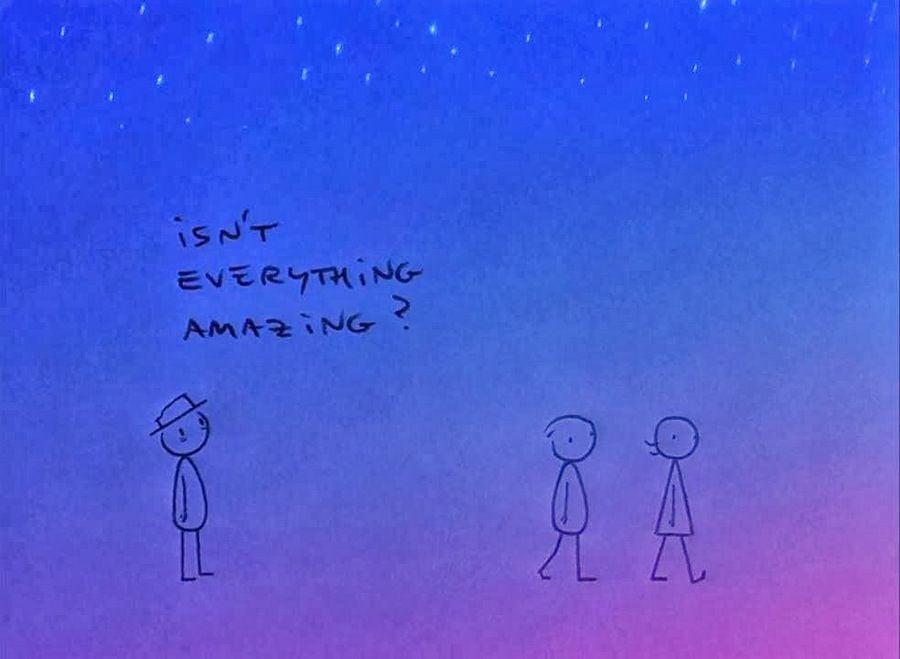
Jay-Ger reflects on their favourite film, and beginning ‘What If Nobody’s Home?’.
‘It’s Such a Beautiful Day’ is my favourite film. At least, it’s the film I say when people ask me, “what’s your favourite film?”. To tell the truth, I haven’t seen it in years and I’m unsure if I’d even enjoy it if I watched it tomorrow; the movie has a lot of flaws. I first watched Don Hertzfeldt’s animated trilogy of shorts – compiled to create ‘It’s Such a Beautiful Day’, aged around sixteen and found it profoundly moving. Since then I’ve rewatched a handful of times and tried (unsuccessfully) to show it to a few friends in recent years. It’s a hard sell – an animated “surrealist” movie about a stick man with such a pretentious name as, ‘It’s Such a Beautiful Day’. Some folk of around my age may be familiar with Hertzfeldt’s work through the short called ‘Rejected’, which in my mind captures the mainstreaming of internet “brainrot” alongside the likes of asdfmovie (a.k.a. “I like trains”), ‘Charlie the Unicorn’, and ‘The Duck Song’, and if folk are nostalgic about this kind of thing then the sell is a bit easier. In my over-intellectualisation of the movie, it’s a nice representation of a dialectic of importance to me in recent years – that between subjects and objects; but we’ll get to that. For now, I’ll say it’s a pretty good film, which you might like if you don’t mind/enjoy eccentric personalities, and are into the more surreal, absurd, and existential aspects of life.
Despite Hertzfeldt having quite a distinct personality, which some may understandably find grating, the main character of ‘It’s Such a Beautiful Day’ strikes me as a generic, average, everyday sort of person. Bill (his name), is literally a stick man with the only sign of quirkiness to his appearance being that he’s pretty much always wearing a top hat. He’s pretty much the visual embodiment of being “just a little guy”. There is something slightly imperfect (to me) about that, if Bill is supposed to be a kind of representation of the abstract human, then the fact that he’s a man plays into the history of philosophy depicting the average person – “the subject” – as masculine or implied to be a man, from Saint Paul to Karl Marx and beyond.
At the same time, maybe Bill speaks to the “wee guy” in all of us; I don’t know. The more queer or gender neutral reading would be that Bill’s subjectivity is expressed entirely in his hat, in a similar way to Salvador Dali’s thin mustache or Marilyn Monroe’s blonde hair. I’ll leave that to readers to decide. The bigger point I wanted to make is that Bill is a little guy in a vast, vast universe. This is most obvious in the final third, where Bill seems to become some kind of universal (in the more literal, cosmic, sense) space traveller. He even travels to different planets and befriends a bunch of aliens at one point, who apparently worship him as a god. In this final part, time seems to disappear. Bill falls in and out of love again and again. There is a tragedy each time, since Bill’s atemporal being is destined to mourn the deaths of his lovers again and again too; and he will forget them all, eventually. Not only that, but he is destined to forget all the little, everyday, “things” he loves too; which are highlighted in a poetic way throughout.

In Bill’s memento mori, so to speak, “His bathmats are gorgeous… The grain patterns in his cheap wood cabinets vibrate something deep within him… The air smells different, brighter somehow… The world is clumsy and beautiful and new”. It is narrated, “He’s never really appreciated these things. All these details he’s never noticed. Detail he’s never noticed. He’s alive…”. These everyday things are what I understand as “objects”. Unfortunately, from the perspective of atemporality, everything becomes an everyday thing. This is part of the tragedy experienced by Bill’s lovers, and even the species of aliens. I developed my understanding of this perspective while studying archaeology as an undergrad through the philosophical movement known as ‘Object Oriented Ontology’. This movement posits what it calls a “flat ontology”, meaning basically that things exist on an equal level of reality, in a kind of extreme anti-heirarchy or anarchism. This flattening of ontological importance between, say, bathmats and people may be deeply uncomfortable to some people, understandably so. For me, adopting this kind of perspective in relation to archaeology was a strategy to try and empathise with people in cultures probably very different to what I was/am familiar with – existing in an extremely different historical context (Ice Age people, for example). I wanted to get out of my modern presuppositions, to the best extent possible. I think it was useful in this sense, but of course I understand the reservations. Importantly, by the end of the film even space disappears. The final lines are: “He lives and he lives; until all of the lights go out”. And then they do… the screen goes black, like in pretty much all films. And then the lights come back on in real life, and we are surrounded by everyday objects… ‘It’s Such a Beautiful Day’ is phenomenological to the core.
The middle section of Hertzfeldt’s film, originally titled ‘I’m So Proud of You’, is the most psychodynamic; delving into time and Bill’s personal (and intergenerational) history. He remembers moments from his childhood – for example a school trip to a beach where he met a seal, the immediacy of grass, and a note from his mum saying “I’m So Proud of You” but revealing her own anxiety about being a not good enough mother. The memories seem jumbled, as memories are; some also seem confused with what is happening in the “here and now”. Apparently, your life flashes before your eyes just before you die; and this section of the movie is kind of a representation of that idea. Again, the film takes a “poetic” stance; treating the memories as not begging to be untangled, but beautiful in-themselves.
The first section of the film, originally titled ‘Everything Will Be Okay’, is precisely more about the “here and now”; and it’s the most narrativistic. As Bill does the “everyday” walks to the bus stop, corner shop, watches TV, and so on, he seems to experience something of a psychotic break. Bill is hospitalised with a mysterious illness and the narrative disintegrates into surrealism, hyperealism, absurdism – whatever you want to call it. Moments from the narrative section, while it lasts, are replayed throughout – again jumbling memory/experience from different “sources”; adopting a kind of dream logic.
Deconstructing this everyday experience allows for what, for me, is a nice transition into the revelation of metaphysical concepts – which, again for me, always lie just “beyond” the everyday. The middle section strikes me as the most closely aligned with object-relations: which was my first love in the world of theory. Coming from a clinical psychotherapy perspective, object-relations needed to make a lot of space for the subject (i.e. the client or prospective client) in its schema. Objects are important or interesting because a person cares about them. In attachment theory, things (usually people – yes, the terminology is a bit problematic) which are important to the client may be related to in different ways – all of which we can glimpse in ‘It’s Such a Beautiful Day’.
The movie frequently employs a first-person perspective to show Bill’s experience by using a variety of creative techniques to display its distortion, and then going back to showing Bill as a character (i.e. from the third-person perspective). As such, in my view the film is a really nice interplay between “object-oriented” and “subject-oriented” approaches; and the way it manages the repeated transitions between the two are often brilliant. Since I love both approaches, in different aspects of life, this interplay is pretty much perfect for me. I care about Bill, from a transferential (or countertransferential) perspective, and this is perhaps what motivated me to love the film in the first place. However, I think it also seems important to adopt a kind of melancholic position (in other words, secure attachment) towards the more poetic and experimental aspects of the film – which, to his great credit, Hertzfeldt gives the viewer many opportunities to. The movie, taken in its three parts, is a kind of descent into madness, poststructuralism, and the unknown; but a fairly gentle and kindhearted one, hopefully helping the viewer not be afraid of it.

Let’s do the personal and present bit of this piece of writing, since I seem to be drifting in that direction. Indeed, going back-and-forth between subjective and objective perspectives is part of what I aim to do here on ‘What If Nobody’s Home?’. I want to communicate how I experienced the movie (or piece of art of another kind), or at least how I’m remembering it in a certain moment. I’ll tend not to rewatch a movie before writing about it, so it’s the case that I’m likely to misremember aspects; so I’ll be providing views that are highly subjective in many senses. The way in which I’m trying to be objective is in arranging certain elements or parts of the work which seem important for some reason – such as themes, characters, motifs, colours, even. Importantly, I’m not proposing that these things are only important to me, but suggesting that they are important/significant objectively. Of course, I’m secure in the faith that all elements are indeed ultimately important (from an ontological perspective), but – to not be too relativist, I’m also hoping that perhaps some of the things I write about may find importance in reader’s lives and sense of interiority too.
At the same time, I’m about to start training as an existential psychodynamic therapist, so a few clarifications may be needed. Firstly, the image of myself which will inevitably emerge as this project progresses is not exactly real in terms of the psychotherapeutic relationship. As I write, I embody both the subjective and objective personalities, and how I transition between those is for me to manage; whereas in a therapeutic relationship the client aims to embody subjectivity and the therapist objectivity (although there may unfortunately and admittedly be countertransference, as it’s called). When Tom suggested starting this project, I was interested in having our entries be more of a dialogue (where we interplay subjective and objective positions with each other), but unfortunately we might not have the time and schedule compatibility for that, so the writing may be more “dialectical” or self-enclosed in this sense – although there may also be aspects which are more “letter like”.
A few other things about me. I have a lot of ideas, and I’m pretty sure a lot of them are really dumb; so I might leave threads untied to be addressed in the future, and I reckon my interpretations are best understood as possibilities in an ocean of them. I love theory and “the life of the mind”, but I’m also a rather emotional and sentimental person so my interpretations are often changing based on mood. In this sense I am, admittedly, a rather bad theorist; although I work hard to keep my mood fairly consistent. I also tend to embody or emphasise different aspects of my personality to create a contrast between myself and the subject matter; since I find that difference opens up the possibility of creative reconciliation and learning as such. Sometimes (having experienced this in my personal life) I can do this too fast, meaning that the difference is treated as threatening rather than an opportunity to come up with something new; something, again, I am working on. This is another reason why it’s best not to treat the image which emerges of me through writing as real. If I was to meet you in real life, I would probably emphasise different aspects of myself. That being said, if a certain “part” of me speaks to you, that’s great.
There’s a lot of things I didn’t get to mention here; for example I wanted to develop an understanding of “brainrot” (i.e. forgetting real things and being left with memetic objects) as contained both by the film and the movement Hertzfeldt is associated with in regards to the internet and “cyborg” humanism more generally; I wanted to talk about this film’s relationship to the colour purple; I wanted to talk more about the flaws, for example Hertzfeldt’s “imperfect” narration and the fact that many aspects of the movie already haven’t aged too well; I wanted to talk about some animation techniques; but Tom and I intended to keep things quite short so I’ll wrap up. I hope to have shared some resonant thoughts and sentiments with you today; that you found the writing interesting and continue to going forwards. ‘It’s Such a Beautiful Day’ is a curious and creative film, both simple and complex, about humanity’s place in the world and the world’s place in humanity. I’m not surprised it has become something of a twenty-first century classic and hope it is well-remembered; although I think, paradoxically, it wants itself to be forgotten.

Leave a Reply