
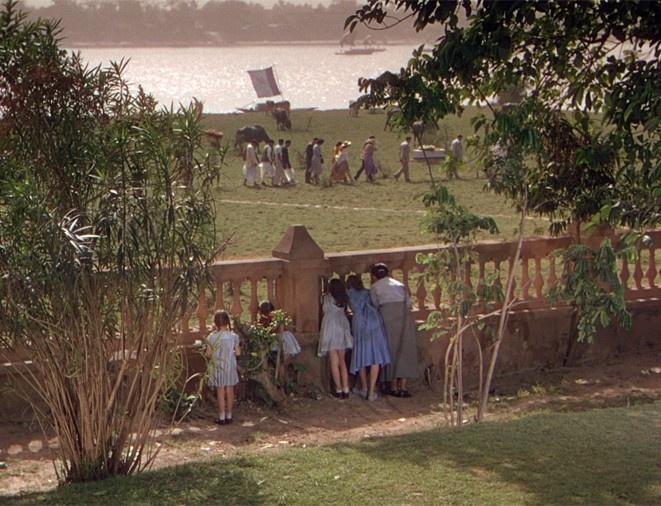
Al considers two different imaginaries, Ganga and the Ganges, with Jean Renoir’s 1951 drama.
Perhaps, as Jay-Ger acknowledges, my retraining in landscape architecture has effected a change in how I spatially experience the world. Earlier this year, I participated in a somatic workshop, drawing out my site. We started by taking a line for a walk, keeping pencil in contact with paper whilst walking around the sculpture court in Edinburgh College of Art. Asked to sketch what was significant, a translation of how we perceived our projects with our movement across the court, I found myself recouping the flows of water into lines, which turned into streams, and eventually fed into the burn which coursed through my site.
We were asked to title each other’s drawings, and my friend, on seeing what I had produced, noted how it looked like a tree, or perhaps its roots. She called it ‘Arbour’, perhaps trying to spatially articulate the lines as a framework, creating a space within them to stage my intervention.
I was thinking of this when I recently watched Jean Renoir’s The River, based on the novel by Rumer Godden. It starts with someone making a drawing on silt, one that we see later in the film celebrating Holi, the Indian spring festival of colour. The credits follow, also written in rice paste, perhaps framing the river and its annual deposit of material during the monsoon as the surface upon which the film is created. We are then introduced to the Ganges river, its expanse, with the life and commerce which it supports. This is contrasted with the house and family of an upper-middle class English family, whose patriarch runs a jute mill, in British India.

Visually, a game is played with the presence and absence of the horizon in the film. The childhood of the protagonist, Harriet, and her siblings are framed by the wall-tops of their garden, enclosing a luscious space so bubbling with fun that they chase away the cares of all who come. A line is drawn, a design act creating a barrier between the garden and the outside world with its horizon. Childhood and its innocence contained within its boundaries. Similarly, we draw a river with a line on both sides, a cartographic separation of land from water. This is the European imagination, delineating and surveying. A line is drawn because you want to hold it, channel it, control it.
It is this absurd act of existential geomorphology, given the richness of the soil where wetness extends across the catchment, that reminded me of my drawing during the workshop. If you look at a line as a contained thing, it leads to the question of what is normal and what is abnormal. The line acts as a control system, so when you take a starting point what flows is ultimately not a river, not the water, what flows is the line that contains the water, designing a channel. A drawing then is not entirely true. By following the topography, I created a whole reality through the drawn lines, indicating land from water. Through the imaginative act of mapping, of articulating line and surface, I was constructing the water bodies that crossed my site on the basis of a design act that has rarely worked.

Jean Renoir’s The River uses this colonised conception of the river as a metaphor, and whilst the river doesn’t flood there still is rupture: in the bodily integrity of visiting Captain John; of Harriet’s younger brother Bogey’s obsession with cobras; and in Harriet’s coming-of-age. The shift in the height of the river during the summer months of monsoon can be dramatic, depositing silt carried down from the Himalayas, and partially covering what is left of the floodplain, otherwise engineered and channeled down to the Bay of Bengal. Perhaps the ship’s cargo was on its way to the jute mills in Dundee.
Recalling Jay-Ger’s invocation of the taskscape, I want to consider a different mode of habitation with the river, or perhaps I should call it wetness. This conception doesn’t delineate space, or where land is livable with its designed order, and water. This indigenous conception involves living in negotiation with wetness, of living across a gradient. This older idea of the Ganga, of a wetness that rises and falls, rather than the ‘normal’ river and flood, was colonised and constructed into the Ganges. The designed construction of the ‘river’, of reinforcing it as a natural object, is a design act for which we are paying the price.

This is true both ecologically and ontologically. Here I’m thinking with Dilip de Cunha who questions this historical moment of granting a river rights, arguing that rights based ethics is grounded in the clarity of the object, therefore accepting the logic of colonialism by restraining wetness as a contained entity in the form of a river. Physical interventions, which accelerated under British rule, reshaped the river’s ecology, hydrology, and relationships with local communities. The Ganga canal system has had disastrous landscape effects which have been linked with contemporary climate-related displacement, where the canals have prevented silt depositing in the Bay of Bengal, resulting in land erosion in Bangladesh.
The last scene of the film, perhaps reaches most towards this older conception of the Ganga, where, from the veranda of the house, Harriet looks over the garden wall towards the river, taking a moment to reflect on the cycles of life and death that take place on its banks.

Leave a Reply