Tag: What If Nobody’s Home

  • ‘The Holy Mountain’

    ‘The Holy Mountain’

    Can a film be composed of aphorisms? Very memorable, sexy images which offer a distinction, a definition. If anything, Alejandro Jodorowsky’s The Holy Mountain, in an ironic way, talks to an idea of subjectivity, having purchase on the contemporary world of Instagram, social media, and perhaps even A.I. I watched it recently amongst friends, and we attempted to discuss it after, first thoughts mumbled, whilst the film was replaced on the projector screen with an A.I. generated loop of a cosy Halloween Street. One person shared that its imagery had inspired album and concert tours of Kanye and Lady Gaga.

    I sensed some discontent with what I had seen. At times I did find it very affecting, the detourment – to use Situationist language – of taking existing culture and twisting it: especially in the scene where The Thief climbs the Torres de Satélite, a group of sculptures in the suburbs of Mexico City, translated into a homage to his mentor Buñuel’s Simon in the Desert, making strange the city which has been flattened by capital. A field of red upon which he climbs.

    When I researched Jodorowsky, seeing his connections to Surrealism, to Artaud and the Theatre of Cruelty, I started to frame the language of the film in a sort of Hegelian or quasi-Hegelian way, such that everything is always a reflection of itself, back to itself or itself in itself. I started to think of Alexandre Kojève’s lectures on Hegel, where he frames the master slave dialectic as a relationship where both sides are dependent upon each other for their status. The master is only the master because the slave recognises them as the master. And the slave is more free than the master because the master is more dependent on the slave for his status, and his kind of subjectivity, than the slave.

    Jodorowsky, styling himself as the Alchemist, guides us to the Holy Mountain to meet the Masters, collecting along the way a series of endless paradoxes in which everything is always reflecting everything back to itself, for itself and its own ends – I did nod off slightly in this section…

    Art exploring how we might think, experience and talk about freedom is vital. And what I took from the film is a very Situationist kind of questioning of what stops us from being free? What are the constraints that hinder our flourishing? How to live a life as directly as possible, free from the constraints into which we are cultured? Talking from my own field, at least in the UK, the Secured by Design initiative, where public space is made hostile through the removal of benches, shrubbery and active transport infrastructure in the effort to ‘design out crime’, creates unnatural rhythms in how people use, move through, and think about the public realm. This body politic conception of design by the Police, treating ‘places to gather’, cribbing from Phineas Harper’s reporting on this, as points of infection, a pathologisation of crime, slips into landscape in the form of anti-skate fins, uncomfortable benches and other elements of hostile architecture. A structuring of movement in urban areas around work or consumption, two main functions of capital.

    The film, in its detourment of the everyday – also filmed without permission, like Situationist practices of walking the city – visually contests who could own or who could structure that conception of the city, of freedom, by making it strange. This concern of how power relationships get institutionalised in the city, in culture and its iconography, is similar to historical materialist perspectives which I’ve encountered around the Reproduction of Space. The Holy Mountain, sitting within Avant-Garde attempts to revitalise the everyday, has this evocative and exciting idea, trying to open up possibilities from the routinised experience of post-industrial society.

    Yet one word that struck me, as we were discussing the film, was nihilism; that the spectacle of the film reveals itself to be a visible negation of life, a negation that has taken on a visible form. Without discussing the ending, I found that the entire language and structure of the film created an expectation which is itself a function of capitalist ideology. The film is meta, so what?

    Here I feel like I’m going to be cast out, like other questioners of surrealist and situationist doctrine before me, no longer allowed to be part of film club because I’ve disagreed with Jodorowsky and the film bros love of him. And perhaps I’m being too harsh, unsympathetic to the anger at the co-option and depoliticisation of surrealism; part of the Cold War institutionalisation of Modernism, shaped by the Museum of Modern Art in New York. After all, in Buñuel’s film, the Devil takes Simon from his pillar near Aleppo in the 5th century to a New York jazz club in the 20th.

    We live at a different time of screen media and photography than when the film was made. Distribution, whilst still cosying up to corporate and state institutions, on apps like Instagram, produce an aesthetic experience of the world; you too could don white robes and a white hat, and sit between two goats. You too, have the ability to create and share media easily and quickly, banishing the postwar passive spectatorship of the world and even their own lives. The Holy Mountain is responding to a feeling of alienation, surreally attempting to address feeling kind of separated from everyone else, and separated from yourself, and your own activity; an impossibility of living a sort of authentic experience. A media environment in which one was bombarded by images which you couldn’t touch, couldn’t control, couldn’t do anything about. Yet what does it mean to post myself in a white hat? Am I adding to a collective social process of making stuff together? Am I the author of the world I inhabit?

    Like the curated clacking of the keys on my laptop, I’m falling into cliche. Would the first screening of the film in the 1970s be more authentic than my watching experience with the film club, A.I. background and white hat shared to insta? In a moment where accelerationist aesthetics tend to dominate, this line of argument extols that to get out of the spectacle we should not retreat back to nature, but to push through the spectacle basis, to use the spectacle against itself. Again, the nihilism, where there’s no point in struggling to maintain authenticity. Like The Holy Mountain, I have already been recuperated by the spectacle.

  • ‘Braindead’

    ‘Braindead’

    The purpose of this article, somewhat unlike the others we have done for What if Nobody’s Home?, is to pitch you a film: Peter Jackson’s crackpot Kiwi horror/comedy, Braindead.

    Kiwi cinema, that is, films set in and produced in New Zealand, holds an immensely special place in my heart. My old English teacher – and father to my best friend, Allen was once an aspiring actor in the NZ scene, and as a teen, I remember my old man, who was ironically Allen’s best friend, tracking down a cult Kiwi film called Once Were Warriors. Allen’s cousin, Cliff Curtis, plays a criminal called Uncle Bully, the aptly named antagonist of the story. We watched the sequel, What Becomes of the Broken Hearted, and waited patiently to see the long locks of my younger English teacher. He pops up during a bar brawl, and I recall my young mind immediately elevating the status of this man to that of a cool uncle. Whether this view of Allen really changed is irrelevant. He was and always will be the best teacher I ever had.

    It is interesting to me how a creative genealogy can be found within films. When held up to other artistic mediums, film is unique in that it features both an unseen and seen cohort of creators. For the seen, the actors, people with any interest can trace an actor’s history through their work. In certain cases, relationships between actors can be discovered, traced and expanded too. This pattern was true for how I viewed Allen and his cousin, and moving down this path led me to Training Day and The Piano at a fairly young age. However, the focus of this article is on the unseen, and that is not to say simply the director or producer, but the artistic visionaries who construct the worlds we love. In the case of fundamental NZ cinema, I see no two people of greater importance than Richard Taylor and Peter Jackson.

    Thinking about Peter Jackson, if you see the world in a similar light to myself, may cause your heart to burn a little. It is hard for people in my generation not to think of the amazing Lord of the Rings trilogy, and the not-so-amazing Hobbit trilogy, without recalling the childhood awe which made these films so successful. LOTR will forever be synonymous with sofa days, snacks, memes, memories, music, idols, icons, intrigue – good and evil. But beyond this romantic and narrow view of Jackson’s filmography, you may find King Kong – the only film I have ever walked out of in pure terror – and the recent The Beatles: Get Back documentary. It may surprise you, however, to learn that Jackson started his career with low-budget, wacky comedy-horror films, and not with the adventure-epic genre for which he is known.

    Finally, we arrive at Braindead. Before proceeding, I must thank my partner, Fern, for suggesting this barrel of laughs. Dating at a distance, it’s hard to find things to share and experience together. But I am grateful to Fern, and of course to Braindead, for making our distance date so enjoyable.

    Setting the mush to one side, Braindead achieves that amazing balance between comedy and horror, which feels so rare in older films. I can think of the Evil Dead franchise, Gremlins and perhaps Shaun of the Dead as some of the few that come to mind. It feels like a sparse genre, historically, and yet the pleasure one can draw from it is immense.

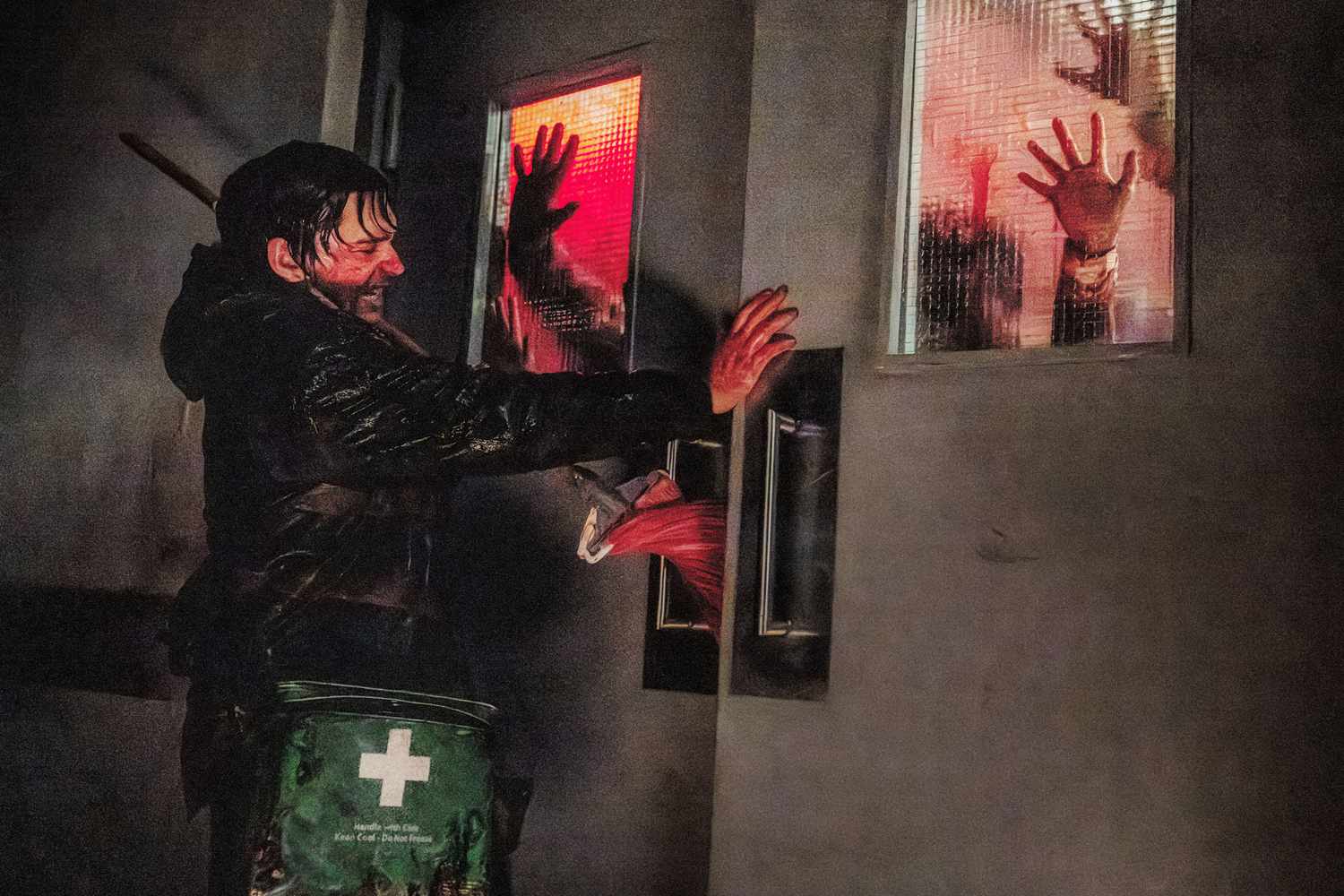
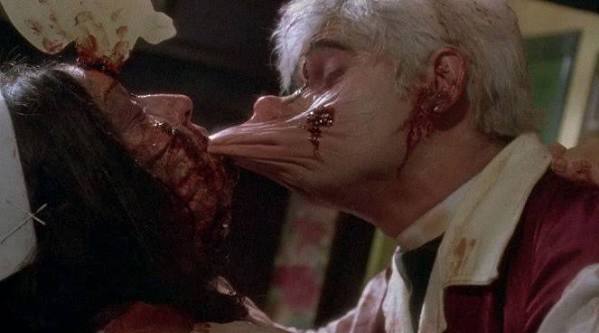
    The film follows the awkward mamas-boy Lionel Cosgrove (Timothy Balme) on a gory quest to get his first kiss – and deal with a growing horde of pustulating undead monsters. At every stage of the story, there is the threat of bombastic gore – everything from zombie babies in blenders to exploding heads and humping ghouls – coupled with the outrageous humour of quick dialogue, unexpected turns, and tropes played out to the maximum. It is outrageously funny, and if you think that the absolute pinnacle comes with the Kung Fu priest shouting ‘I kick ass for the lord’ before dropping into the most outrageous fight scene ever put to film – think again.

    I wholeheartedly believe that this film could only ever have been made in New Zealand. It captures that distant but familiar humour Kiwis embody. The film does not take itself so seriously, and the joy with which it was made bleeds through with the abundant puss. It feels at once as large and as vast as those familiar landscapes we know from LOTR, while simultaneously appearing localised and intricate. I think that a huge part of this success is down to the work of Richard Taylor, one of Jackson’s longtime collaborators, who worked on the special effects of the film alongside Bob McCarron. Together they used over three hundred litres of fake blood and utilised miniatures to reconstruct the busy streets of old Wellington. In this way, the scenes with the urgent tram are like an ancestor to the streets of Gondor. It is here, in this connection, that we may find another, wider film genealogy, with connections to Blade Runner 2049, The Chronicles of Narnia, The Legend of Zorro, and more, all being discoverable under the umbrella of Taylor’s Weta Workshop. Importantly, however, Braindead is the precursor to all these fantastic worlds.

    Watching Braindead was like finding a single root on a family tree – a source in which comedy and horror work together, in a small-budget Kiwi film, to create an actual timeless masterpiece. I laughed, I recalled, I recoiled, I gagged, and I giggled. This movie is a joy.

  • ‘The White Lotus (Season Two)’

    ‘The White Lotus (Season Two)’

    Jay-Ger considers mimetic desire and Sicily’s landscape in Mike White’s upside-down drama.

    ~

    While Ethan angrily telling Cameron he has, ‘a bad case of something called mimetic desire’, is not the first time ‘French theory’ has been brought up in the show (books by Jacques Lacan and Judith Butler, among others, humorously feature in season one), it’s the most direct. Mike White hides his love for certain theorists like Reynolds Woodcock in the seams of his dresses, and to a partially literate and confused-taste viewer like myself Rene Girard appears to occupy the most intimate spot. Girardian themes are again revealed in season three, particularly with the much talked-about Sam Rockwell monologue, while one may also spot the way in which Sam Nivola’s character is torn between studying at two universities Girard taught at. In the theorist’s early works of literary interpretation, a sense of their respective times are observed in novels by Stendhal, Proust and Dostoevsky; while in Stendhal’s universe characters mimic mythical archetypes, in Proust’s such archetypes are excavated through remembering a better world, meanwhile for Dostoevsky the possibility of this seems blocked with few exceptions.

    If Dostoevsky’s universe presents upside-down characters in an upside-down world, The White Lotus surely does the same. White’s acerbic characters seem filled with petty jealousies, giving the show its satirical edge. Largely portraying super-wealthy guests at the eponymous hotel chain, it seems the show has been widely interpreted as a critique of today’s bourgeoisie. While this is true, I think the mimetic drama on display is more spontaneous than this implies. To dig a little deeper, let’s start with the context of Ethan and Cameron’s conflict.

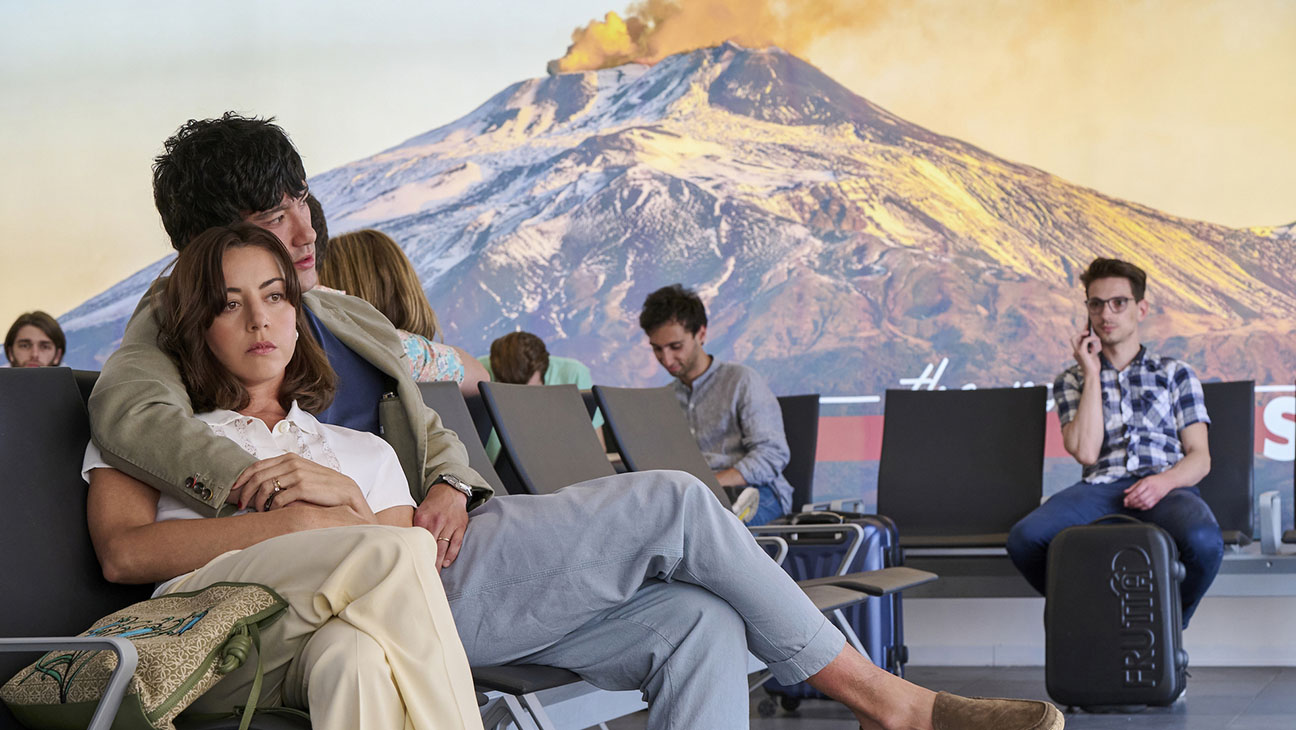
    Harper, played by Aubrey Plaza, quickly intuits the rivalry between Ethan and Cameron, which she ultimately uses to her advantage while hardly escaping the mimetic dynamic. For Ethan (Will Sharpe), Cameron (Theo James) is a model for something like the Don Juan archetype; the related desire for sex with women is expressed through Ethan’s porn addiction, connecting to envy he projects onto Cameron in the guise of financial desire for his own lifestyle. The proximity forced by the show’s premise (spending a week together in an island retreat) encourages a confrontation with this form of mimesis, and with the symbolic lack of his model. Over the course of the season, Ethan is repeatedly asked by Harper to confront his desire, particularly when she finds evidence that someone else has been having sex in their room. Ethan, confident of the fact he did not cheat, is confused by Harper’s questioning, not fully realising that she wants him to communicate his desire for sex with women in general (not so much for a specific woman); something ultimately communicated in a sexual act between the couple. However, this is not until Ethan breaks Cameron’s symbolic status as a model by sleeping with his wife Daphne (Meghann Fahy). There is something of a tragic tone in the way Harper asks Ethan; ‘What’s going to happen to us?’, before they get it on – so she can sustain her desire which assumingly involves staying in a relationship with Ethan, she recognises that his addiction will have to be confronted.

    It’s something of a shame that this mimetic dynamic plays into a trope which treats women as interchangable. In particular, Harper and especially Daphne’s desires are obscured, and both are implicitly asked to bear being viewed as women in general rather than unique individuals by their respective husbands. At the same time, White’s Girardian spirit favours the power of background desires, so the dynamic is complicated and unconscious. The interplay between background models and the show’s characters can be glimpsed in the plot involving the Di Grasso family, which will be talked about next.

    The portrayal of Sicily’s landscape as playing an active role in the mimetic desires of the characters is perhaps what brings this season (and this show) to the next level. There is, however, also something to be said about Sicily’s form as an island. Something I am familiar with from studying archaeology is how islands tend to produce eccentric cultures, many of which have been subject to their own mimetic dynamics. For example, the roots of Western civilisation are arguably traceable to the Minoan culture of Crete, which still displays a unique sense of mythos and artistry in its archaeology. The geographic sense of Sicily being an island seems more important to the show than the cultural one. The forced proximity of island life seemingly plays an active role in the characters confronting their desires, as we have seen so far with Ethan in particular.

    At the same time, Sicilian culture also comes off as active. The presence of the mafia especially is ultimately crucial to the death of Tanya (Jennifer Coolidge). While the use of such cultural distinctions risks playing into unhelpful stereotypes, I think the treatment of that regarding Sicily is fairly well-observed – although as someone with little connection to that background I am hardly in the best position to judge. Mimetically speaking, this theme plays an interesting role in the story of the Di Grassos, who have come from L.A. in search of their roots. Visiting the house prominently featured in The Godfather, their new friend Portia (Haley Lu Richardson) rightly calls out the hollowness of culture-based tourism, calling the experience ‘icky’. While the family agrees to an extent, their ability to separate today’s Sicilian culture from mafioso stereotypes is not applied to the stereotype or myth of harmonious extended family life. This results in hilarious consequences when they finally track down their ancestral house, only to be chased away by a grandmother swearing in Italian. Meanwhile, as it turns out the mafioso stereotypes have some basis in truth, as Portia in particular finds out to her shock and horror.

    The three generations of Di Grasso men, each of which have modelled themselves to an extent on Sicilian-ness, are left questioning what this means – ultimately, they realise the larger extent to which they really modelled themselves on each other. While each of the Di Grassos successfully refine the understanding of their true models, they can hardly be described as freeing themselves from mimetic dramas either – as their interfamilial rivalry is bound to continue. This notion of freedom can perhaps be flipped when it comes to Tanya, who will be turned to next.

    As the only character in the season to also feature heavily in the previous, and the most prominent to be killed, if any character carries the spirit of season two it’s Tanya. In contrast to most of the other characters, Tanya’s psychological drama arguably revolves around a lack of modelling. This may be understandable given her unique status as wealthy among the wealthy, the erratic behaviour of her mother revealed in season one, combined with the absence of her father, and her tendency to reject intimacy for fear of being taken advantage of financially. In psychotherapeutic language, she holds unstable object-relations. This is not saying she doesn’t try; in the first season we see a whirlwind attachment to Natasha Rothwell’s character, who is rapidly discarded when Tanya meets Greg, who in this season she has married. While this relationship seems promising given Greg’s stability, tragically the marriage is a scam to steal her money, which Greg has planned in cahoots with the mafia (or at least mafia-adjacent forces).

    After a fight early in the season, Greg leaves the island and Tanya goes into psychological freefall. She tries to attach to the stars by getting a professional tarot reading, but this goes awry leaving her even more vulnerable. At this point, she makes friends with a group of European aristocrats, who as it turns out are also in on the conspiracy. Things are good for Tanya until she realises she has been betrayed, again. A particularly promising attachment is made with Quentin (Tom Hollander), who at one point invites her to see Madame Butterfly, with him later saying: ‘You’re like the heroine of your own Italian opera’. As Tanya dies, falling into the ocean, O Mio Babbino Caro plays. It’s a really emotional scene, and deeply tragic since it shows the unrealised potential for Tanya to attach to literary heroines themselves: a possibility which for her arrives too late. Going back to Girard, Tanya encounters the possibility of a Stendhalesque form of modelling after the fact and in a false pretence. In a Dostoevskyian universe, she falls (quite literally) as an upside-down hero who could in other circumstances have been rightside-up. Since, however, we are talking about a work of fiction ourselves, in her death Tanya becomes a relatively forgetten-about archetypal character.

    What other buried archetypes does the season contain? This is where my interpretation becomes much more tentative (not that it wasn’t already), but where I would also like to put forth that landscape plays an active role in the mimetic dynamics of the characters, making for a nicely-observed depiction of what Jane Bennett calls vibrant matter.

    As previously mentioned, for me the most impressive aspect of the season is how the landscape seems to play an active role in the mimetic dynamics of the characters, and ultimately I think the truest drama takes place in the background. The season’s intro closes with a shot of a lone seagull freely soaring above the Aegean sea while that song again, O Mio Babbino Caro, plays – embodying Tanya’s literary spirit. While Ethan and Daphne are having sex, from a distance we see an islet just off the beach called Isolabella, which holds its own mythos and (through synecdoche) implies that the intimate events of the season are largely unknown to outsiders. The presence of Mount Etna in the background seems to suggest passivity, but ends up being anything else – erupting as the season enters its nexus.

    In a similar way to the treatment of cultural differences, the way in which landscape features are shot could be described as touristic. This could quite easily play into the voyeuristic, but I think that rather than being shown as a kind-of romanticised object to be gazed at, Etna (for example), has a fire-breathing agency which is emphasised both in its eruption and its passive, everyday, desire not to erupt. I don’t think its a coincidence that the main events of the character’s dramas occur during its eruption – particularly Ethan and Harper’s pivotal sex scene, and Tanya’s death sequence. Both Ethan and Tanya’s eruptions of emotion can be speculated to be unconsciously modelled on Etna – with White perhaps suggesting that the mythical archetypes of Stendhal and the likes were themselves modelled on much more ancient things like the mountains, the seas, and the birds.

    White again seems to explore such themes in the following season, with water being a pivotal model. In an upside-down world, that which has truly modelled the human story is unclear, and I think this show understands that: it’s searching for answers. As is communicated over the course of events, it is possible to escape negative mimesis, but doing so involves a large slice of luck, since the models most truly in control of reality are often opaque to us. Perhaps the overhanging message of the season is to start looking in a couple of directions to help model our desires more positively: literature and more broadly culture, and what we tend to call the natural world.

  • ‘Raising Arizona’

    ‘Raising Arizona’

    Do you know what Arizona means? It means ‘small spring’.

    The story of raising up a small spring is often one of love – but seldom one without turbulence. Here, in Arizona, it is the story of movements across a vast copper space, littered with bullet-riddled Huggies. If you close your eyes, you will see the colourful musings of a man convicted of taking pleasure from cash drawers. As we wander with his mind, we will see a road emerge between the whimsical and the serious, cutting through the vast desert landscape. And, whether that small spring chooses to stay there or not, a torrent of verdant life will certainly grow in its wake. If not in Arizona, then maybe somewhere close by.

    Maybe in Utah.

    This story feels like something John Steinbeck would dream up after a deep dive on William Faulkner and Kurt Vonnegut, with perhaps half a tonne of mescaline by his side. It is a distinctly American story, in so much as it captures that dream that all of us, the uninitiated, find both fascinating and inspiring. It has, at its heart, the beautiful mediation of opposites: A cop marrying a convict, materialistic fantasy and idealist reality, screaming banjos and operatic synths. What emerges is not a hodgepodge of emotions, but rather a glimpse at the in-between.

    H.I. McDunnough (Nicolas Cage) is the embodiment of this mediation. His thoughts labour on the metaphysical and the whimsical in equal weight – though the narrative result feels outstandingly poetic. In the opening sequence, we hear him speak fairly little to his peers, though sometimes with a trademark rambling politeness. Yet, his thoughts are relentless in their beauty and, ultimately, they take up so much of the opening that when the title card finally does roll, it feels like a trick akin to something in Gaspar Noé’s films. A signpost reading: now the story begins in earnest.

    The story is, as I said before, American in nature. The real kind which is founded on hope and aspiration in the face of great difficulty. Behind the humour of this film is the tragedy of true love faced with infertility, and the desperation which can arise from such situations. Ed (Holly Hunter), who we first meet as an officer of the law, is so desperate to fix her predicament that she is willing to literally steal a baby to settle her grief. Ed grieves the future she may not have, while H.I. grieves for the ‘salad days’ and the love that they once had.

    It is most interesting to me that H.I. spends most of the film either trapped in the present or looking back. When faced with familial stress, he turns simply to old, albeit illegal, passions. He opens the story with a summary of the events leading to the present, and he offers safety to old friends, without considering the consequences of these actions.

    Despite this, the film is only settled once we finally see that small spring grow. When H.I., dreaming with that familiar and lovable narration, sees the future, he sees the possibility of a loving and happy life.

    I think my love for this film lies in this conclusion. Happiness, like hope, lies in the future and its possibilities. We must remember to take the whimsical with the serious and avoid dodgy old friends, creepy bosses, and bounty hunters with a penchant for finding children.

  • ‘One Battle After Another’ and ‘Inherent Vice’

    ‘One Battle After Another’ and ‘Inherent Vice’

    Jay-Ger touches on neoliberalism, meaningless words, and embodiment with Paul Thomas Anderson’s takes on Pynchon.

    So this one’s going to be among my more ‘thesis-like’ pieces, since the idea is to articulate why I like the movie One Battle After Another, largely in response to random discourse I’ve come across recently about the film, but which reminded me of many takes I heard shortly after its release and subsequent success at the Oscars. The specific interpretation I want to counterpoint is what I’d call ‘the South Park reading’; basically, the idea is that the work’s main purpose is to poke fun at both sides of America’s political divide, while disavowing its own stance behind the veil of ‘neutrality’. When it comes to South Park (and applying to Trey Parker and Matt Stone’s works more generally), I think this reading makes more sense; the libertarian-ness is treated as natural rather than emerging from history, meanwhile other ideologies – such as those we might call more socially liberal or right-wing populist, for example – are treated as ephemeral, absurd, and lampooned as such (it’s worth mentioning, by the way, that I generally find Parker and Stone’s works funny; mea culpa).

    In terms of One Battle Another, the movie is said to frame both what we could call the anarchist left – represented by the likes of Bob Ferguson (Leonardo DiCaprio), Perfidia Beverly Hills (Teyana Taylor), Junglepussy, and Willa Ferguson (Chase Infiniti); and the ethno-nationalist right, represented by Steven J. Lockjaw (Sean Penn), ‘The Christmas Adventurers Club’ (a secret society Lockjaw seeks entry to), and elements of the state – as engaged in a kind of psychological folie a deux, which gives the film its absurd edge. This reading, it seems to me, doesn’t really explain why the movie was so successful at the Oscars, an institution which tends to be somewhat self-conscious about appearing ‘progressive’. However, it may well be that simply highlighting certain elements of the American state (if not the state itself) as ethno-nationalist and/or fascist is considered radical; or, even more sadly, that, in Oscars tradition, most of the voters didn’t even watch the movie and were impressed by the ‘radical’ aesthetics of its promotional material.

    My sense, having a reasonable familiarity with Paul Thomas Anderson’s career so far (like Tom, I also adore Punch-Drunk Love), was always that the reparative drive behind making the film was to redeem Inherent Vice; PTA’s 2014 work usually considered his worst to date, set in the ‘hippy’ ’70s and based on Thomas Pynchon’s book of the same name. An interesting feature of Pynchon’s work generally is the highlighting of something I described in last time’s reflection on Fargo (Season Five); the introduction of ecologies of floating signifiers to everyday life. One Battle After Another is PTA’s only other work to be based on a Pynchon book, in this case Vineland (though more loosely), which has a broader historical scope compared to Inherent Vice; taking place from the ’60s to the ’80s. To use a framing device from the Oscar-winning movie, ‘Sixteen years later, very little had changed’: while One Battle After Another is set roughly (very roughly) today, it’s supposed to feel like a continuation of this historical period.

    For those holding ‘the South Park reading’, this has led the film to be described as not only apolitical (or right-wing by default) but ahistorical. How key challenges for revolutionary subjectivity may have changed during and since those years is obscured by a flattening of time and historicity (to use a fancy word). I think, read intertextually alongside Pynchon’s postmodern themes, this isn’t true. What I liked about the film most after initially watching was the ‘Pynchonesque’ way in which Bob (in particular) repeatedly encounters this sense of meaningless words; functioning to prove one’s allegiance to a political ideology, often with an incredibly obscure technocratic bar of entry – such as having to memorise lines of a particular book. In contrast to a work more prone to reification, for me it’s by abstracting this historical continuity against a pseudo-concrete background (and exhibiting its intensification), which gives the movie its historicity, as well as artistic flair.

    If we consider the three key times of action across Inherent Vice and One Battle After Another (the early ’70s, the early ’80s, and the current era), it’s possible to see how this aspect of postmodernism may have been experienced by everyday people over the years. In the early ’70s, the confusion over how to navigate these emerging ecologies is embodied in Doc (Joaquin Phoenix); but whether they were really ‘there’ during that time is made ambivalent by something else strongly associated with the era – the stoner ‘haze’ impacting memory. The question posed is: was the ‘inherent vice’ Doc encounters, keeping him from uncovering the truth he seeks, this emerging aspect of postmodernism, or the ’60s tripped-out state-of-mind? (if they are even separable).

    In the early ’80s, I feel that Perfidia also encounters something of an inherent vice in a rather tragic way. While the earlier Black Power movement was indeed empowering insofar as cementing a new kind of revolutionary subjectivity, it also seems to me that the longer history of African-Americans encountering a much higher, if not absent, bar of entry into powerful ‘white’ roles, was far from totally erased. For Perfidia, there’s a sense that she has to be a ‘perfect’ revolutionary, meanwhile Bob (as a white man) can embrace more ‘counter-revolutionary’ and contradictory aspects of life; such as raising a child in a nuclear family structure. Indeed, it’s not clear to me whether this is mostly because of how Perfidia relates to her blackness, or the depicted pressure from her family (in psychodynamic style, I’d guess it’s both), but this sense of inherent vice exists in a way which isn’t the case for other characters, particularly white men. I’ve seen some folk describe Perfidia as weak or selfish, which I think is harsh, especially when considered in terms of historical and familial circumstance; for me, she’s quite straightforwardly imperfect and human, like all good characters.

    In the present day, Perfidia and Bob’s kid Willa (not biologically but let’s say spiritually) is a teenager. With Bob having smoked away the last however-many years, he and Willa are thrown into a cat-and-mouse style conflict with a military team led by Lockjaw (Willa’s biological father) since they remain enemies of the state; while Lockjaw initially has the further incentive of determining if Willa is his daughter, something impermissible to the Christmas Adventurers Club. This is the context in which Bob discovers the intensification of floating signifiers in everyday life, provoking Pynchonesque ontological paranoia. In contrast to Inherent Vice, Bob’s stonerism doesn’t impact One Battle After Another’s form, which I think is a major decision by PTA. That is, instead of appearing as a kind of deconstructed ‘non-narrative’ piece, it stays within the formal conventions of an action film. I think this is not only a good directorial decision (at least in terms of chances for commercial success), but also makes sense historically; it seems to me that the advent of ‘neoliberalism’, associated with the election of Ronald Reagan in the US (and Margaret Thatcher in the UK), is partly another way of describing the historical intensification of floating signification. Of course, this can be overplayed; I’m not saying that they are the same thing, since neoliberalism is much broader, but it seems to me a feature of the last half-century or so which is worth highlighting.

    Read phenomenologically from Bob’s withdrawn and slightly dazed perspective (inherited by Willa), it makes sense that the early ’80s are depicted in such a presentist, confused, way. It also makes sense to me that Bob is able to navigate this shocking new terrain, albeit with struggle, since his inability to mourn a time seemingly before neoliberalism (and, perhaps his relationship with Perfidia then) gives him a kind of melancholia which means a sense of there being a ‘lost object’ beyond the everyday technocracy and bureaucracy, even in revolutionary organisations; something he often finds embodied when reacquainting with old friends. What One Battle After Another seems to depict with unconditional positive regard are human relations, and perhaps even a sense of shared purpose within a community. It’s easy to be romantic about a time when these things had not been (arguably) broken by neoliberal policies and ideology. I’m trying not to be; but at the same time I think it’s a question worth asking: how did we (those who assumingly want to try and make the world a better place) get here? Perhaps, in a sense, from time-to-time we are all Bob; gazing down a hazy looking-glass, trying to piece together the good from a bed of maybe-illusory broken words and terms, on which we also rest.

    I’ll start to wrap up with a bit of personal reflection. I wish I got to talk more about Willa, since I relate to her quite strongly – I’m not sure if this is as a fellow ‘third-culture kid’ or ‘golden child’ (as I was, for a time); by the way, I’m not opposed to saying there’s a little overlap there in the way we’re raised. I’d also like to have talked more about the quite strong and honestly valid ‘necrophilia’ critique, seeing the film’s depiction of Perfidia as problematic: although perhaps that’s also not really for me to expand on. I’ve felt a little withdrawn in my therapy training recently, so perhaps that’s related to this focus on empty speech: honestly, I’m not sure I’ve had much to say, but write I will. Hopefully, I’ll return to more vital topics later; I feel myself coming back to them.

    Overall, I’d hesitate to say that One Battle After Another is a properly political film (in the sense of being capable of creating or even containing large-scale change) for much the same reasons as with Fargo (Season 5) – if this is even possible for any work of mass culture; or, even more depressingly, perhaps even art generally. I do, however, think the idea that it’s not a historical film misses the point (at least, the point I thought would be worth sharing among other interpretations). While I think it’s a bit silly to get personally invested in this kind of stuff, I’m fairly happy it won Best Picture at the Oscars, even though it wasn’t my favourite of the nominees; and neither is it my favourite PTA. I suspect that the win was (alongside recognition of artistic merit) actually largely a legacy-pick, kind of like DiCaprio winning for The Revenant; as if the voters felt a debt owed for not awarding PTA Best Picture before, particularly for the much-celebrated There Will Be Blood.

    Still, personal artistic revolutions are, I think, worth celebrating; perhaps because they can be inspiring, and perhaps simply because of their reparative beauty. Looking back at Inherent Vice now, I appreciate the film much more, and I don’t see why others (silly people like me who ‘missed the point’ before) won’t too. I think, due to my own associations with the hippy-era, I was expecting something more full of wonder; instead, I got a cold, grounded, depiction of the ontological confusion arising with the (seeming) loss of a kind of meaning – a spiritually ’80s film about the ‘true story’ behind psychedelic glam. If I’m right to say PTA was, in part, consciously reworking that movie into a clearer message – stripping it back to bare-bones and then pulping it up, with the ‘historical’ justification of doing so, then One Battle After Another is likeable not just as a standalone film, but one which helps another, one which is more forgotten and easy to toss aside.

  • ‘Resident Evil’

    ‘Resident Evil’

    Tom questions the endings of recent horror films.

    Let me pre-empt this by saying I am a fan of both Zach Cregger’s work and video games more generally. On a scale of one to desperately contacting a priest, Cregger’s Barbarian falls somewhere far from one. It was freaky, it was fun, and yes, admittedly, I was a bit scared watching it. Many video games have affected me similarly, Dead Space in particular… however, my understanding of the terror associated with the Resident Evil games is much more limited. I have a vague recollection of playing Resident Evil 4 as a kid – a game often touted as one of the greatest in its genre – but really, I think my juvenility and, more importantly, the age of the game being played led to it feeling ultimately forgettable. Its polygonal form felt old and far removed from my modern gaming experience, and while Cregger’s Resident Evil certainly does not feel old, something does feel missing.

    One of the achievements of this film, like Weapons, is its balance between humour and horror. I’d bet that you’d be hard-pressed to find anyone who doesn’t at least smile while Bryan (Austin Abrams) is chased by the undead around an upturned police cruiser. The ‘Jumping Scene’ and Bryan’s brilliant reactions had me convulsing with giggles. These moments are, of course, hilarious and slapstick, but ultimately their tone characterises the nature of horror in 2026. It is finally fun again.

    I think it is fair to say the film community has been feeling exhausted by the horror genre. The likes of the Insidious or Conjuring franchises, which I didn’t even know were different, contribute to this feeling via weak jump scares and regurgitated characters. If you watch one, you have seen them all – think marvel for gore. I heard the critic Chris Ryan describe the state of horror on a recent podcast as just sad – these films are just overflowing with sadness. I think that horror has been lacking an awareness of its own effect, that is, to entertain through terror.

    Terror, to a gaming child with wotsit fingers and play-placid adults alike, is a sensation adjacent to humour – why do we so often laugh when we are scared? This is what Cregger does so well: he finds the humour in the terror and by embracing the two, a story becomes something that exists purely to be enjoyed. The reality of horror, whether supernatural or otherwise, is that it is often strange and bizarre, and Cregger’s films, like some other recent horror films, are showing an awareness of its effects. For example, there is something really funny about an undead woman chasing a squeaky young man around a car in the middle of nowhere.

    So, long pre-empt over, why did I not like this movie?

    Resident Evil is undeniably a fun watch and, despite any qualms viewers may have, it feels as close to a video game narrative as possible. The constantly changing weapons become increasingly ludicrous, the transitions between areas offer moments of reprieve akin to save points, and pivotally, our affection towards the central character only grows. For the side characters, save perhaps the unseen Michelle, we feel next to nothing, and simply want our character, who in a video game sense would be ourselves also, to succeed. Isn’t that a nice thought? That perhaps the success of this movie lies in our own relatability to the character? Well, where this film fails is in its inability to capitalise on this dynamic. More specifically, the film ends with prolonged and unsatisfying tragedy. Even more specifically, this film ends with the hint of future instalments – as if our investment in the character was simply the key to a whole bigger world, one coming to you soon via Sony Pictures, to suck dry everything that made this film fun. Call me a pessimist, but the last five minutes of this movie, and the threat of another horror franchise, frustrated me so much that it spoiled my entire understanding of the film.

    Now, comparison, as T.S. Eliot once said, is the chief tool of the critic, and so if we consider the other two biggest horror films of the year, Kane Parson’s creepypasta (what the hell does that even mean) Backrooms and Curry Barker’s Obsession, in conjunction with Resident Evil, we should be able to get to the bottom of this conundrum. And really, it is a conundrum, as all are certainly good films, but I only really ‘loved’ Obsession. They all play with conventions of horror and provide something refreshing for a franchise-tired genre. On the one hand, Backrooms looks at an interesting subject and utilises extreme ambiguity and, ultimately, the viewer’s imagination to conjure its sickly feel. On the other hand, Obsession modernises the monkey’s paw trope by framing it in the desires of a toxic young man, whose carelessness and ‘nice guy’ energy led to the deaths of all of his closest friends. And yet, for these two movies, only Backrooms felt like it had a ‘The Avengers will return’ style ending. With Obsession, its ending, like so many of the great horror classics, produces both a neat resolution and an indication of continuing horror for one or all of the characters. Resident Evil falls in the Backrooms camp.

    Now, maybe I just hate the whole zoom in thing at the end of Resident Evil – the most Marvel moment by far – but either way, this film really just lacks the satisfaction of an actual ending. It feels like an introduction and not a neat, nor complete story, and it left me rolling my eyes at the thought of another horror franchise – doomed to fall further and further into tired tropes and tawdriness. Comparatively, where Obsession succeeds, the other two fail: the ending is complete and does not feel like someone (or some corporation) tugging you in on a fishing hook.

    All said and done, I think Resident Evil is still worth seeing. It’s a fun ride and if, like me, you enjoyed the thrills of video games in your youth – it feels somehow nostalgic and new all at once. It certainly balances humour and horror too, but its ending, and the promise of another franchise, left me frustrated, sick and tired.

  • ‘Fargo (Season Five)’

    ‘Fargo (Season Five)’

    Jay-Ger reflects on the meaning of a biscuit in the popular TV show.

    The most recent season of Fargo, a show which may be the first contribution to a nascent Coen brothers shared universe, ends with a strange and symbolically dense scene in which the protagonist, Dorothy ‘Dot’ Lyon (Juno Temple), bakes a biscuit for Ole Munch (Sam Spruell). Munch is a nihilistic contract-killer who ritualistically slathers himself in mud, staging himself as a ‘sin-eater’; something mirrored in his profession, where he enacts murders on behalf of the rich and powerful. In response to Munch’s melancholic sense of cosmic debt, Dot says: ‘It feels like that, I know… What they do to us. Make us swallow. Like it’s our fault. But you wanna know the cure? You gotta eat something made with love and joy. And be forgiven’. Munch eats the biscuit and breaks into a mouth-full smile, and the season ends. The scene strikes me as very Coen brothers, containing absurdity and ideology in a world trying to come terms with the twists-and-turns into and of postmodernism. At the same time, it stays within the show’s tendency of advocating for a kind of ordinary nice-ness, of twee and small-town character, summed up in the cultural phrase ‘Minnesota nice’. Perhaps, the biscuit can be said to represent this concept.

    Niceness is often reified in capitalism. Something the show, especially this season, does well is making it rather obvious that this ethos can’t be taken for granted. Dot, a profoundly traumatised person with a horrifying past, would be (more than) forgiven for not being particularly nice; especially to Munch, who was originally contracted to kill her. In contrast to a work which treats Dot’s trauma as simply a plot device, I like that in this season her way of navigating complex trauma has an ideological valance; being nice isn’t simply an escape or defence, but is proposed to be an ideological option alongside Munch’s version of nihilism, and well as Roy Tillman’s (the primary antagonist of the season, contractor of Munch, and long-term abuser of Dot; played by Jon Hamm), version of patriachalism.

    At the same time, the demand to ‘be nice’ which we may feel (while watching or more generally), the idea that we ‘should’ be nice, is really what I would see as a reification. I think the season understands that niceness is not the natural order of things (because, perhaps, there is no natural order of things); meaning that being ‘Minnesota nice’ is an existential choice with no guarantee of reward. While the season ends comically, it could have ended tragically, and I don’t think this would have made Dot’s ethos any less inspiring. It’s worth also mentioning that ‘niceness’ isn’t totally treated in the somewhat one-dimensional, middle-class, way all this might suggest. Another character, Indira Olmstead (Richa Moorjani), is in many ways not stereotypically nice; being a kind of hard-nosed policewoman, who also happens to be grappling with around two-hundred grand of debt. At one point, her husband – a kind of man-child figure, says (in what apparently involves a direct adaption of Judy Brady’s 1971 essay): ‘I want a wife, someone to keep the house clean and cook… A wife who comes to the club for the socials… and trades recipes, with the other wives’. To continue my theme from the essay on Cleo from 5 to 7, I suppose there’s many ways to become a woman; and, well, also to become ‘Minnesota nice’.

    Sheriff Roy Tillman, ‘a hard man for hard times’, is far from nice. While I could go into a character analysis here, I’d rather use this opportunity to discuss whether the season provides a useful political ideology. My answer here is… maybe? Generally, I think the ideologies at play are used to resolve social contradictions amongst the season’s characters. While, in our relations with friends, family, and so on, we may be inspired to ‘be nice’; I don’t think this is enough to develop and enact a project capable of large-scale, political, change. A sense I have (which I associate with the postmodern theories of Ernesto Laclau and Chantal Mouffe, finding them rather limited), is that much of politics has become something like an ecology of floating signifiers; ‘nice’ being one of them. While this isn’t at the sharp-end of what I think the show’s creator, Noah Hawley, wants to say; I think adopting the artifice of the Coen brother’s style has meant that highlighting such things are inevitable.

    In, for example, a scene towards the end, Tillman stands for re-election as sheriff. Usually unopposed, this time a scheme has been created to embarrass him; with three other candidates, each also named ‘Roy Tillman’ and adopting his (frankly spectacular, although nothing compared to Munch’s) adornment style, also on stage. As Roy responds using the usual ‘soundbites’ (in this case, ‘defense’, ‘security’), the other Tillman’s parrot him, leading to Roy losing his cool; storming off stage and punching the host. The postmodernist-ish point is, I suppose, that to speak of being ‘nice’ or ‘hard’ when it comes to mass culture (Fargo is arguably the first example of which I have written about for WINH); contains a substantial meaning with political potential, but it tends to be couched in so much irony that this meaning becomes opaque, in need of excavation.

    Well, I was supposed to talk about biscuits and I fear I’ve strayed too far. Fargo is an interesting show; although I’m not sure if it’s ‘good’, I’d recommend giving it a watch. The seasons I’ve seen (five, two and one) are pretty consistent in terms of quality, and each brings something a little different to this snowy, diner and mitts filled, area of the Coen’s universe. The show tends to support a non-progressive, twee, message; but, honestly, I think being twee or ‘nice’ is far from the worst thing a person can be. In the context of the season, the biscuit has a strongly representational quality. However, I tend to see objects of mass culture pointing not just to themselves, but also something bigger. In this sense, Dot’s biscuit is a little like the choccy milk I rambled about in my essay involving Show Me Love; representing a kind of potential (in this case for larger-scale change), but with no guarantee various political actors would, like Munch, love the biscuit; so to (ridiculously) speak.

    Anyway, I think the heart of the season remains with the smaller-scale; of discrete relationships, characters, places, twists-of-fate, psycho-dramas, and that sort of thing. I enjoyed getting to know Dot, Indira, and others – in a parasocial way of course; and look forward to what Hawley’s show brings next.

  • ‘The River’

    ‘The River’

    Al considers two different imaginaries, Ganga and the Ganges, with Jean Renoir’s 1951 drama.

    Perhaps, as Jay-Ger acknowledges, my retraining in landscape architecture has effected a change in how I spatially experience the world. Earlier this year, I participated in a somatic workshop, drawing out my site. We started by taking a line for a walk, keeping pencil in contact with paper whilst walking around the sculpture court in Edinburgh College of Art. Asked to sketch what was significant, a translation of how we perceived our projects with our movement across the court, I found myself recouping the flows of water into lines, which turned into streams, and eventually fed into the burn which coursed through my site.

    We were asked to title each other’s drawings, and my friend, on seeing what I had produced, noted how it looked like a tree, or perhaps its roots. She called it ‘Arbour’, perhaps trying to spatially articulate the lines as a framework, creating a space within them to stage my intervention.

    I was thinking of this when I recently watched Jean Renoir’s The River, based on the novel by Rumer Godden. It starts with someone making a drawing on silt, one that we see later in the film celebrating Holi, the Indian spring festival of colour. The credits follow, also written in rice paste, perhaps framing the river and its annual deposit of material during the monsoon as the surface upon which the film is created. We are then introduced to the Ganges river, its expanse, with the life and commerce which it supports. This is contrasted with the house and family of an upper-middle class English family, whose patriarch runs a jute mill, in British India.

    Visually, a game is played with the presence and absence of the horizon in the film. The childhood of the protagonist, Harriet, and her siblings are framed by the wall-tops of their garden, enclosing a luscious space so bubbling with fun that they chase away the cares of all who come. A line is drawn, a design act creating a barrier between the garden and the outside world with its horizon. Childhood and its innocence contained within its boundaries. Similarly, we draw a river with a line on both sides, a cartographic separation of land from water. This is the European imagination, delineating and surveying. A line is drawn because you want to hold it, channel it, control it.

    It is this absurd act of existential geomorphology, given the richness of the soil where wetness extends across the catchment, that reminded me of my drawing during the workshop. If you look at a line as a contained thing, it leads to the question of what is normal and what is abnormal. The line acts as a control system, so when you take a starting point what flows is ultimately not a river, not the water, what flows is the line that contains the water, designing a channel. A drawing then is not entirely true. By following the topography, I created a whole reality through the drawn lines, indicating land from water. Through the imaginative act of mapping, of articulating line and surface, I was constructing the water bodies that crossed my site on the basis of a design act that has rarely worked.

    Jean Renoir’s The River uses this colonised conception of the river as a metaphor, and whilst the river doesn’t flood there still is rupture: in the bodily integrity of visiting Captain John; of Harriet’s younger brother Bogey’s obsession with cobras; and in Harriet’s coming-of-age. The shift in the height of the river during the summer months of monsoon can be dramatic, depositing silt carried down from the Himalayas, and partially covering what is left of the floodplain, otherwise engineered and channeled down to the Bay of Bengal. Perhaps the ship’s cargo was on its way to the jute mills in Dundee.

    Recalling Jay-Ger’s invocation of the taskscape, I want to consider a different mode of habitation with the river, or perhaps I should call it wetness. This conception doesn’t delineate space, or where land is livable with its designed order, and water. This indigenous conception involves living in negotiation with wetness, of living across a gradient. This older idea of the Ganga, of a wetness that rises and falls, rather than the ‘normal’ river and flood, was colonised and constructed into the Ganges. The designed construction of the ‘river’, of reinforcing it as a natural object, is a design act for which we are paying the price.

    This is true both ecologically and ontologically. Here I’m thinking with Dilip de Cunha who questions this historical moment of granting a river rights, arguing that rights based ethics is grounded in the clarity of the object, therefore accepting the logic of colonialism by restraining wetness as a contained entity in the form of a river. Physical interventions, which accelerated under British rule, reshaped the river’s ecology, hydrology, and relationships with local communities. The Ganga canal system has had disastrous landscape effects which have been linked with contemporary climate-related displacement, where the canals have prevented silt depositing in the Bay of Bengal, resulting in land erosion in Bangladesh.

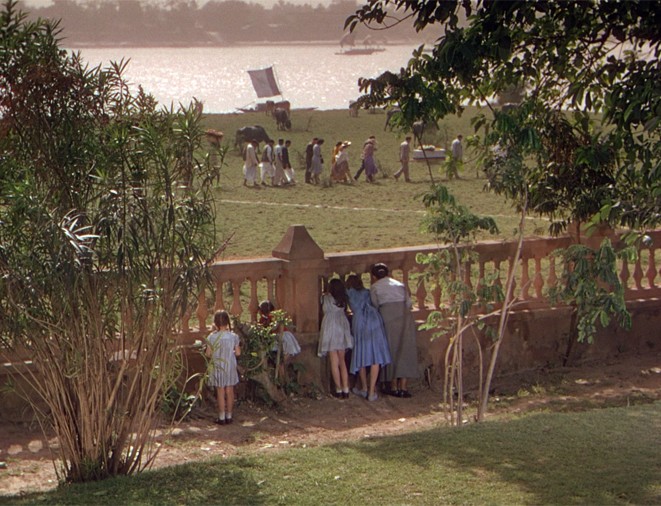
    The last scene of the film, perhaps reaches most towards this older conception of the Ganga, where, from the veranda of the house, Harriet looks over the garden wall towards the river, taking a moment to reflect on the cycles of life and death that take place on its banks.

  • ‘Cleo from 5 to 7’

    ‘Cleo from 5 to 7’

    Jay-Ger thinks about walking in cities and encountering symbols with Agnes Varda’s existential slice-of-life.

    I really enjoyed reading Al’s response to The Odyssey and would like to relate it back to some of the themes brought up in Tom’s review of Manhunter, if possible. In an elementally-lucid state of mind, Al asks: ‘If my Troy were to burn tomorrow, how much time would I have?’. It’s an interesting question, and reminds me of Tom writing about temporal suspension and the image of the sun. From my perspective, the things we love are experienced before we feel them in time (unless we happen to love time for its own sake, which leads to a bit of a different story). I think this means that there is an understanding of reality which is almost entirely spatial rather than temporal; in my own reflection on It’s Such a Beautiful Day, I danced around how that understanding might be contained in the objective beauty of everyday things. I’m sure Al, being a lover of architecture, is well-aware of the spatial experience of beautiful mundanities (which seems to me a fitting way to describe nice buildings). The thing is, when I walk around a city or a town, I feel like an alienated consumer of buildings rather than having anything to do with their creation; which may not be the case with Al.

    What does this have to do with Cleo from 5 to 7? Well, it’s stunningly obvious but worth mentioning that Agnes Varda’s classic of the French New Wave takes place in a beautiful environment: the natty pavements, apartment buildings, and parks of ‘60s Paris. That being said, I like that Varda doesn’t seemingly attempt to have Paris resemble Paris. While a different film might have used established symbols of the city (like the Eiffel Tower), to comment on the city from with-out, Varda’s interest seemingly tends towards how it appears to the everyday person within. The person we as the audience are invited to see from the perspective of is Florence, a young singer known professionally as ‘Cleo’. The film’s premise is that, in a twist of fate, Cleo is given reason to doubt she will be alive much longer. This means that the professional ‘taskscape’ (a word Tim Ingold came up with, which I loved as an archaeology student), has subjectively collapsed into a kind of bare and existentially meaningless landscape.

    There is something to be said about being in public here; the fact that the protagonist has a famous professional persona means that simply walking down the street for her is a kind of work. At the same time, Varda cleverly makes the space for it to be shown between-the-lines that being a young woman and being a celebrity are sometimes not too different. As Cleo walks the pavements, the verite camera glimpses how people around her react; particularly men who may see her as a symbol of desire. Looking in the mirror, Cleo says; ‘Ugliness is a kind of death. As long as I’m beautiful, I’m even more alive than the others’, showing the dialectical way in which she is both reacting to her surroundings and creating a personal space within it. However, from the hours of (roughly) 5 to 7, Cleo is left purposeless; temporal suspension ensues. Without a task and an associated taskscape, there is a melancholic sense of having lost the need to work, to perform, both as a celebrity and as a woman. This is difficult, but ultimately shown to be quite freeing for Cleo. She is left ‘Florence’, having lost her sense of beauty and glow; but at the same time in the existentially-mature position of being able to envisage different ways of ‘becoming a woman’, rather than being the woman she was, until time left the room.

    I think what’s so beautiful about Varda’s approach to this experience of subjective freedom is that she shows Cleo the possibility of growth in a more behind-the-scenes creative direction, but leaves the choice up to her, making for a strong sense of ambivalence when the movie ends. For me, there is a really sharp sense of mutual recognition and projective identification between the protagonist and their director. Varda and Cleo can be said to contain elements of each other; but my sense is it’s a case of ‘same but different’. In other words, Varda respects the choices Cleo has made in creating her persona, and also affirms her own sense of being otherwise; showing in the process different possible ways of becoming a woman. In my favourite Varda film (documentaries aside), One Sings, the Other Doesn’t, this dynamic of split feminine subjectivity and its reconciliation in universal responsibility is played out with less of the formal experimentation which characterised the nouvelle vague; but exploring that movie more is for another time.

    Let’s talk about archetypes. Cleo from 5 to 7 begins with a tarot reading, in which the protagonist interprets the cards as foretelling her death by cancer. The reader, in response to her anxiety, reassures considering the pivotal card; ‘This is not necessarily death; it means a complete transformation of your whole being’, a statement they both seem skeptical of. Nonetheless, Varda’s treatment of fate throughout the film is ambivalent; by the end the transformative interpretation seems more correct, but of course existentially-speaking the difference between transformation and death can be questioned. A theme of my first couple of essays was a consideration of the archetypal qualities in bizarre or everyday objects – from chocolate milk to Bill’s carpets. Part of what makes these things interesting to me is that they lack meaning in any established archetypal schema I’ve come across. Nonetheless, the fact that their meaning is open to interpretation can be universalised to established symbols. In the case of death, this adventurous approach allows for a questioning of whether death really means death, or something else; something Varda explores quite beautifully.

    I wonder, Tom, if you would say something similar about the sunset. The sun (also a tarot card), I would say is an ‘established symbol’ of profound happiness; something Varda also explores in her film Le Bonheur (‘Happiness’ being the title in English). Sunset can be understood as an associated symbol of happiness in the process of being lost, yet established in its own right. My question is this: do you find it more interesting when a symbol has a fixed or established meaning, and if so to what extent do you see the symbol of the sunset (for example) as truly experienced universally? Of course, I am going back to a couple of posts ago with the question, so happy for you to address it many posts in the future too!

    I think my personal feeling for the movie is primarily admiration for how wonderfully simple but effective it is. Sometimes I like to dress a little crazy, and in those moments I feel the streets are like catwalks more so than normal; it can be fun, and perhaps I do feel more alive. Like Cleo, I’m pretty comfortable with public attention, although as I’ve got older I find myself more interested in the background conditions of existence highlighted by Varda; in also illuminating, being-with, and understanding them. I also find walking, particularly in a city, to be remarkably consistent with mulling over these things. I think this is partly why I tend to blend my appearance in more than I used to; and also probably why I don’t dress as gender non-conforming as I feel – I value disappearing into a cityscape too much. I like the idea that there are some like me – and Cleo from 5 to 7, who are constantly thinking about death and meaning; anonymously roaming a landscape while others are floating on the thrill of the task – although I recognise, of course, that I am perceived as being involved in a taskscape too: I suppose time is never actually suspended.

    That being said, sometimes I do like to dress with contrast. I have this yellow raincoat I quite like on a grey and dreich day; for someone who is generally quite sympathetic towards bleakness, I quite enjoy playing the sun. Putting jokes about Scottish weather aside, perhaps this is because when something novel emerges out of the everyday, I quite like to playfully embody its opposite; staging a contradiction for others to make what they will out of, I’m not sure. Maybe this gimmick only works, if it does, since yellowness and raininess are symbolically-coded in relative contradiction; although that would mean they are established enough to make some kind of common sense out of. Anyway, I’ll leave it there before I start bringing out my whole wardrobe. Cleo from 5 to 7 is a movie which looks for, and perhaps finds, magic in the everyday; despite the seriousness of its subject matter and realist elements of style, to me it feels profoundly warm and sincere. The mirror Varda holds to Cleo (and vice-versa) is something of the camera-obscura variety, and this makes for a sense of encountering the surprisingness of reality as it is; that is, with the mystique contained inside.

  • ‘Punch-Drunk Love’

    ‘Punch-Drunk Love’

    In 2011 I stepped off a plane onto the tarmac of the world’s longest runway. At the time, it was said that NASA could land a space shuttle either in Houston or in Doha – the latter of which was to become the capital of my new home. I remember panicking as I hopped onto an airport bus, because the heat, though extreme, was nothing compared to the brightness of the sky. Everything was white. I was about to pass out, though I know that staring at that silly long runway helped to calm me down. I found out much later that the length came about from an error between converting between metric and imperial systems, like the matter of Napoleon’s height, I suppose. It was ridiculous really. Later still, I found that the memory of that day, the newness and the excitement of it all, is now tied inexplicably to a film I watched over a decade later.

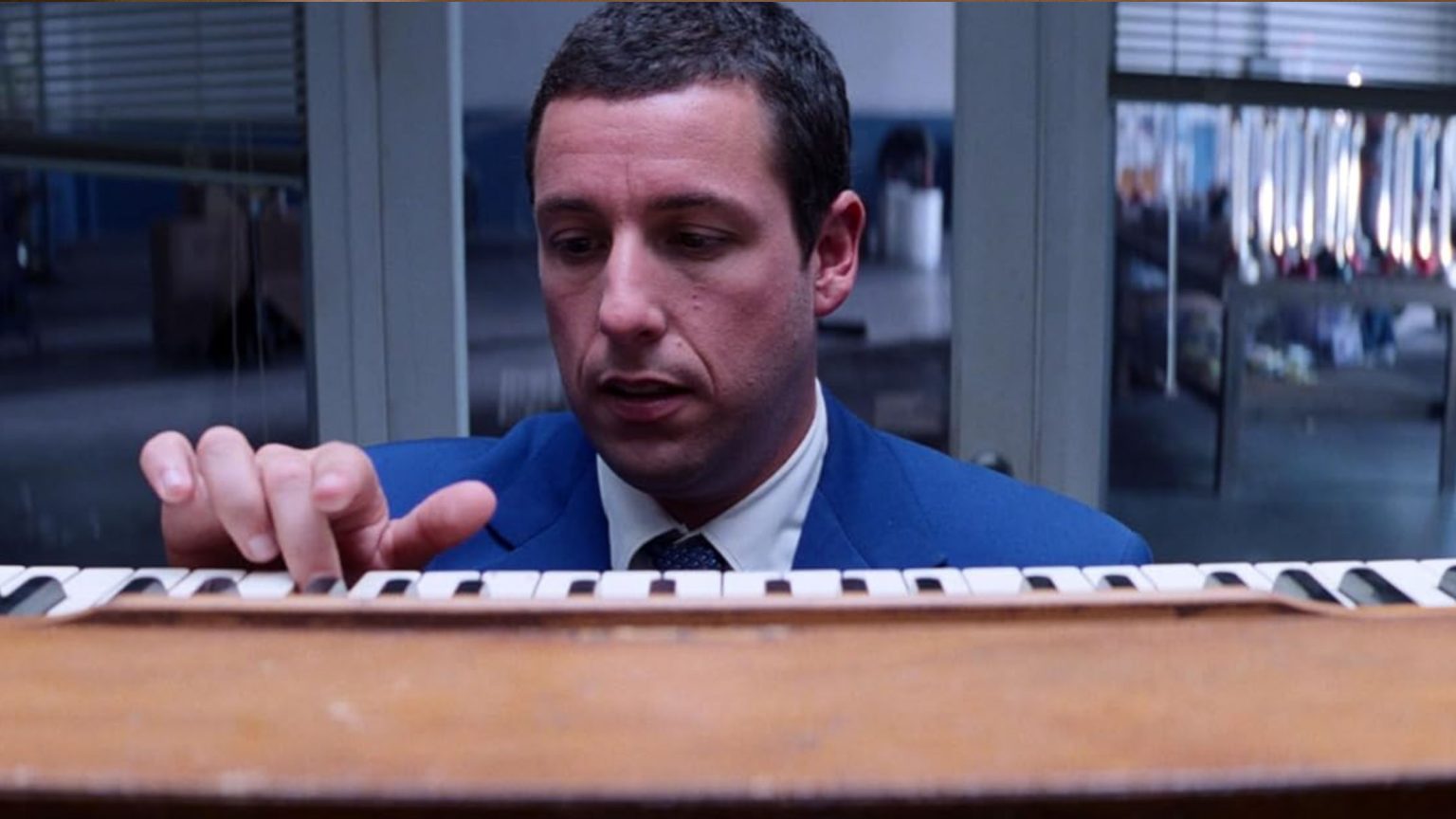
    Jay-Ger, in their most recent essay on Pariah and Show Me Love, asked me whether humanity is best expressed in music or people. I think we can find at least part of an answer via the harmonium. According to Jon Brion, the film’s composer, it is a misconception that the harmonium we see in the film was used to compose the OST. In fact, the only time we actually hear the harmonium being played is when Barry Egan (Adam Sandler) tentatively flirts with its keys. And yet, the wheezing, airy nature of the soundtrack still captures the pneumatic feel of the instrument and indeed the deeply anxious, sometimes hyperventilating character who interacts with it. Music in Punch-Drunk Love is an expression of what Barry holds inside of himself and, when placed together, they present a colourful reality brimming with possibility. I think in that sense, my cop-out answer is that both the character and the music serve the audience, both mirror the possibility of being something more, even if that potential has been there all along.

    When Jay-Ger and I first watched Punch-Drunk Love, I was gripped by the nervousness of its protagonist, the beauty of its colours, and, primarily, the brightness of its aspirations. This story looks to right wrongs and accept the fallibility we people must always contend with, and I felt, lying there on the sofa of our somewhat messy flat, that a movie had been made to settle the fears in ourselves – to remind us to breathe and laugh at our own ridiculousness. It remains one of my favourite movies because of this.

    Mark Kermode is aware of the meta-ridiculousness of the film, commenting that ‘when Paul Thomas Anderson said he was making Punch-Drunk Love everyone thought at first it was a joke, because he had just made Magnolia and somebody said, “what are you doing next”, and he said “I’m gonna make an Adam Sandler comedy”’. Tonally, this film does feel miles away from PTA’s other films. There is, for the most part, very little dialogue, and the film focuses on a single protagonist and doesn’t dare to look too deeply into the lives of others. Lena (Emily Watson), the main catalyst for Barry’s changing perception of himself, is left largely alone, often being presented largely as she is. Her affection and gentle words complete the other side to Barry’s coin. On the other hand, for Mattress Man (Philip Seymour Hoffman) we see that he has a furious temper and an air of overconfidence. If Barry and Lena are a coin, then Mattress Man is a credit card. Throughout his humorous and serious trials, when Barry finally confronts his rival, he has accepted himself and gained his confidence. He recognises his own capacity to love and finally allows himself to accept his mistakes and take pride in his pudding coupon success. Marching around this world, Barry often grips onto things to settle his nerves, yet the phone he holds and seemingly continues to hold from California to Utah is only released after this confrontation/realisation in the mattress shop. He goes to Lena after, to be honest, and to try and do better.

    When I got off that plane fifteen years ago, like poor Barry in Hawaii, it wasn’t a choice really – it was something that simply had to be done. And yet, despite any mistakes we make along the way, there is passion to be found in great change, in discomfort – love even. In Barry’s words: ‘I have so much strength in me you have no idea. I have a love in my life. It makes me stronger than anything you can imagine. I would say “that’s that”, Mattress Man’.