
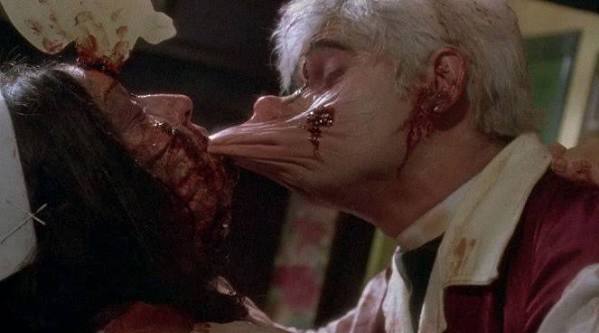
The purpose of this article, somewhat unlike the others we have done for What if Nobody’s Home?, is to pitch you a film: Peter Jackson’s crackpot Kiwi horror/comedy, Braindead.
Kiwi cinema, that is, films set in and produced in New Zealand, holds an immensely special place in my heart. My old English teacher – and father to my best friend, Allen was once an aspiring actor in the NZ scene, and as a teen, I remember my old man, who was ironically Allen’s best friend, tracking down a cult Kiwi film called Once Were Warriors. Allen’s cousin, Cliff Curtis, plays a criminal called Uncle Bully, the aptly named antagonist of the story. We watched the sequel, What Becomes of the Broken Hearted, and waited patiently to see the long locks of my younger English teacher. He pops up during a bar brawl, and I recall my young mind immediately elevating the status of this man to that of a cool uncle. Whether this view of Allen really changed is irrelevant. He was and always will be the best teacher I ever had.
It is interesting to me how a creative genealogy can be found within films. When held up to other artistic mediums, film is unique in that it features both an unseen and seen cohort of creators. For the seen, the actors, people with any interest can trace an actor’s history through their work. In certain cases, relationships between actors can be discovered, traced and expanded too. This pattern was true for how I viewed Allen and his cousin, and moving down this path led me to Training Day and The Piano at a fairly young age. However, the focus of this article is on the unseen, and that is not to say simply the director or producer, but the artistic visionaries who construct the worlds we love. In the case of fundamental NZ cinema, I see no two people of greater importance than Richard Taylor and Peter Jackson.

Thinking about Peter Jackson, if you see the world in a similar light to myself, may cause your heart to burn a little. It is hard for people in my generation not to think of the amazing Lord of the Rings trilogy, and the not-so-amazing Hobbit trilogy, without recalling the childhood awe which made these films so successful. LOTR will forever be synonymous with sofa days, snacks, memes, memories, music, idols, icons, intrigue – good and evil. But beyond this romantic and narrow view of Jackson’s filmography, you may find King Kong – the only film I have ever walked out of in pure terror – and the recent The Beatles: Get Back documentary. It may surprise you, however, to learn that Jackson started his career with low-budget, wacky comedy-horror films, and not with the adventure-epic genre for which he is known.
Finally, we arrive at Braindead. Before proceeding, I must thank my partner, Fern, for suggesting this barrel of laughs. Dating at a distance, it’s hard to find things to share and experience together. But I am grateful to Fern, and of course to Braindead, for making our distance date so enjoyable.

Setting the mush to one side, Braindead achieves that amazing balance between comedy and horror, which feels so rare in older films. I can think of the Evil Dead franchise, Gremlins and perhaps Shaun of the Dead as some of the few that come to mind. It feels like a sparse genre, historically, and yet the pleasure one can draw from it is immense.
The film follows the awkward mamas-boy Lionel Cosgrove (Timothy Balme) on a gory quest to get his first kiss – and deal with a growing horde of pustulating undead monsters. At every stage of the story, there is the threat of bombastic gore – everything from zombie babies in blenders to exploding heads and humping ghouls – coupled with the outrageous humour of quick dialogue, unexpected turns, and tropes played out to the maximum. It is outrageously funny, and if you think that the absolute pinnacle comes with the Kung Fu priest shouting ‘I kick ass for the lord’ before dropping into the most outrageous fight scene ever put to film – think again.

I wholeheartedly believe that this film could only ever have been made in New Zealand. It captures that distant but familiar humour Kiwis embody. The film does not take itself so seriously, and the joy with which it was made bleeds through with the abundant puss. It feels at once as large and as vast as those familiar landscapes we know from LOTR, while simultaneously appearing localised and intricate. I think that a huge part of this success is down to the work of Richard Taylor, one of Jackson’s longtime collaborators, who worked on the special effects of the film alongside Bob McCarron. Together they used over three hundred litres of fake blood and utilised miniatures to reconstruct the busy streets of old Wellington. In this way, the scenes with the urgent tram are like an ancestor to the streets of Gondor. It is here, in this connection, that we may find another, wider film genealogy, with connections to Blade Runner 2049, The Chronicles of Narnia, The Legend of Zorro, and more, all being discoverable under the umbrella of Taylor’s Weta Workshop. Importantly, however, Braindead is the precursor to all these fantastic worlds.
Watching Braindead was like finding a single root on a family tree – a source in which comedy and horror work together, in a small-budget Kiwi film, to create an actual timeless masterpiece. I laughed, I recalled, I recoiled, I gagged, and I giggled. This movie is a joy.

Leave a Reply