Category: Tom’s long journal

  • ‘Resident Evil’

    ‘Resident Evil’

    Tom questions the endings of recent horror films.

    Let me pre-empt this by saying I am a fan of both Zach Cregger’s work and video games more generally. On a scale of one to desperately contacting a priest, Cregger’s Barbarian falls somewhere far from one. It was freaky, it was fun, and yes, admittedly, I was a bit scared watching it. Many video games have affected me similarly, Dead Space in particular… however, my understanding of the terror associated with the Resident Evil games is much more limited. I have a vague recollection of playing Resident Evil 4 as a kid – a game often touted as one of the greatest in its genre – but really, I think my juvenility and, more importantly, the age of the game being played led to it feeling ultimately forgettable. Its polygonal form felt old and far removed from my modern gaming experience, and while Cregger’s Resident Evil certainly does not feel old, something does feel missing.

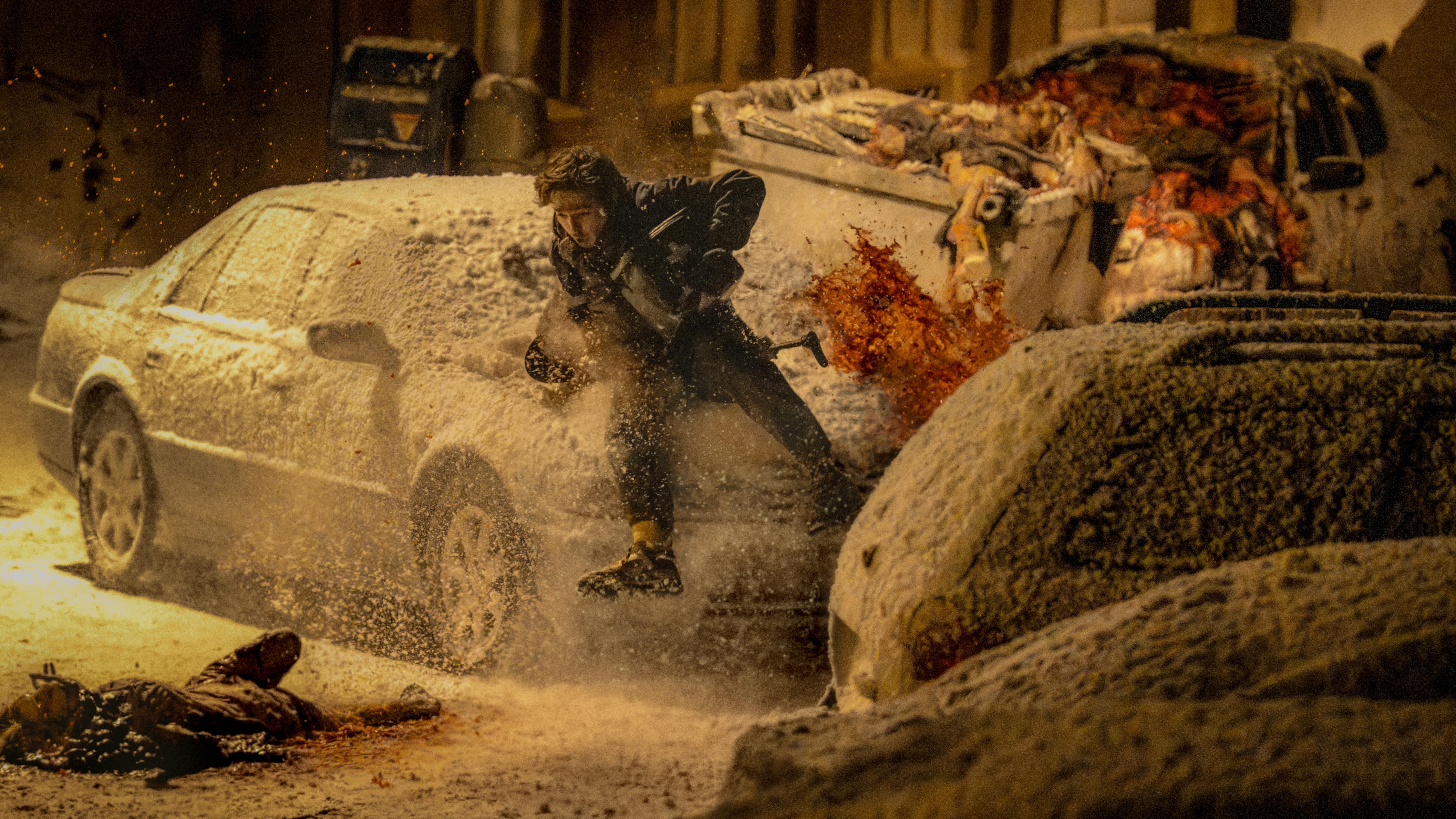
    One of the achievements of this film, like Weapons, is its balance between humour and horror. I’d bet that you’d be hard-pressed to find anyone who doesn’t at least smile while Bryan (Austin Abrams) is chased by the undead around an upturned police cruiser. The ‘Jumping Scene’ and Bryan’s brilliant reactions had me convulsing with giggles. These moments are, of course, hilarious and slapstick, but ultimately their tone characterises the nature of horror in 2026. It is finally fun again.

    I think it is fair to say the film community has been feeling exhausted by the horror genre. The likes of the Insidious or Conjuring franchises, which I didn’t even know were different, contribute to this feeling via weak jump scares and regurgitated characters. If you watch one, you have seen them all – think marvel for gore. I heard the critic Chris Ryan describe the state of horror on a recent podcast as just sad – these films are just overflowing with sadness. I think that horror has been lacking an awareness of its own effect, that is, to entertain through terror.

    Terror, to a gaming child with wotsit fingers and play-placid adults alike, is a sensation adjacent to humour – why do we so often laugh when we are scared? This is what Cregger does so well: he finds the humour in the terror and by embracing the two, a story becomes something that exists purely to be enjoyed. The reality of horror, whether supernatural or otherwise, is that it is often strange and bizarre, and Cregger’s films, like some other recent horror films, are showing an awareness of its effects. For example, there is something really funny about an undead woman chasing a squeaky young man around a car in the middle of nowhere.

    So, long pre-empt over, why did I not like this movie?

    Resident Evil is undeniably a fun watch and, despite any qualms viewers may have, it feels as close to a video game narrative as possible. The constantly changing weapons become increasingly ludicrous, the transitions between areas offer moments of reprieve akin to save points, and pivotally, our affection towards the central character only grows. For the side characters, save perhaps the unseen Michelle, we feel next to nothing, and simply want our character, who in a video game sense would be ourselves also, to succeed. Isn’t that a nice thought? That perhaps the success of this movie lies in our own relatability to the character? Well, where this film fails is in its inability to capitalise on this dynamic. More specifically, the film ends with prolonged and unsatisfying tragedy. Even more specifically, this film ends with the hint of future instalments – as if our investment in the character was simply the key to a whole bigger world, one coming to you soon via Sony Pictures, to suck dry everything that made this film fun. Call me a pessimist, but the last five minutes of this movie, and the threat of another horror franchise, frustrated me so much that it spoiled my entire understanding of the film.

    Now, comparison, as T.S. Eliot once said, is the chief tool of the critic, and so if we consider the other two biggest horror films of the year, Kane Parson’s creepypasta (what the hell does that even mean) Backrooms and Curry Barker’s Obsession, in conjunction with Resident Evil, we should be able to get to the bottom of this conundrum. And really, it is a conundrum, as all are certainly good films, but I only really ‘loved’ Obsession. They all play with conventions of horror and provide something refreshing for a franchise-tired genre. On the one hand, Backrooms looks at an interesting subject and utilises extreme ambiguity and, ultimately, the viewer’s imagination to conjure its sickly feel. On the other hand, Obsession modernises the monkey’s paw trope by framing it in the desires of a toxic young man, whose carelessness and ‘nice guy’ energy led to the deaths of all of his closest friends. And yet, for these two movies, only Backrooms felt like it had a ‘The Avengers will return’ style ending. With Obsession, its ending, like so many of the great horror classics, produces both a neat resolution and an indication of continuing horror for one or all of the characters. Resident Evil falls in the Backrooms camp.

    Now, maybe I just hate the whole zoom in thing at the end of Resident Evil – the most Marvel moment by far – but either way, this film really just lacks the satisfaction of an actual ending. It feels like an introduction and not a neat, nor complete story, and it left me rolling my eyes at the thought of another horror franchise – doomed to fall further and further into tired tropes and tawdriness. Comparatively, where Obsession succeeds, the other two fail: the ending is complete and does not feel like someone (or some corporation) tugging you in on a fishing hook.

    All said and done, I think Resident Evil is still worth seeing. It’s a fun ride and if, like me, you enjoyed the thrills of video games in your youth – it feels somehow nostalgic and new all at once. It certainly balances humour and horror too, but its ending, and the promise of another franchise, left me frustrated, sick and tired.
  • ‘Punch-Drunk Love’

    ‘Punch-Drunk Love’

    In 2011 I stepped off a plane onto the tarmac of the world’s longest runway. At the time, it was said that NASA could land a space shuttle either in Houston or in Doha – the latter of which was to become the capital of my new home. I remember panicking as I hopped onto an airport bus, because the heat, though extreme, was nothing compared to the brightness of the sky. Everything was white. I was about to pass out, though I know that staring at that silly long runway helped to calm me down. I found out much later that the length came about from an error between converting between metric and imperial systems, like the matter of Napoleon’s height, I suppose. It was ridiculous really. Later still, I found that the memory of that day, the newness and the excitement of it all, is now tied inexplicably to a film I watched over a decade later.

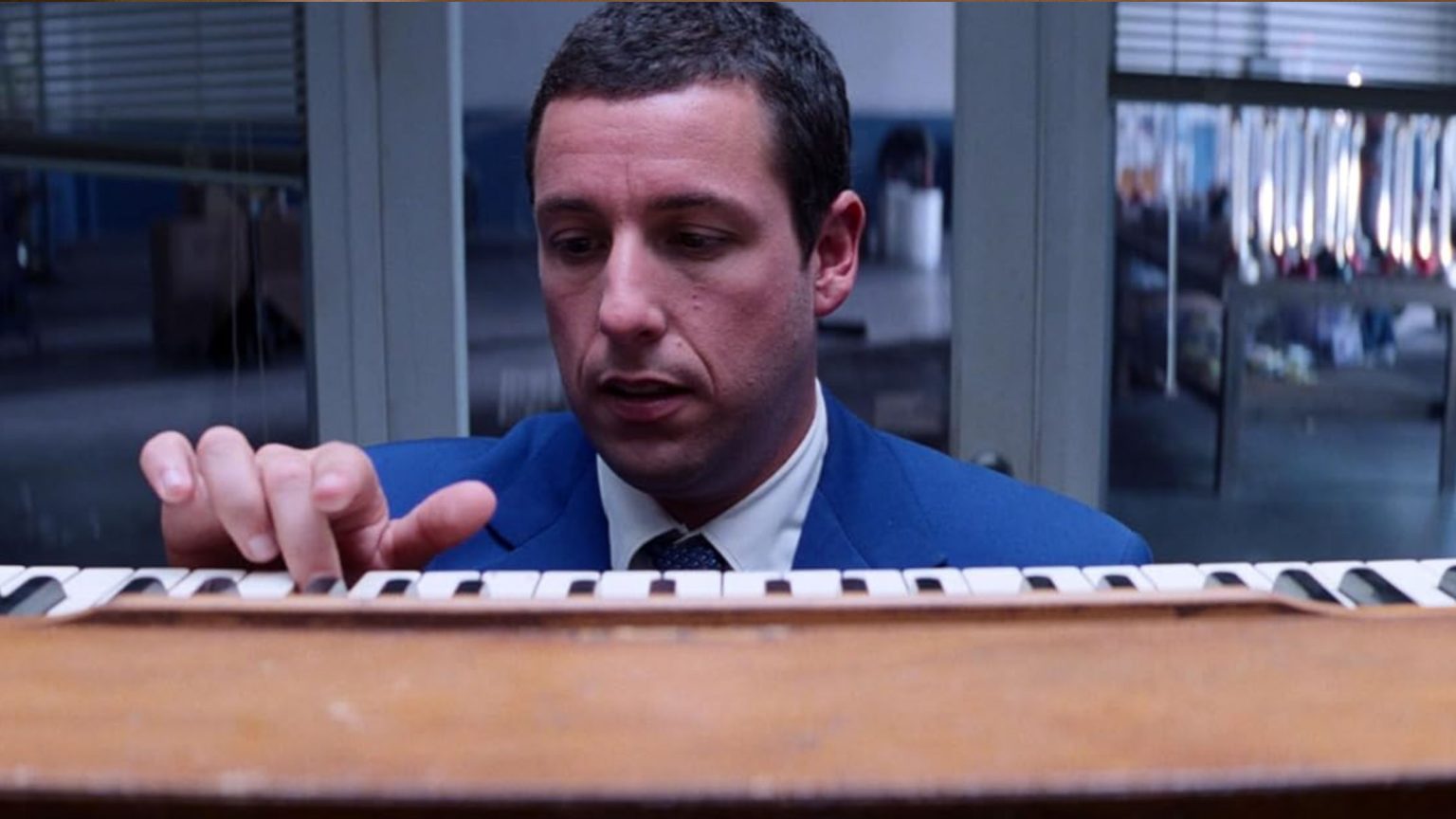
    Jay-Ger, in their most recent essay on Pariah and Show Me Love, asked me whether humanity is best expressed in music or people. I think we can find at least part of an answer via the harmonium. According to Jon Brion, the film’s composer, it is a misconception that the harmonium we see in the film was used to compose the OST. In fact, the only time we actually hear the harmonium being played is when Barry Egan (Adam Sandler) tentatively flirts with its keys. And yet, the wheezing, airy nature of the soundtrack still captures the pneumatic feel of the instrument and indeed the deeply anxious, sometimes hyperventilating character who interacts with it. Music in Punch-Drunk Love is an expression of what Barry holds inside of himself and, when placed together, they present a colourful reality brimming with possibility. I think in that sense, my cop-out answer is that both the character and the music serve the audience, both mirror the possibility of being something more, even if that potential has been there all along.

    When Jay-Ger and I first watched Punch-Drunk Love, I was gripped by the nervousness of its protagonist, the beauty of its colours, and, primarily, the brightness of its aspirations. This story looks to right wrongs and accept the fallibility we people must always contend with, and I felt, lying there on the sofa of our somewhat messy flat, that a movie had been made to settle the fears in ourselves – to remind us to breathe and laugh at our own ridiculousness. It remains one of my favourite movies because of this.

    Mark Kermode is aware of the meta-ridiculousness of the film, commenting that ‘when Paul Thomas Anderson said he was making Punch-Drunk Love everyone thought at first it was a joke, because he had just made Magnolia and somebody said, “what are you doing next”, and he said “I’m gonna make an Adam Sandler comedy”’. Tonally, this film does feel miles away from PTA’s other films. There is, for the most part, very little dialogue, and the film focuses on a single protagonist and doesn’t dare to look too deeply into the lives of others. Lena (Emily Watson), the main catalyst for Barry’s changing perception of himself, is left largely alone, often being presented largely as she is. Her affection and gentle words complete the other side to Barry’s coin. On the other hand, for Mattress Man (Philip Seymour Hoffman) we see that he has a furious temper and an air of overconfidence. If Barry and Lena are a coin, then Mattress Man is a credit card. Throughout his humorous and serious trials, when Barry finally confronts his rival, he has accepted himself and gained his confidence. He recognises his own capacity to love and finally allows himself to accept his mistakes and take pride in his pudding coupon success. Marching around this world, Barry often grips onto things to settle his nerves, yet the phone he holds and seemingly continues to hold from California to Utah is only released after this confrontation/realisation in the mattress shop. He goes to Lena after, to be honest, and to try and do better.

    When I got off that plane fifteen years ago, like poor Barry in Hawaii, it wasn’t a choice really – it was something that simply had to be done. And yet, despite any mistakes we make along the way, there is passion to be found in great change, in discomfort – love even. In Barry’s words: ‘I have so much strength in me you have no idea. I have a love in my life. It makes me stronger than anything you can imagine. I would say “that’s that”, Mattress Man’.

  • ‘Manhunter’

    ‘Manhunter’

    Tom thinks about sympathy and sunsets in ‘Manhunter’.

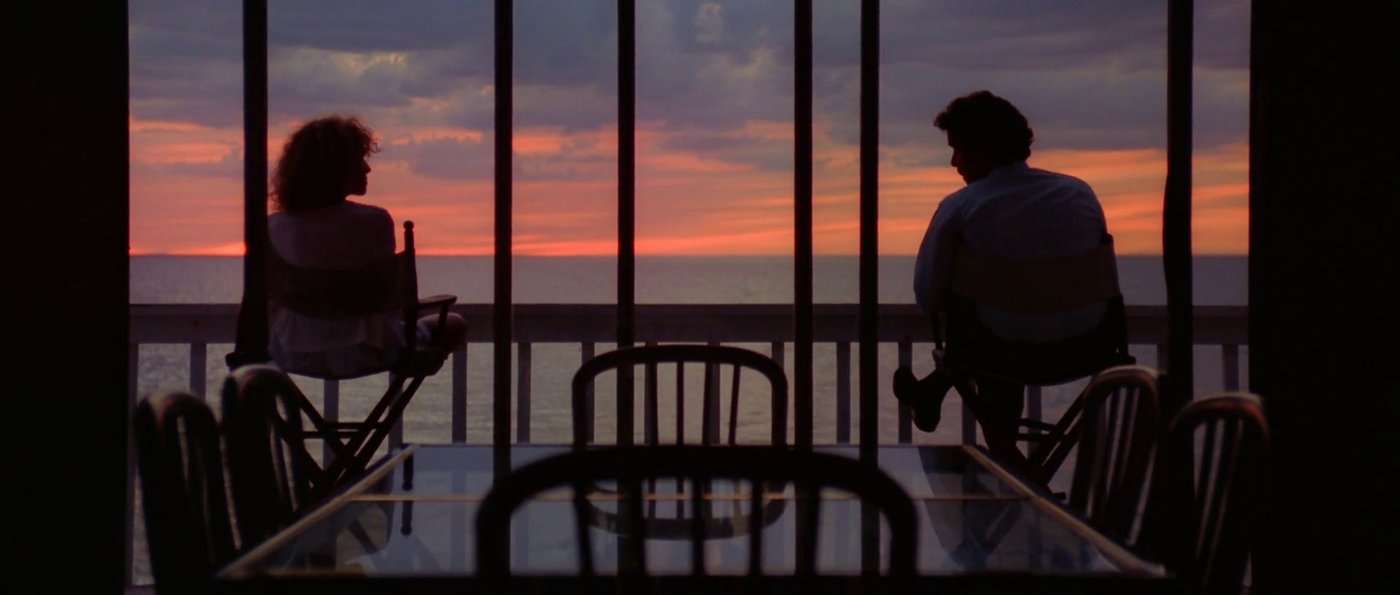
    The opening of ‘Manhunter’ is one drowning in nostalgia; a burning sun collapsing under the weight of a difficult proposition conjures a feeling familiar to many of us, and so, we begin in the in-between, at the crepuscular and fleeting bridge between light and dark; good and bad; clear and obscure. Although the view of a sinking sun is, arguably, a slightly cliché image for film, it remains universally emotive and distinctly natural, or distinctly human. The cinematographer, Dante Spinotti (a name destined for art), captures the sunset as an amalgamation between narrative expectation and spiritual empathetic (or perhaps sympathetic) sense. I love this scene because of what we expect to see and feel: a choice within a temporal suspension – as found in ‘Days of Heaven’ or ‘Paris, Texas’. And yet, Spinotti shows that time is certainly not suspended here. Within the first ten minutes we see and hear the dread of the opening attack, while the sun sinks further and further away. The plot too, like the closing day, moves quickly. We have met our protagonists on a clear bright beach and, when a decision is made, the sun sets. Darkness is the realm of this film. Pathetic fallacies are often found in the brooding teenager listening to their indie music on a rainy day, yet for Will Graham (William Petersen) the sun falls loudly away when his peace is broken. For most of us, the rain is a suitable pathetic fallacy – sadness, cold, blue and so on. For Will, it is the celestial, the spiritual, the passionate and, ultimately, the violent and destructive which fits his mould.

    The sun and its positioning form an interesting recurring motif, where the film is bookmarked by sunsets. By framing the narrative structure in this way, the ending creates a sense of ambiguity as the darkness of the credits rolls in. Will the night bring back more murder and ultraviolence? Is there another, impending horror for Will and his family to experience, or is it that the horror just continues, but without these characters experiencing it? Interestingly, or comparatively, the ending presents an earlier or younger sunset, not quite at its end – we do not get to see what follows it. Hence, could it be something as meta as the darkness of the credits, the rows and rows of cast and crew spread out like a casualty list in some horrible disaster? I think fans of the book will find joy in this final interpretation.

    At the focal point of the film, there is a notable inversion of the sunset, where the Tooth Fairy, Francis Dollarhyde (Tom Noonan), embraces Reba McClane (Joan Allen) at daybreak. This is, without a doubt, one of the more tender and heartfelt moments of the film – if such adjectives can be used to describe the core of such a violent story. Watching this scene, I felt an intense sense of sympathy for these two characters, where Reba’s physical blindness seems to mirror the spiritual blindness of Francis. In this moment of profound beauty and, in a slightly bizarre sense, intense passion, we are reminded that neither one can see the sun.

    I think that this is the moment I was drawn to most. When Jay-Ger and I thought about starting this project, I wanted us to focus on discussing the elements of film which most interest us. For Jay-Ger, particularly in his latest essay on ‘It’s Such a Beautiful Day’, his approach is rooted more in the interpretation of the medium – and all the various philosophical and artistic methods of interpretation which come with that. I think, or guess, that I am interested in the humanity in film. That’s not to say it’s about finding the humanity in film, but rather finding the mirror in film. Within all of us is the ability to empathise and the ability to sympathise with – or scorn – humanity. There is evil everywhere; there is good everywhere and, for me, I enjoy film because it often illuminates the crepuscular and murky in-between, and the people or characters who often inhabit these spaces.

    The genius of this film, if I’m being hyperbolic, lies within how the protagonist responds to the villain. For Will Graham, as indeed was the fashion in the early days of the FBI’s behavioural science unit, empathy, sympathy, etc. are all tools for understanding, predicting and capturing these “serial killers”. He is the embodiment of destructive empathy and represents an extreme example of the sheep in wolf’s clothing. For the killer, Will admits that he feels sympathy, but he is careful to note the paradoxical nature of his stance. He says to his superior, Jack Crawford (Dennis Farina), “My heart bleeds for him, as a child. Someone took a kid and manufactured a monster. At the same time, as an adult, he’s irredeemable. He butchers whole families to pursue trivial fantasies. As an adult, someone should blow the sick fuck out of his socks. Do you think that’s a contradiction?”

    I believe that this is, in some sense, a contradiction – if not a full-blown paradox. One could just as easily attach the ‘Killing Baby Hitler’ thought experiment to Will’s argument and enjoy the lengthy debates which will likely spawn. This, however, does not interest me. What interests me is how Will recognises that he must mirror evil to find it. Throughout the film we are led to believe that Will toes the line, that he is mere moments away from becoming the evil he is trying to prevent. Yet, the film never really commits to this bit, as, even as a psychological mirror to Francis, the actions or methods of the two deviate when it matters: there are organised and disorganised killers; the Tooth Fairy is the former. Will, in a moment of immense tension, seems to almost consider allowing the murder to go ahead, before literally jumping through the pane with which he watches, empathises and sympathises with the killer. This disorganised stunt detaches him from the mind of the murderer, who, terrifyingly, manages to draw out a shotgun, kill the lights and murder several police officers within moments. He was clearly prepared, while Will almost certainly was not. In these moments, Will is the still of a setting sun – frozen in the in-between and never quite ready to set fully.

    When we begin to understand the psychological dangers of Will’s pursuit, it is in a conversation with his son, Kevin (David Seaman). His son is probably not much older than an actual tooth-fairy believer when he ponders the dangers of his father’s profession. The scene is mundane, moving along the aisle of a store, and yet, for all the intensity of its other more famous scenes, this scene is the centre of Will’s narrative. On the one hand, we have Francis enjoying the blind passions under a burning sun; for Will, it is all reality – under the harsh lights of a shop. His son asks honest questions and receives honest answers; ultimately, after listening intently, he asks “What sort of coffee do you like?” It’s a beautiful question.

    I think I’ll end this with a question of my own, to my friend and colleague. Jay-Ger, the one thing I did not particularly enjoy about this film was the soundtrack… Is a soundtrack essential to a film?