In 2011 I stepped off a plane onto the tarmac of the world’s longest runway. At the time, it was said that NASA could land a space shuttle either in Houston or in Doha – the latter of which was to become the capital of my new home. I remember panicking as I hopped onto an airport bus, because the heat, though extreme, was nothing compared to the brightness of the sky. Everything was white. I was about to pass out, though I know that staring at that silly long runway helped to calm me down. I found out much later that the length came about from an error between converting between metric and imperial systems, like the matter of Napoleon’s height, I suppose. It was ridiculous really. Later still, I found that the memory of that day, the newness and the excitement of it all, is now tied inexplicably to a film I watched over a decade later.
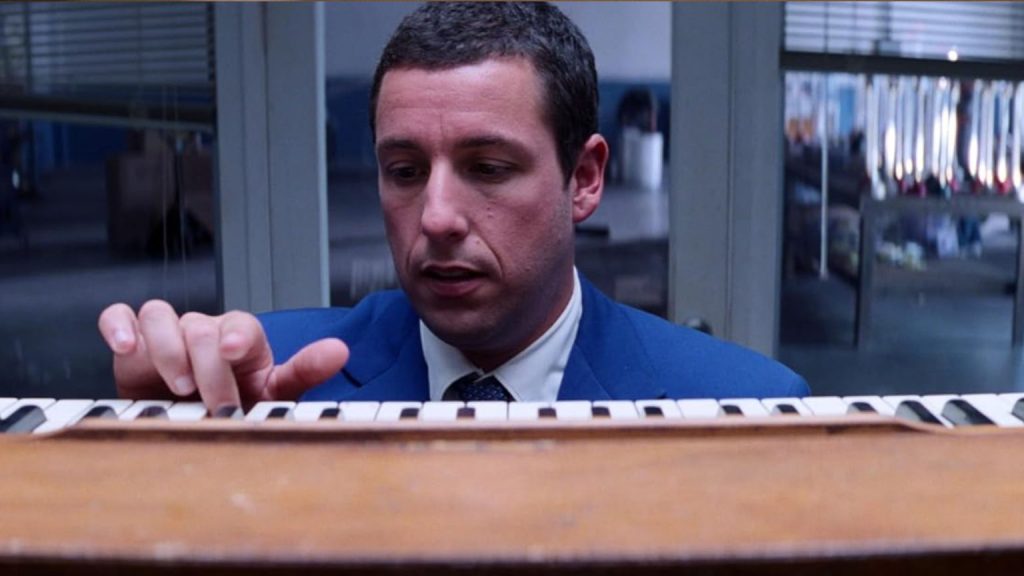
Jay-Ger, in their most recent essay on Pariah and Show Me Love, asked me whether humanity is best expressed in music or people. I think we can find at least part of an answer via the harmonium. According to Jon Brion, the film’s composer, it is a misconception that the harmonium we see in the film was used to compose the OST. In fact, the only time we actually hear the harmonium being played is when Barry Egan (Adam Sandler) tentatively flirts with its keys. And yet, the wheezing, airy nature of the soundtrack still captures the pneumatic feel of the instrument and indeed the deeply anxious, sometimes hyperventilating character who interacts with it. Music in Punch-Drunk Love is an expression of what Barry holds inside of himself and, when placed together, they present a colourful reality brimming with possibility. I think in that sense, my cop-out answer is that both the character and the music serve the audience, both mirror the possibility of being something more, even if that potential has been there all along.
When Jay-Ger and I first watched Punch-Drunk Love, I was gripped by the nervousness of its protagonist, the beauty of its colours, and, primarily, the brightness of its aspirations. This story looks to right wrongs and accept the fallibility we people must always contend with, and I felt, lying there on the sofa of our somewhat messy flat, that a movie had been made to settle the fears in ourselves – to remind us to breathe and laugh at our own ridiculousness. It remains one of my favourite movies because of this.
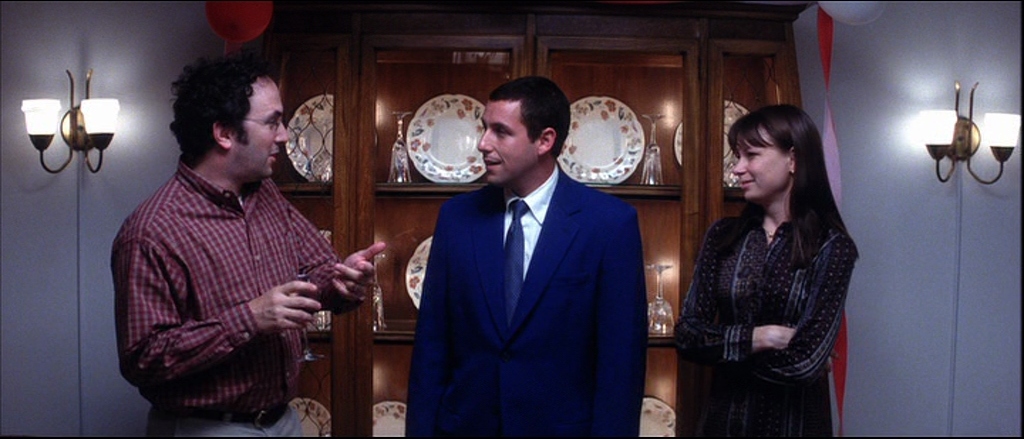
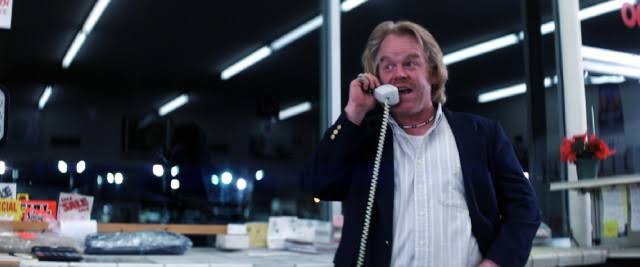
Mark Kermode is aware of the meta-ridiculousness of the film, commenting that ‘when Paul Thomas Anderson said he was making Punch-Drunk Love everyone thought at first it was a joke, because he had just made Magnolia and somebody said, “what are you doing next”, and he said “I’m gonna make an Adam Sandler comedy”’. Tonally, this film does feel miles away from PTA’s other films. There is, for the most part, very little dialogue, and the film focuses on a single protagonist and doesn’t dare to look too deeply into the lives of others. Lena (Emily Watson), the main catalyst for Barry’s changing perception of himself, is left largely alone, often being presented largely as she is. Her affection and gentle words complete the other side to Barry’s coin. On the other hand, for Mattress Man (Philip Seymour Hoffman) we see that he has a furious temper and an air of overconfidence. If Barry and Lena are a coin, then Mattress Man is a credit card. Throughout his humorous and serious trials, when Barry finally confronts his rival, he has accepted himself and gained his confidence. He recognises his own capacity to love and finally allows himself to accept his mistakes and take pride in his pudding coupon success. Marching around this world, Barry often grips onto things to settle his nerves, yet the phone he holds and seemingly continues to hold from California to Utah is only released after this confrontation/realisation in the mattress shop. He goes to Lena after, to be honest, and to try and do better.
When I got off that plane fifteen years ago, like poor Barry in Hawaii, it wasn’t a choice really – it was something that simply had to be done. And yet, despite any mistakes we make along the way, there is passion to be found in great change, in discomfort – love even. In Barry’s words: ‘I have so much strength in me you have no idea. I have a love in my life. It makes me stronger than anything you can imagine. I would say “that’s that”, Mattress Man’.
And I saw it coming, clouds bloodshot with the red
Of victory fires, the raw wound of that dawn
Igniting and erupting, bearing down
Like lava on a fleeing population.
From Seamus Heaney’s ‘Mycenae Lookout’.
~
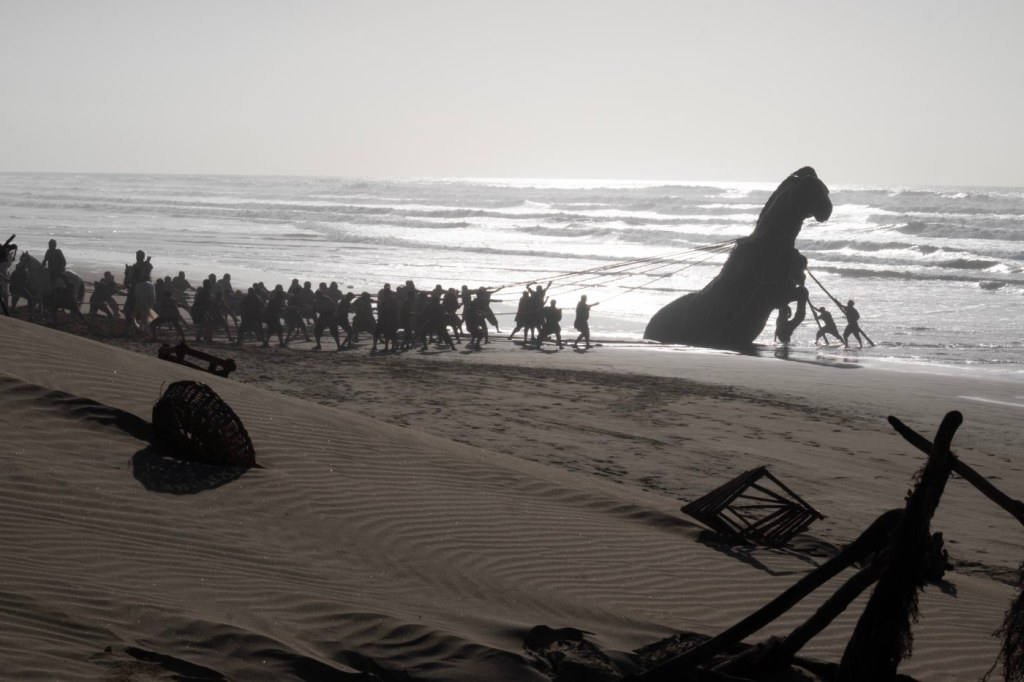
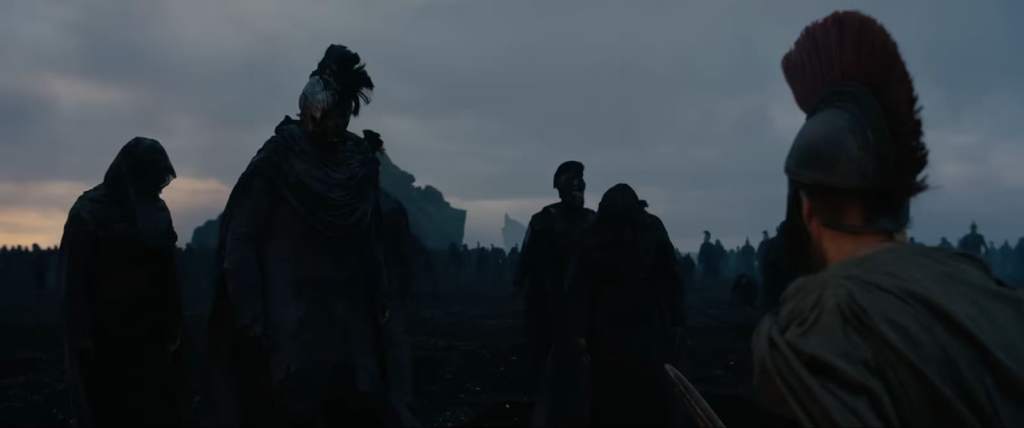
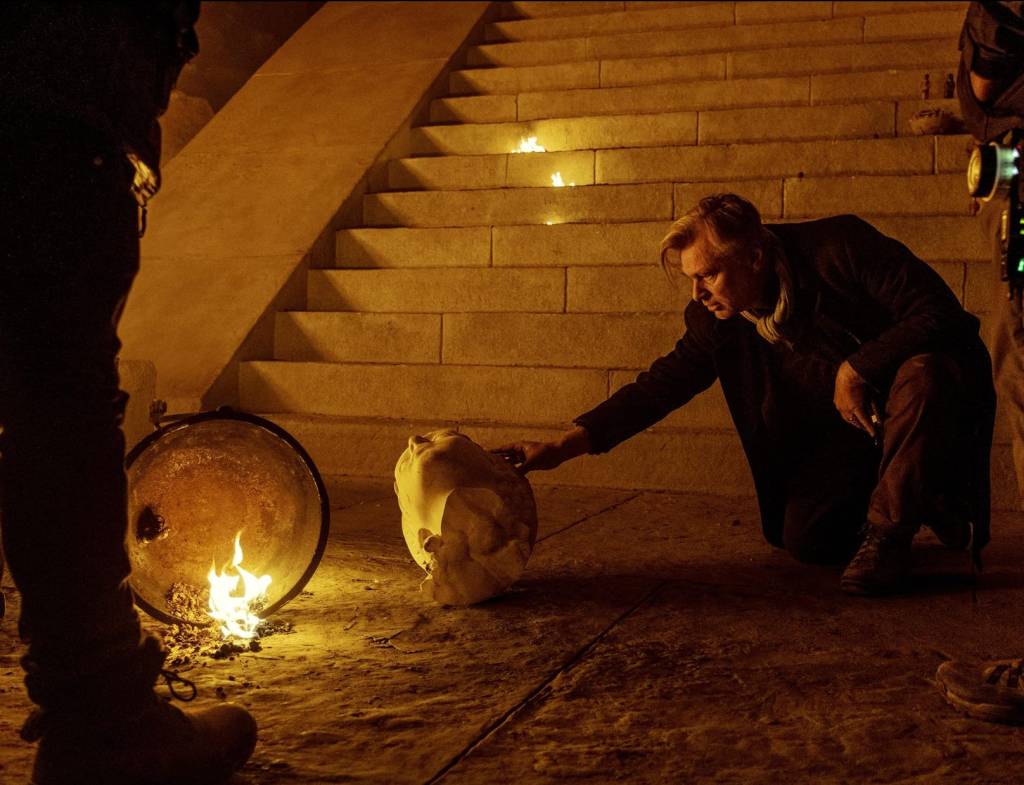
On waking after seeing ‘The Odyssey’, I ambled through to my kitchen and prepared a stovetop, checking that the gas had ignited before tending to last night’s dishes. Waiting for the water to warm, I wondered if the boiler used gas or was electric, and looked around, seeing candles dotted about and a diffuser fuelled by a tealight. Beyond the incandescent, I wondered about the materiality of the rug, sofa, and of the faux-linoleum flooring.
With reading John Vaillant’s ‘Fire Weather’ yesterday, before the film, I had watched Underwriters Laboratories’ 2009 experiment. It compares legacy furnishings – those not derived from petro-chemicals – with modern furnishings, and the speed with which a candle placed on the sofa in the respective rooms reached flashover, the point at which heated air in an enclosed area causes near spontaneous ignition across that space. If my Troy burnt tomorrow, how much time would I have?
In Adam Tooze’s podcast on ‘The Odyssey’, he talks about the Late Bronze Age Collapse, where between 1200s and mid 1100 BC, there was a civilisational shift away from the more centralised, palace cultures represented by the Achaeans and the Trojans in the poem, towards the fragmented social formations of the early Greek Iron age. Tooze’s materialist analysis frames Homer’s epic as looking back, not just at the disaster of the Trojan war, but at civilisations that were on the cusp.
Time moves in a peculiar way, but this is history: things unfolding gradually across the intersecting horizons of landscape and time until the moment when, with astonishing suddenness, they merge and the event is upon you. Ten years waiting outside the walls of Troy, before one terrible night. You wonder where all the time has gone, when in fact it hasn’t gone anywhere, it is the events within it that appear to amplify in speed and scale – because they now include you. Factors attributed to the Late Bronze Age Collapse include climate change, earthquakes and internal unrest, events which can remain an abstraction, yet when they are upon you, time and circumstance achieve a kind of singularity and, suddenly nothing else exists; its immediacy – its presence – is overwhelming.
Jay-Ger considers a couple of takes on the bildungsroman, along with poetic and punk ways of being.
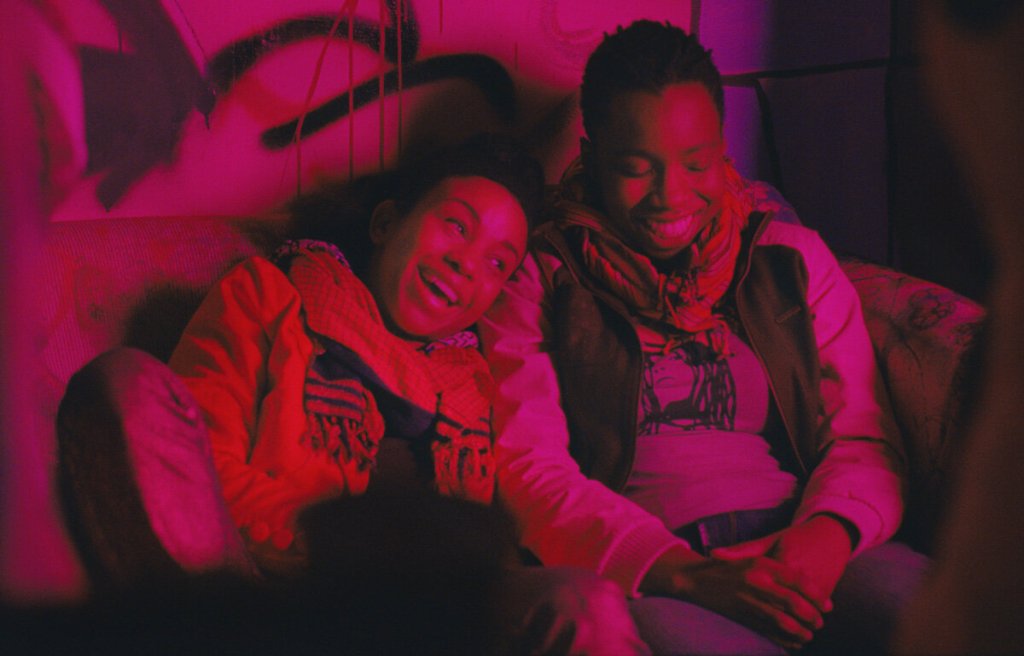
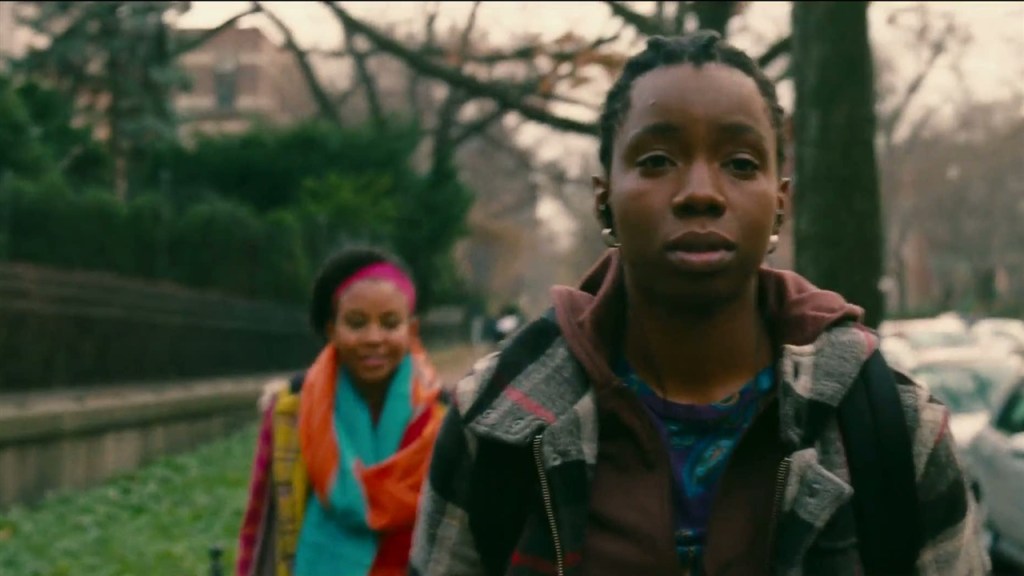
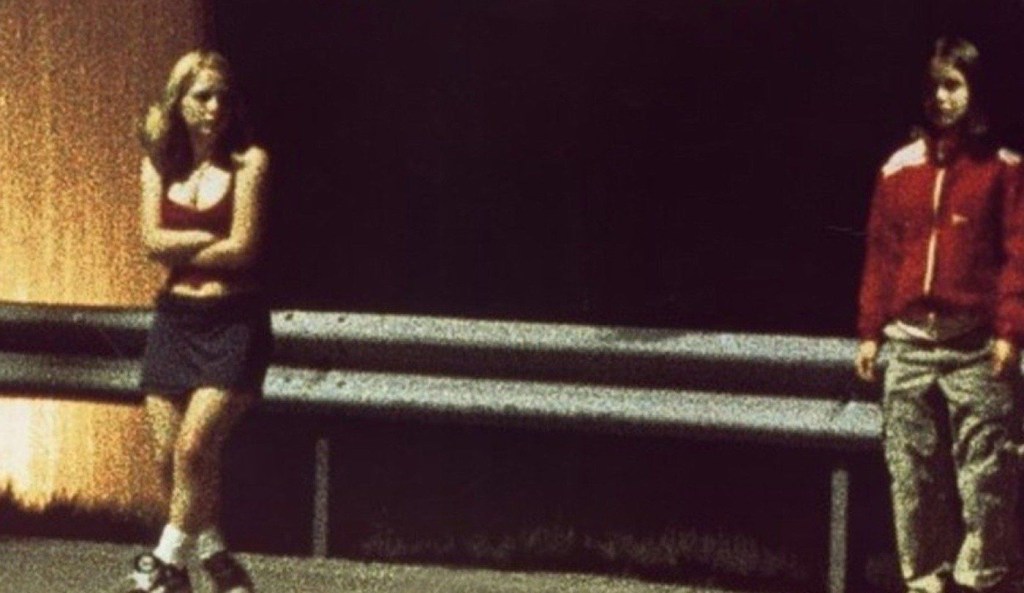
Following my last essay, I thought I would indulge in memories of teenagehood in a slightly different way; a couple of versions of bildungsroman. ‘Pariah’, directed by Dee Rees, centres around seventeen year-old Alike, growing up in inner-city Brooklyn. It has a social realist tone with slight poetic flourishes, such as the soundtrack and Alike’s own spoken-word pieces; similar films might include ‘Moonlight’ and ‘Fish Tank’. In contrast, Lukas Moodysson’s ‘Show Me Love’ is somewhat more tonally punk, capturing the more ferocious energy and village angst of the slightly younger Elin and Agnes. While both contain coming-of-age and coming-out, in ‘Show Me Love’ the characters seem to break through a certain barrier; meanwhile for Alike the breaking is ontologically posited – the closing poem contains the repeated lines: “I am broken, I am open”, following, “See the love shine through my cracks? See the light shine out through me?”. Alike (and the film’s) sensitivity towards words is perhaps what makes it unique; the associated movie posters, for example, tend to display its title as broken too, into syllables. Meanwhile, Moodysson’s film is arguably more sensitive towards music; or at least the relatively fast-paced rhythms of yearned-for city life. I was initially thinking of just writing about ‘Pariah’, being one of the movies I associate most with purple, but after reading Tom’s writing about ‘Manhunter’ I thought including the Swedish film would make a nice comparison piece.
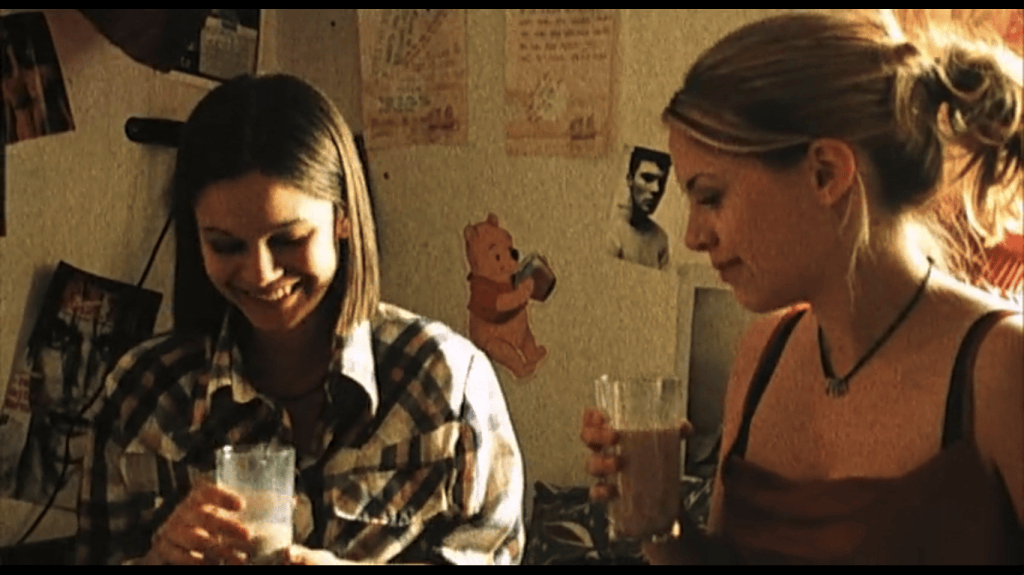
‘Show Me Love’ ends in quite a light way for a movie which grapples with some serious themes (somewhat like ‘Manhunter’), almost coming off as a rom-com by the end. After clumsily but quite beautifully coming out to their whole school, Elin and Agnes have a mundane kind of conversation about chocolate milk. I love this scene because while the film could have ended in a more “happily ever after” sort of way, the conversation glimpses a kind of everyday curiosity and being-with this likely entails; what you (Tom) said about ‘Manhunter’ reminded me of that, even if it wasn’t the intention. So… I’ll play with your question!
The short and boring answer is obviously that I think the way in which a film’s soundtrack matters is context dependent. At least, soundtracks often allow a glimpse into subjective feeling. This seems quite clearly the case in ‘Show Me Love’, where the consistent punk represents a kind of existential angst and rebellion against the apparent constraints of peripheral village life (the Swedish title, “Fucking Amal” – Amal being the village, captures this better than the English one). The love shared by Elin and Agnes is very much intermixed with this feeling – assuming as I do that the film’s main “subject” is the couple and emotional bonds between them rather than either of the girls individually. On the other hand, I think the soundtrack in Rees’ film is less important, partly because the subjective feeling of the film is expressed more genuinely in Alike’s poetry. A lot of the music in ‘Pariah’ is non-digetic, capturing something about her environment, meanwhile the relative silence of the mise-en-scence in ‘Show Me Love’ tells its own story; the social realist tone of ‘Pariah’ reflects a sense of absence that Alike assumingly positions as the melancholic core from which she creates poetry: in this case a lack of music resonates with subjective feeling.
Funnily enough, the major element I left out of my reflection on ‘It’s Such a Beautiful Day’ was indeed the soundtrack, which is quite powerful – mostly containing sweeping romantic-classical compositions from Bedrich Smetana to Georges Bizet, with the occasional Celtic folk piece. I think, in a strange way, these pieces may also be best understood as related to subjective feeling; although there is a sense of harmonice mundi in Hertzfeldt’s movie which is not quite so present in Rees’ or Moodysson’s. My sense is that I don’t need to enjoy a soundtrack to enjoy a movie; but that’s also entangled with the extent to which the film’s meaning is centred around music – or, perhaps even more radically, the film is musical in form.
One of my favourite examples of this latter kind of movie are the early films of Gregg Araki, particularly the “Teenage Apocalypse” trilogy; which at one point I decided to think of as “ontological shoegaze”. In, for example, ‘Nowhere’, there is a kind of absurd or dream logic which does not suggest a human subject to me (as with ‘It’s Such a Beautiful Day’), but rather a kind of big, monstrous, surreal, queer, and indeed soft and pillowy being. I was not sure what to call this entity, but it gave me the same sense as shoegaze so I decided the subjective logic of the movie was connectable through this kind of feeling; called the resultant imagined object “ontological shoegaze” (ridiculously), and decided to move on. In this case, quite literally, I cannot understand the film without its associated music; and the more shoegaze is played throughout, the easier it becomes for me to make sense of and immediately enjoy. Here, it is even possible that subjective feeling isn’t even important: there is something which “goes beyond” that – with shoegaze pretty much being a hyperobject in Timothy Morton’s sense; at least in relation to the film.
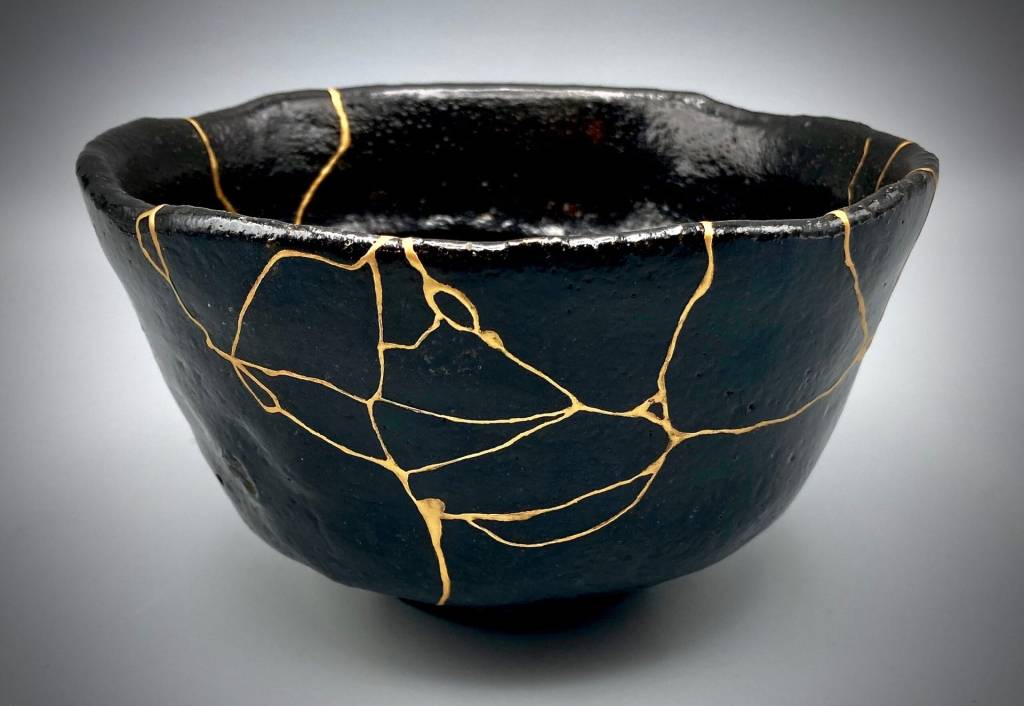
I’ll insert my own questions for you (Tom) at this point. Do you find the mirror more usually in a film’s music, or its characters? Also, do you think humanity is best expressed in music or people? In the meantime, let’s return to the themes of brokenness and openness. For Melanie Klein, maturity often involves acceptance of the self as it really is. People live in a state of attachment to loved ones, and how they act towards them changes what their loved ones mean to them; in this sense action creates cracks of meaning which it’s the self’s responsibility to resolve or repair. I like to think of the self, in this model, as analogous to a teacup in the Japanese art of kintsugi – perfectly-imperfect, composed of cracks yet being a complete object. From a subject-oriented perspective, the light of love shines out from within; through the cracks much like Alike describes. Openness to action and in this sense new bonds of love are preconditioned by brokenness; for Klein therefore, guilt toward one’s brokenness is among the fundamentals.
At the same time, Alike’s sense of existential responsibility for her parent’s traumas and prejudice – motivating her to leave her “fish bowl” surroundings and take a new perspective on it, are psychodynamically very moving. Often, reparation in a Kleinian sense is not only a lifelong commitment but must be projected past one’s own being. For Alike, art and particularly poetry allow for this long-term projective identification. It’s moving to me because it glimpses what Klein calls the depressive position, which for her is a sign of maturity; immaturity involves “manic reparation”, where the subject attempts to resolve their relationships too quickly – Alike’s commitment to the art life seems congruent with what for her is an appropriate rhythm of the reparative process. It’s worth saying that, for Klein, people tend to fall out of the depressive position throughout life and thus are motivated to work back to it. Along these lines, I am slightly suspicious of coming-of-age as a genre: since it seems too often to focus on the transition from teenage to adult years. That being said, the psychodynamics involved in both ‘Pariah’ and ‘Show Me Love’ feel quite real to me.
This is partly why I adore the ending of ‘Show Me Love’, as to me it implies the reconciliation of Elin and Agnes with Amal – their small-town environment. There is no punk apparent; in fact the following credits are paired with a much more “girly” pop track. In my reading, punk allows the girls to connect with a sense of being responsible in breaking or destruction. If both Elin and Agnes are like kintsugi teacups, their light shines through the cracks and attaches to punk as a loved object; this shared love is arguably fundamental to the girl’s relationship. Nonetheless, as a punk track plays over their coming-out scene, we transition into the aforementioned scene of everyday life. What is the meaning of choccy milk? Perhaps, here, it can be said that shared love of choccy milk has the potential to form a new basis of relationality between the girls. Punk, in this sense, is for them what Jacques Lacan calls the “passage to the act” – a medium for which the process of reparation can be completed and a new bond of love formed. The final scene is noteworthy for its sense of accomplishment but also ambivalence and ambiguity. There is no real guarantee that Elin and Agnes will find a new shared thing to love. Realistically, chocolate milk stands for the potential of anything in particular to provide this basis; meaning it is probably my favourite kind of object, that of a kind of unrecognised potential. For a moment, the girls see punk as it is (or was), to them. Because of its role as a passage to the act, I think ‘Show Me Love’ also becomes much less enjoyable without its propulsive soundtrack.
I’ll wrap up with an unfortunately abridged version of personal reflections because, again, I’ve droned on too long. There are aspects of all three – Alike, Elin, and Agnes – which I see parts of myself in. When it comes to Elin and Agnes, I relate to the feeling of wanting to leave my small town environment and finding music as a kind of imaginative way to do that (temporarily). My memory of those years strikes me as slightly more along the lines of Alike’s though, and my instinct is that ‘Pariah’ is a marginally better film. It’s a sad film, because ultimately I think it’s largely grappling with multifaceted intergenerational trauma; but it does so in a way which feels honest, mature, and patient. These aspects of myself are somewhat buried in characters like Alike, Elin, and Agnes (overlapping with queer characters more generally); and, honestly, I’m kind of okay with that – the past is the past, even if it’s good to take out and look at every now and then.
The signifier “teenage pariah” can do a lot of work to contain these; and I suppose writing this has helped me realise why I often describe myself that way. Both films are a little under the radar, but in my view are worth a watch. They handle bildungsroman well in their respective ways, showing the variation of rhythms and trajectories we are on in this life. Music (or lack of it), plays an important role in creating a synchronous emotional landscape; although I think both movies make sense without it. For Elin and Agnes, punk style, attitude, and more are accentuated by the soundtrack; but my sense is they would still go down the passage if it were slightly differently shaped. For Alike, there seems to be a need to focus on words; perhaps with the more obviously rhythmic aspects of existence becoming significant later in life. For me, music can often carry a film; however, in most instances its elements could also have been held otherwise.
Tom thinks about sympathy and sunsets in ‘Manhunter’.
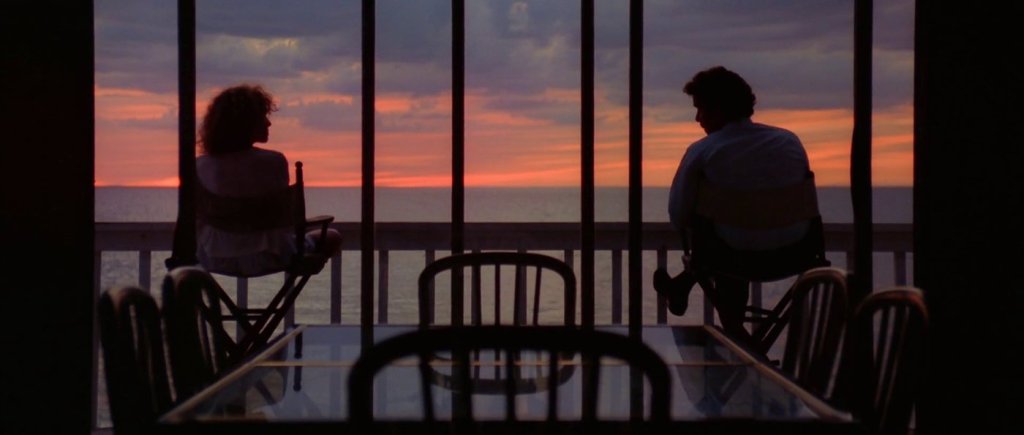
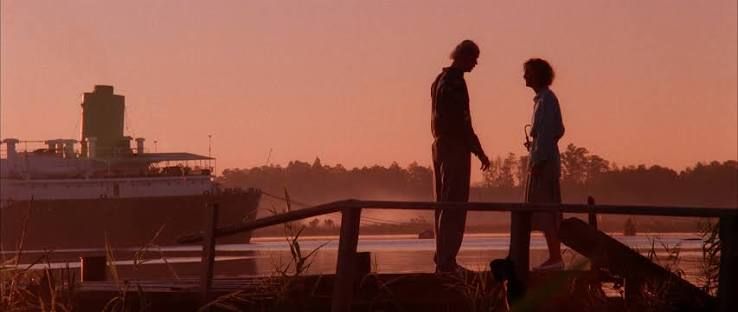
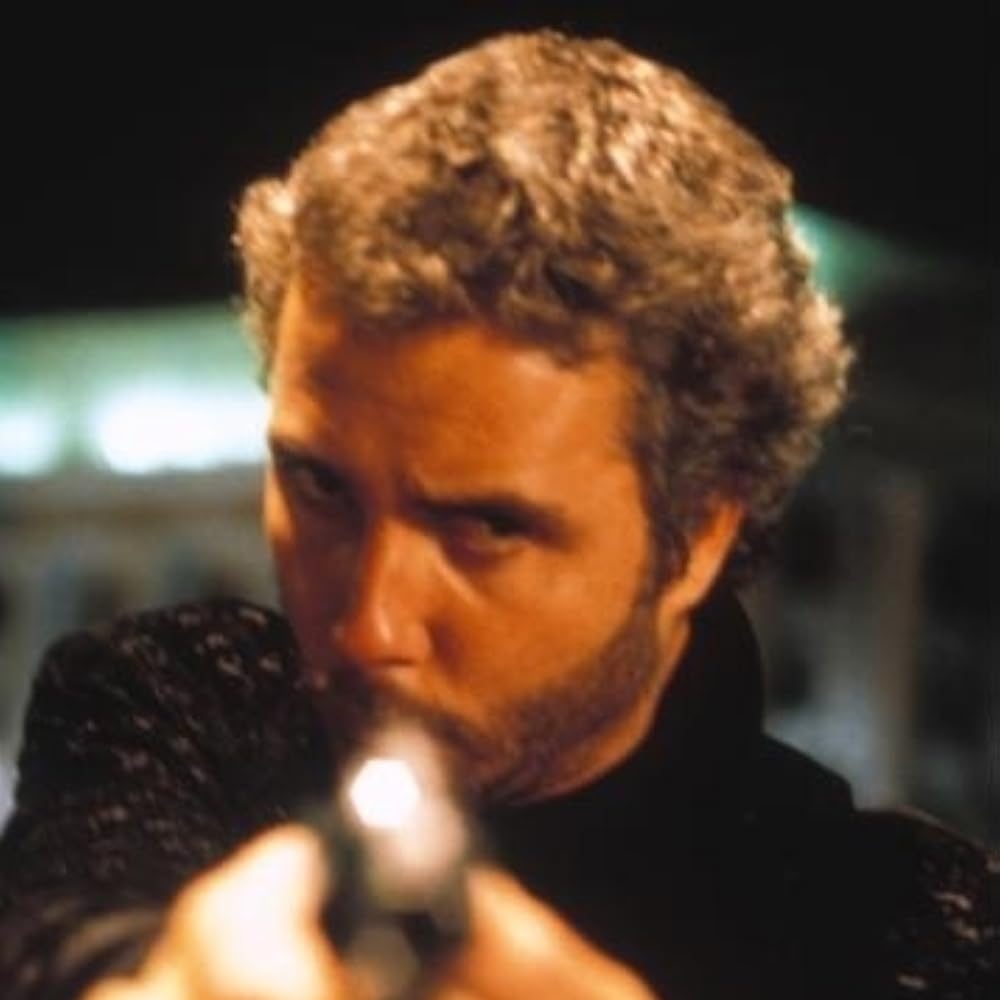
The opening of ‘Manhunter’ is one drowning in nostalgia; a burning sun collapsing under the weight of a difficult proposition conjures a feeling familiar to many of us, and so, we begin in the in-between, at the crepuscular and fleeting bridge between light and dark; good and bad; clear and obscure. Although the view of a sinking sun is, arguably, a slightly cliché image for film, it remains universally emotive and distinctly natural, or distinctly human. The cinematographer, Dante Spinotti (a name destined for art), captures the sunset as an amalgamation between narrative expectation and spiritual empathetic (or perhaps sympathetic) sense. I love this scene because of what we expect to see and feel: a choice within a temporal suspension – as found in ‘Days of Heaven’ or ‘Paris, Texas’. And yet, Spinotti shows that time is certainly not suspended here. Within the first ten minutes we see and hear the dread of the opening attack, while the sun sinks further and further away. The plot too, like the closing day, moves quickly. We have met our protagonists on a clear bright beach and, when a decision is made, the sun sets. Darkness is the realm of this film. Pathetic fallacies are often found in the brooding teenager listening to their indie music on a rainy day, yet for Will Graham (William Petersen) the sun falls loudly away when his peace is broken. For most of us, the rain is a suitable pathetic fallacy – sadness, cold, blue and so on. For Will, it is the celestial, the spiritual, the passionate and, ultimately, the violent and destructive which fits his mould.
The sun and its positioning form an interesting recurring motif, where the film is bookmarked by sunsets. By framing the narrative structure in this way, the ending creates a sense of ambiguity as the darkness of the credits rolls in. Will the night bring back more murder and ultraviolence? Is there another, impending horror for Will and his family to experience, or is it that the horror just continues, but without these characters experiencing it? Interestingly, or comparatively, the ending presents an earlier or younger sunset, not quite at its end – we do not get to see what follows it. Hence, could it be something as meta as the darkness of the credits, the rows and rows of cast and crew spread out like a casualty list in some horrible disaster? I think fans of the book will find joy in this final interpretation.
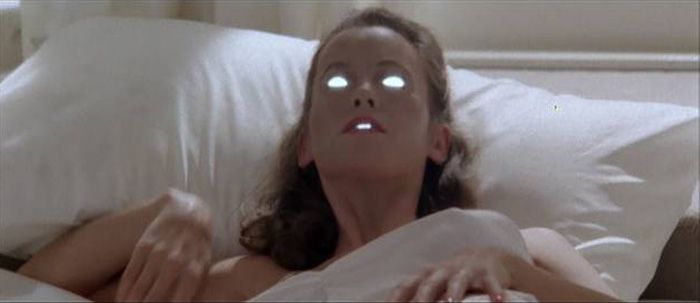
At the focal point of the film, there is a notable inversion of the sunset, where the Tooth Fairy, Francis Dollarhyde (Tom Noonan), embraces Reba McClane (Joan Allen) at daybreak. This is, without a doubt, one of the more tender and heartfelt moments of the film – if such adjectives can be used to describe the core of such a violent story. Watching this scene, I felt an intense sense of sympathy for these two characters, where Reba’s physical blindness seems to mirror the spiritual blindness of Francis. In this moment of profound beauty and, in a slightly bizarre sense, intense passion, we are reminded that neither one can see the sun.
I think that this is the moment I was drawn to most. When Jay-Ger and I thought about starting this project, I wanted us to focus on discussing the elements of film which most interest us. For Jay-Ger, particularly in his latest essay on ‘It’s Such a Beautiful Day’, his approach is rooted more in the interpretation of the medium – and all the various philosophical and artistic methods of interpretation which come with that. I think, or guess, that I am interested in the humanity in film. That’s not to say it’s about finding the humanity in film, but rather finding the mirror in film. Within all of us is the ability to empathise and the ability to sympathise with – or scorn – humanity. There is evil everywhere; there is good everywhere and, for me, I enjoy film because it often illuminates the crepuscular and murky in-between, and the people or characters who often inhabit these spaces.
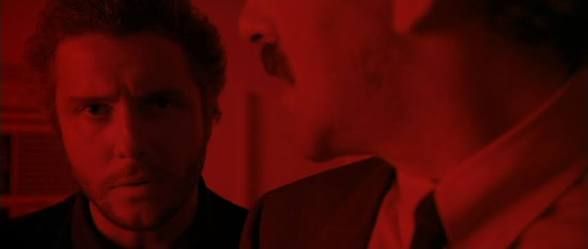
The genius of this film, if I’m being hyperbolic, lies within how the protagonist responds to the villain. For Will Graham, as indeed was the fashion in the early days of the FBI’s behavioural science unit, empathy, sympathy, etc. are all tools for understanding, predicting and capturing these “serial killers”. He is the embodiment of destructive empathy and represents an extreme example of the sheep in wolf’s clothing. For the killer, Will admits that he feels sympathy, but he is careful to note the paradoxical nature of his stance. He says to his superior, Jack Crawford (Dennis Farina), “My heart bleeds for him, as a child. Someone took a kid and manufactured a monster. At the same time, as an adult, he’s irredeemable. He butchers whole families to pursue trivial fantasies. As an adult, someone should blow the sick fuck out of his socks. Do you think that’s a contradiction?”
I believe that this is, in some sense, a contradiction – if not a full-blown paradox. One could just as easily attach the ‘Killing Baby Hitler’ thought experiment to Will’s argument and enjoy the lengthy debates which will likely spawn. This, however, does not interest me. What interests me is how Will recognises that he must mirror evil to find it. Throughout the film we are led to believe that Will toes the line, that he is mere moments away from becoming the evil he is trying to prevent. Yet, the film never really commits to this bit, as, even as a psychological mirror to Francis, the actions or methods of the two deviate when it matters: there are organised and disorganised killers; the Tooth Fairy is the former. Will, in a moment of immense tension, seems to almost consider allowing the murder to go ahead, before literally jumping through the pane with which he watches, empathises and sympathises with the killer. This disorganised stunt detaches him from the mind of the murderer, who, terrifyingly, manages to draw out a shotgun, kill the lights and murder several police officers within moments. He was clearly prepared, while Will almost certainly was not. In these moments, Will is the still of a setting sun – frozen in the in-between and never quite ready to set fully.
When we begin to understand the psychological dangers of Will’s pursuit, it is in a conversation with his son, Kevin (David Seaman). His son is probably not much older than an actual tooth-fairy believer when he ponders the dangers of his father’s profession. The scene is mundane, moving along the aisle of a store, and yet, for all the intensity of its other more famous scenes, this scene is the centre of Will’s narrative. On the one hand, we have Francis enjoying the blind passions under a burning sun; for Will, it is all reality – under the harsh lights of a shop. His son asks honest questions and receives honest answers; ultimately, after listening intently, he asks “What sort of coffee do you like?” It’s a beautiful question.
I think I’ll end this with a question of my own, to my friend and colleague. Jay-Ger, the one thing I did not particularly enjoy about this film was the soundtrack… Is a soundtrack essential to a film?
Jay-Ger reflects on their favourite film, and beginning ‘What If Nobody’s Home?’.
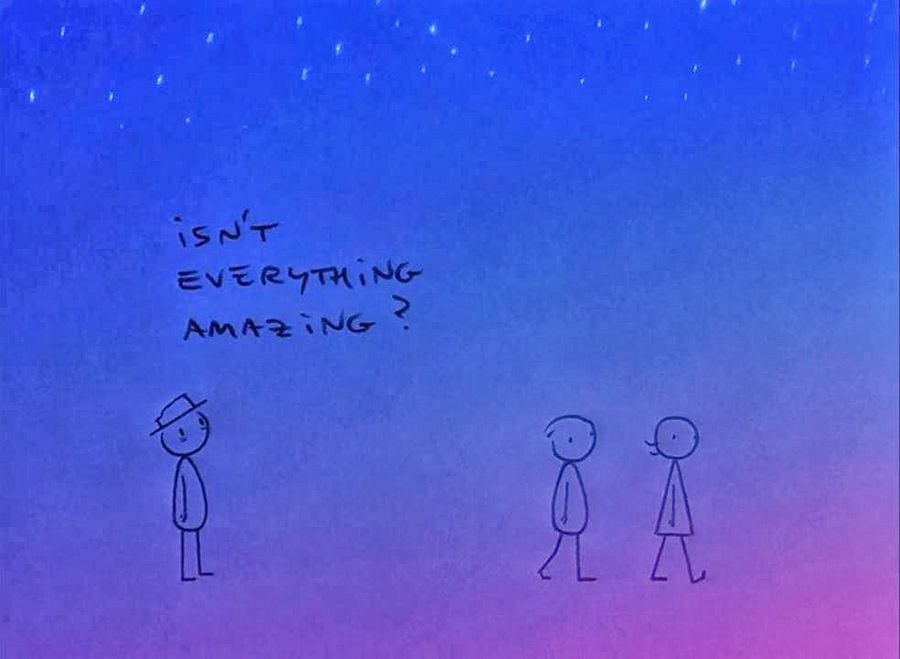
‘It’s Such a Beautiful Day’ is my favourite film. At least, it’s the film I say when people ask me, “what’s your favourite film?”. To tell the truth, I haven’t seen it in years and I’m unsure if I’d even enjoy it if I watched it tomorrow; the movie has a lot of flaws. I first watched Don Hertzfeldt’s animated trilogy of shorts – compiled to create ‘It’s Such a Beautiful Day’, aged around sixteen and found it profoundly moving. Since then I’ve rewatched a handful of times and tried (unsuccessfully) to show it to a few friends in recent years. It’s a hard sell – an animated “surrealist” movie about a stick man with such a pretentious name as, ‘It’s Such a Beautiful Day’. Some folk of around my age may be familiar with Hertzfeldt’s work through the short called ‘Rejected’ (2000), which in my mind captures the mainstreaming of internet “brainrot” alongside the likes of asdfmovie (a.k.a. “I like trains”), ‘Charlie the Unicorn’, and ‘The Duck Song’, and if folk are nostalgic about this kind of thing then the sell is a bit easier. In my over-intellectualisation of the movie, it’s a nice representation of a dialectic of importance to me in recent years – that between subjects and objects; but we’ll get to that. For now, I’ll say it’s a pretty good film, which you might like if you don’t mind/enjoy eccentric personalities, and are into the more surreal, absurd, and existential aspects of life.
Despite Hertzfeldt having quite a distinct personality, which some may understandably find grating, the main character of ‘It’s Such a Beautiful Day’ strikes me as a generic, average, everyday sort of person. Bill (his name), is literally a stick man with the only sign of quirkiness to his appearance being that he’s pretty much always wearing a top hat. He’s pretty much the visual embodiment of being “just a little guy”. There is something slightly imperfect (to me) about that, if Bill is supposed to be a kind of representation of the abstract human, then the fact that he’s a man plays into the history of philosophy depicting the average person – “the subject” – as masculine or implied to be a man, from Saint Paul to Karl Marx and beyond.
At the same time, maybe Bill speaks to the “wee guy” in all of us; I don’t know. The more queer or gender neutral reading would be that Bill’s subjectivity is expressed entirely in his hat, in a similar way to Salvador Dali’s thin mustache or Marilyn Monroe’s blonde hair. I’ll leave that to readers to decide. The bigger point I wanted to make is that Bill is a little guy in a vast, vast universe. This is most obvious in the final third, where Bill seems to become some kind of universal (in the more literal, cosmic, sense) space traveller. He even travels to different planets and befriends a bunch of aliens at one point, who apparently worship him as a god. In this final part, time seems to disappear. Bill falls in and out of love again and again. There is a tragedy each time, since Bill’s atemporal being is destined to mourn the deaths of his lovers again and again too; and he will forget them all, eventually. Not only that, but he is destined to forget all the little, everyday, “things” he loves too; which are highlighted in a poetic way throughout.
In Bill’s memento mori, so to speak, “His bathmats are gorgeous… The grain patterns in his cheap wood cabinets vibrate something deep within him… The air smells different, brighter somehow… The world is clumsy and beautiful and new”. It is narrated, “He’s never really appreciated these things. All these details he’s never noticed. Detail he’s never noticed. He’s alive…”. These everyday things are what I understand as “objects”. Unfortunately, from the perspective of atemporality, everything becomes an everyday thing. This is part of the tragedy experienced by Bill’s lovers, and even the species of aliens. I developed my understanding of this perspective while studying archaeology as an undergrad through the philosophical movement known as ‘Object Oriented Ontology’. This movement posits what it calls a “flat ontology”, meaning basically that things exist on an equal level of reality, in a kind of extreme anti-heirarchy or anarchism. This flattening of ontological importance between, say, bathmats and people may be deeply uncomfortable to some people, understandably so. For me, adopting this kind of perspective in relation to archaeology was a strategy to try and empathise with people in cultures probably very different to what I was/am familiar with – existing in an extremely different historical context (Ice Age people, for example). I wanted to get out of my modern presuppositions, to the best extent possible. I think it was useful in this sense, but of course I understand the reservations. Importantly, by the end of the film even space disappears. The final lines are: “He lives and he lives; until all of the lights go out”. And then they do… the screen goes black, like in pretty much all films. And then the lights come back on in real life, and we are surrounded by everyday objects… ‘It’s Such a Beautiful Day’ is phenomenological to the core.
The middle section of Hertzfeldt’s film, originally titled ‘I’m So Proud of You’, is the most psychodynamic; delving into time and Bill’s personal (and intergenerational) history. He remembers moments from his childhood – for example a school trip to a beach where he met a seal, the immediacy of grass, and a note from his mum saying “I’m So Proud of You” but revealing her own anxiety about being a not good enough mother. The memories seem jumbled, as memories are; some also seem confused with what is happening in the “here and now”. Apparently, your life flashes before your eyes just before you die; and this section of the movie is kind of a representation of that idea. Again, the film takes a “poetic” stance; treating the memories as not begging to be untangled, but beautiful in-themselves.
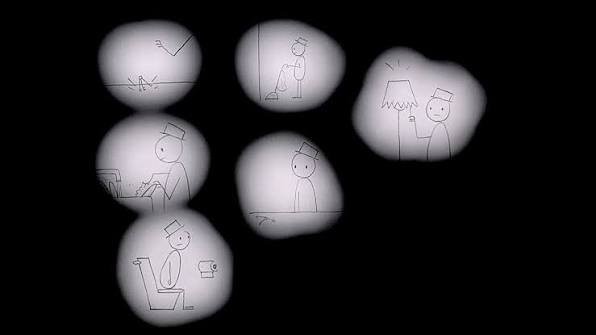
The first section of the film, originally titled ‘Everything Will Be Okay’, is precisely more about the “here and now”; and it’s the most narrativistic. As Bill does the “everyday” walks to the bus stop, corner shop, watches TV, and so on, he seems to experience something of a psychotic break. Bill is hospitalised with a mysterious illness and the narrative disintegrates into surrealism, hyperealism, absurdism – whatever you want to call it. Moments from the narrative section, while it lasts, are replayed throughout – again jumbling memory/experience from different “sources”; adopting a kind of dream logic.
Deconstructing this everyday experience allows for what, for me, is a nice transition into the revelation of metaphysical concepts – which, again for me, always lie just “beyond” the everyday. The middle section strikes me as the most closely aligned with object-relations: which was my first love in the world of theory. Coming from a clinical psychotherapy perspective, object-relations needed to make a lot of space for the subject (i.e. the client or prospective client) in its schema. Objects are important or interesting because a person cares about them. In attachment theory, things (usually people – yes, the terminology is a bit problematic) which are important to the client may be related to in different ways – all of which we can glimpse in ‘It’s Such a Beautiful Day’.
The movie frequently employs a first-person perspective to show Bill’s experience by using a variety of creative techniques to display its distortion, and then going back to showing Bill as a character (i.e. from the third-person perspective). As such, in my view the film is a really nice interplay between “object-oriented” and “subject-oriented” approaches; and the way it manages the repeated transitions between the two are often brilliant. Since I love both approaches, in different aspects of life, this interplay is pretty much perfect for me. I care about Bill, from a transferential (or countertransferential) perspective, and this is perhaps what motivated me to love the film in the first place. However, I think it also seems important to adopt a kind of melancholic position (in other words, secure attachment) towards the more poetic and experimental aspects of the film – which, to his great credit, Hertzfeldt gives the viewer many opportunities to. The movie, taken in its three parts, is a kind of descent into madness, poststructuralism, and the unknown; but a fairly gentle and kindhearted one, hopefully helping the viewer not be afraid of it.
Let’s do the personal and present bit of this piece of writing, since I seem to be drifting in that direction. Indeed, going back-and-forth between subjective and objective perspectives is part of what I aim to do here on ‘What If Nobody’s Home?’. I want to communicate how I experienced the movie (or piece of art of another kind), or at least how I’m remembering it in a certain moment. I’ll tend not to rewatch a movie before writing about it, so it’s the case that I’m likely to misremember aspects; so I’ll be providing views that are highly subjective in many senses. The way in which I’m trying to be objective is in arranging certain elements or parts of the work which seem important for some reason – such as themes, characters, motifs, colours, even. Importantly, I’m not proposing that these things are only important to me, but suggesting that they are important/significant objectively. Of course, I’m secure in the faith that all elements are indeed ultimately important (from an ontological perspective), but – to not be too relativist, I’m also hoping that perhaps some of the things I write about may find importance in reader’s lives and sense of interiority too.
At the same time, I’m about to start training as an existential psychodynamic therapist, so a few clarifications may be needed. Firstly, the image of myself which will inevitably emerge as this project progresses is not exactly real in terms of the psychotherapeutic relationship. As I write, I embody both the subjective and objective personalities, and how I transition between those is for me to manage; whereas in a therapeutic relationship the client aims to embody subjectivity and the therapist objectivity (although there may unfortunately and admittedly be countertransference, as it’s called). When Tom suggested starting this project, I was interested in having our entries be more of a dialogue (where we interplay subjective and objective positions with each other), but unfortunately we might not have the time and schedule compatibility for that, so the writing may be more “dialectical” or self-enclosed in this sense – although there may also be aspects which are more “letter like”.
A few other things about me. I have a lot of ideas, and I’m pretty sure a lot of them are really dumb; so I might leave threads untied to be addressed in the future, and I reckon my interpretations are best understood as possibilities in an ocean of them. I love theory and “the life of the mind”, but I’m also a rather emotional and sentimental person so my interpretations are often changing based on mood. In this sense I am, admittedly, a rather bad theorist; although I work hard to keep my mood fairly consistent. I also tend to embody or emphasise different aspects of my personality to create a contrast between myself and the subject matter; since I find that difference opens up the possibility of creative reconciliation and learning as such. Sometimes (having experienced this in my personal life) I can do this too fast, meaning that the difference is treated as threatening rather than an opportunity to come up with something new; something, again, I am working on. This is another reason why it’s best not to treat the image which emerges of me through writing as real. If I was to meet you in real life, I would probably emphasise different aspects of myself. That being said, if a certain “part” of me speaks to you, that’s great.
There’s a lot of things I didn’t get to mention here; for example I wanted to develop an understanding of “brainrot” (i.e. forgetting real things and being left with memetic objects) as contained both by the film and the movement Hertzfeldt is associated with in regards to the internet and “cyborg” humanism more generally; I wanted to talk about this film’s relationship to the colour purple; I wanted to talk more about the flaws, for example Hertzfeldt’s “imperfect” narration and the fact that many aspects of the movie already haven’t aged too well; I wanted to talk about some animation techniques; but Tom and I intended to keep things quite short so I’ll wrap up. I hope to have shared some resonant thoughts and sentiments with you today; that you found the writing interesting and continue to going forwards. ‘It’s Such a Beautiful Day’ is a curious and creative film, both simple and complex, about humanity’s place in the world and the world’s place in humanity. I’m not surprised it has become something of a twenty-first century classic and hope it is well-remembered; although I think, paradoxically, it wants itself to be forgotten.



 What If Nobody's Home?