
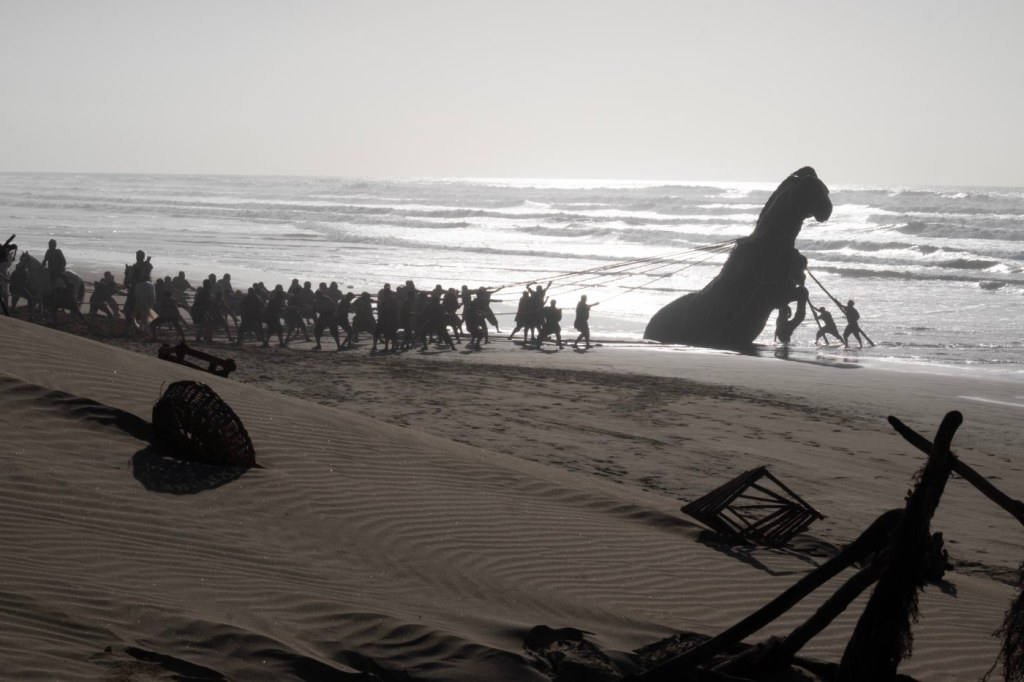
I balanced between destiny and dread
And I saw it coming, clouds bloodshot with the red
Of victory fires, the raw wound of that dawn
Igniting and erupting, bearing down
Like lava on a fleeing population.
From Seamus Heaney’s ‘Mycenae Lookout’.
~
On waking after seeing ‘The Odyssey’, I ambled through to my kitchen and prepared a stovetop, checking that the gas had ignited before tending to last night’s dishes. Waiting for the water to warm, I wondered if the boiler used gas or was electric, and looked around, seeing candles dotted about and a diffuser fuelled by a tealight. Beyond the incandescent, I wondered about the materiality of the rug, sofa, and of the faux-linoleum flooring.
With reading John Vaillant’s ‘Fire Weather’ yesterday, before the film, I had watched Underwriters Laboratories’ 2009 experiment. It compares legacy furnishings – those not derived from petro-chemicals – with modern furnishings, and the speed with which a candle placed on the sofa in the respective rooms reached flashover, the point at which heated air in an enclosed area causes near spontaneous ignition across that space. If my Troy burnt tomorrow, how much time would I have?
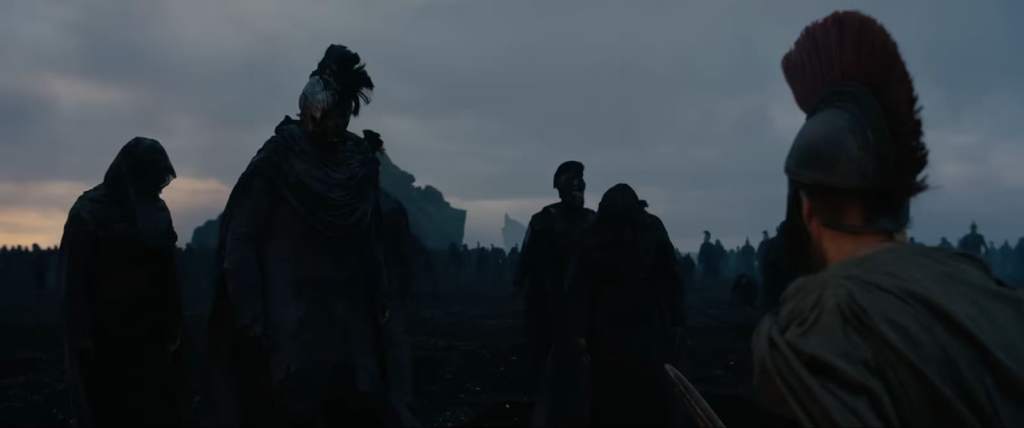
In Adam Tooze’s podcast on ‘The Odyssey’, he talks about the Late Bronze Age Collapse, where between 1200s and mid 1100 BC, there was a civilisational shift away from the more centralised, palace cultures represented by the Achaeans and the Trojans in the poem, towards the fragmented social formations of the early Greek Iron age. Tooze’s materialist analysis frames Homer’s epic as looking back, not just at the disaster of the Trojan war, but at civilisations that were on the cusp.
Time moves in a peculiar way, but this is history: things unfolding gradually across the intersecting horizons of landscape and time until the moment when, with astonishing suddenness, they merge and the event is upon you. Ten years waiting outside the walls of Troy, before one terrible night. You wonder where all the time has gone, when in fact it hasn’t gone anywhere, it is the events within it that appear to amplify in speed and scale – because they now include you. Factors attributed to the Late Bronze Age Collapse include climate change, earthquakes and internal unrest, events which can remain an abstraction, yet when they are upon you, time and circumstance achieve a kind of singularity and, suddenly nothing else exists; its immediacy – its presence – is overwhelming.
 What If Nobody's Home?